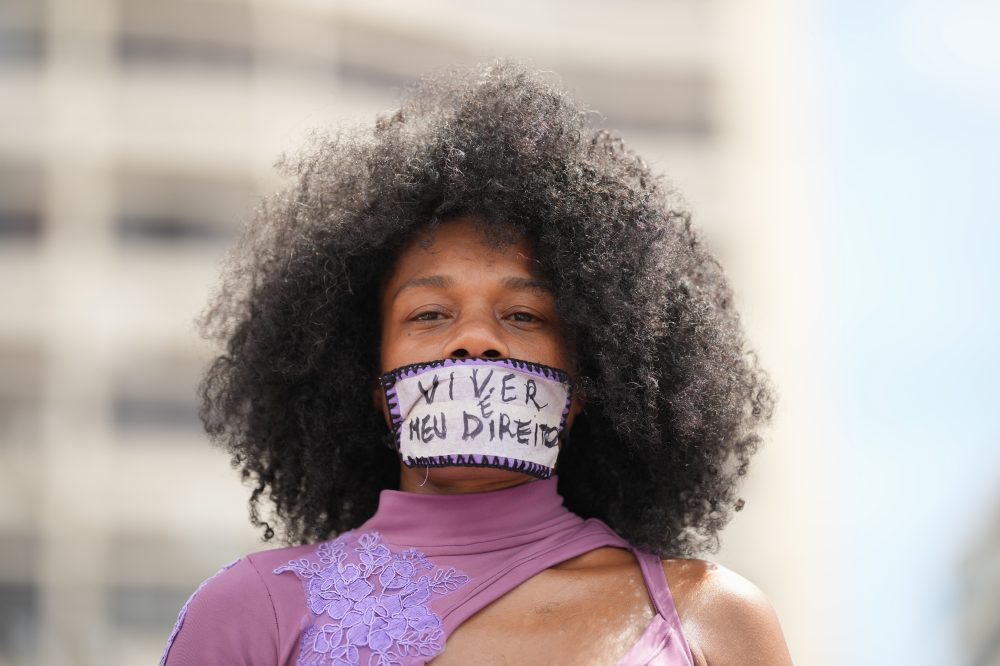

Thousands of protesters filled the streets across Brazil on Sunday during International Women’s Day demonstrations, demanding action against gender-based violence following a shocking alleged gang rape case involving a teenage victim in Rio de Janeiro’s famous Copacabana district.
The incident occurred in January but captured national attention this week after four suspects surrendered to police. Law enforcement officials have classified the attack as a gang rape, intensifying ongoing concerns about escalating violence against women throughout the country and triggering widespread demonstrations and online activism campaigns.
Organizers coordinated at least 15 protest events nationwide, demanding protection for women’s lives and calling for an end to femicide across Brazil.
According to Rio’s Civil Police, the four young men currently held in pretrial detention face rape charges, while a fifth suspect — who is underage — surrendered to authorities Friday and will face comparable charges under juvenile justice laws.
Law enforcement officials issued an arrest warrant for the minor after discovering his alleged connection to another sexual violence case with similarities to the Copacabana incident, according to an email from Rio state prosecutors’ office.
Defense attorneys representing two of the accused have proclaimed their clients’ innocence, while lawyers for the remaining three suspects have not yet made public statements regarding the charges.
Police investigators determined that the victim received an invitation from a school classmate in January to visit a friend’s residence at her elite private school. After entering the apartment, she was forced into a room and confined with the suspects, where she endured sexual assault along with physical and psychological abuse, according to a March 4 police report.
Security camera recordings showing the men entering and exiting the alleged crime location spread rapidly across social media platforms earlier this week.
Public attention intensified after news outlets reported that one suspect’s father worked as undersecretary for governance and compliance in Rio’s state social development and human rights department. The official was terminated from his position following the allegations against his son, according to Wednesday’s announcement in the state government’s official publication.
Brazilian citizens, women’s advocacy organizations, and prominent officials including ministers Anielle Franco and Sônia Guajajara used social media platforms to condemn the case.
“It’s impossible not to feel indignation when a 17-year-old young woman suffers such brutal sexual violence,” declared Racial Equality minister Franco, sister of murdered councilwoman Marielle Franco, while encouraging mass demonstrations on March 8 International Women’s Day.
Violence targeting women in Brazil continues rising, with 1,568 documented femicides in 2025 representing a 4.7% jump from the prior year and more than triple the 2015 figures, data from the Brazilian Forum on Public Safety shows.
Additional crimes against women — including threats, stalking, psychological abuse, physical harm, sexual assault and attempted femicide — have also shown consistent increases over recent years, the research organization reported before March 8.
“Women’s bodies continue to be seen as someone else’s territory, which can be threatened, assaulted, sexually violated and murdered,” the organization stated.
Following multiple high-profile cases and resulting protests last year, Brazil’s government expanded protective measures. President Luiz Inácio Lula da Silva’s administration announced a comprehensive anti-femicide initiative this year involving executive, legislative and judicial branches.
Brazilian officials unveiled emergency measures this week featuring a national task force to execute roughly 1,000 outstanding arrest warrants for known perpetrators, implementation of electronic monitoring systems for individuals subject to protective orders, and deployment of 52 mobile assistance units for women experiencing violence.
Government initiatives carry significant symbolic importance and demonstrate that authorities consider violence against women unacceptable, explained Isadora Vianna, a sociology researcher from Rio de Janeiro State University. However, she emphasized, “it would be more effective to invest massively in policies of prevention and support networks.”
Vianna also highlighted the need for stronger internet regulation to prevent rapid spread of misogynistic content online.
Tatianny Araújo, a 47-year-old veteran women’s rights advocate who has attended more than 30 International Women’s Day events, described this year as uniquely impactful following prominent reports of sexual violence, including the alleged Copacabana gang rape. Her 13-year-old son attends the same school as two suspects currently facing expulsion.
“We feel bad, we cry, we’re consumed by rage and by pain,” Araújo explained. “But at the same time we cannot stop. We have to mobilize, we have to do something.”