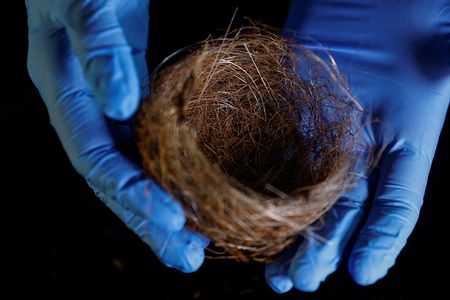

Near the front lines of the war in Ukraine, birds have found an unexpected use for one of the conflict’s most modern tools — fiber-optic cable. Researchers say small nests woven together from these ultra-thin cables and dry grass reveal just how deeply the more than four-year-old war has changed the surrounding environment.
Along Ukraine’s roughly 1,200-kilometer (about 746-mile) front line, fiber-optic cables are widely used by both Ukrainian and Russian forces to steer aerial attack drones. Unlike radio-controlled drones, these cable-guided aircraft cannot be disrupted by electronic jamming. The cables, which can extend up to 20 kilometers in length, have ended up tangled in trees, spread across open fields, and draped over rooftops in front-line towns — shimmering in sunlight like enormous spider webs.
Wildlife has started incorporating these leftover materials into their homes. Yana Hrynko, a senior researcher at Kyiv’s War Museum, carefully examined two fragile nests that the Ukrainian armed forces sent to the museum directly from the battlefield.
“Objects such as bird nests with fragments of optic fibre demonstrate the change in the nature of war,” Hrynko said.
Russia launched its invasion of Ukraine in February 2022, relying heavily on tanks, armored vehicles, and artillery. In response, Ukraine invested heavily in drone technology to offset Russia’s edge in conventional weaponry, and drones have since become a defining feature of the fighting.
Hrynko noted that researchers have not yet been able to determine which bird species constructed the nests or how the birds managed to collect the long, thin cables. “The first nest mainly contains dry grass and fibre-optic cable. And it’s pretty tightly twisted,” she said.
Reuters journalists spoke with several Ukrainian soldiers serving in the front-line regions of Donetsk, Kharkiv, and Zaporizhzhia who had come across similar nests and shared photos and videos of them online.
One of the two nests will be kept permanently at the War Museum in Kyiv as part of its wartime collection. The other will be shipped to the Netherlands for scientific study before being returned, researchers said.
Auke-Florian Hiemstra, a 33-year-old biologist based in the Dutch city of Leiden who focuses on artificial materials used in bird nests, said Ukraine’s diverse bird population means many species could potentially be responsible for building the nests.
“We’re going to look for DNA traces still in a nest to determine who actually made the nest,” Hiemstra said. “I have never seen nests like this before — and I have seen many, many bird nests.”
Hiemstra said the effect of fiber-optic cable on birds is likely complicated. On one hand, birds could become dangerously tangled in the material. On the other, the cables might actually help reinforce the structure of the nest. “And by documenting this nest, we’re also documenting the impact of war on nature in Ukraine,” Hiemstra added.