
RALEIGH, N.C. — Planning to visit the Liberty Bell during America’s upcoming 250th anniversary celebration but can’t make it to Philadelphia? You might be surprised to learn there’s likely a nearly identical replica sitting in your own state.
While it won’t be the authentic bell, these copies are remarkably accurate reproductions.
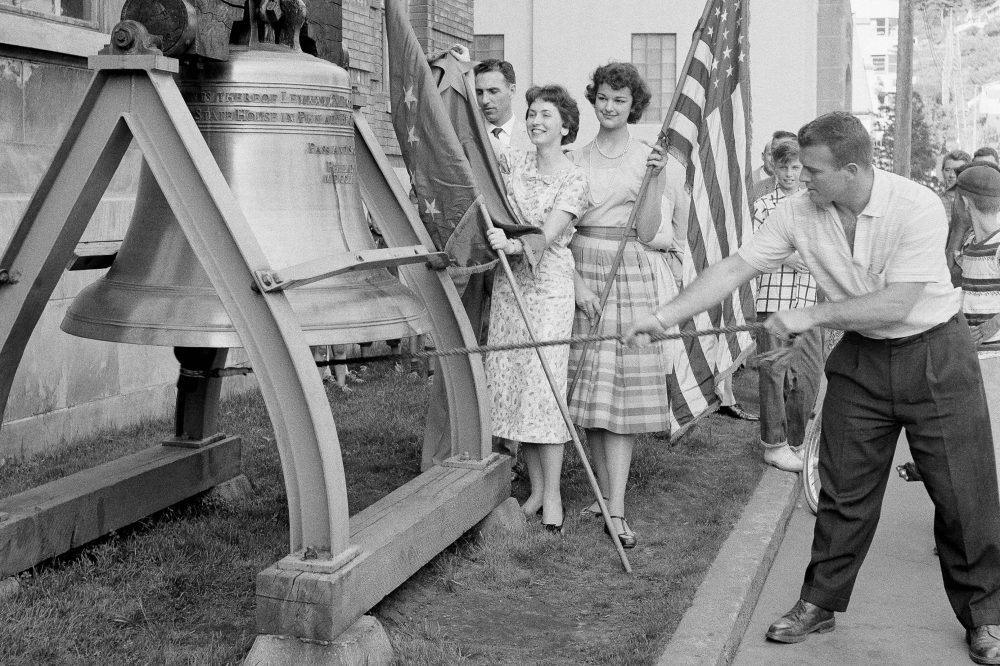
Back in 1950, the U.S. Treasury Department created replicas of the iconic cracked bell for every state and several territories as part of a savings bond campaign. Apart from unique serial numbers, these reproductions were exact matches — complete with the Pass and Stow maker’s mark and an artificial crack.
A dedicated community of “bell hunters” has emerged, committed to tracking down as many of these replicas as they can find. Leading this movement is Tom Campbell, who has become something of an authority on the subject.
“It was a casual thing that turned into an obsession,” said Campbell, who works as a graphic designer.
Though Campbell now calls Fort Collins, Colorado home, he grew up in Philadelphia and experienced the original Liberty Bell during his childhood visits.
The original bell was commissioned for Pennsylvania’s State House, which we now call Independence Hall. It famously cracked during its initial test in the 1750s, leading officials to melt it down and recast it. Historians have found no proof it actually rang on July 4, 1776. Abolitionists gave it the “Liberty Bell” name during the 1830s, referencing the biblical inscription around its top: “Proclaim Liberty Throughout All the Land Unto All the Inhabitants thereof.”
The exact timing and cause of the bell’s second crack remains a mystery, though the final major repair effort took place during the 1840s.
Campbell remained unaware of the replica program until relocating to Denver in the late 1990s.
“I was wandering around, meeting a friend at a bar for a drink, and cut across the Capitol lawn and saw a full-size Liberty Bell sitting there,” he remembered. After reading about the bond campaign on a small bronze marker, his mission began.
During their travels across the nation, Campbell and his wife Dawn Putney started incorporating bell visits into their trips. She eventually surprised him by creating a website called tomlovesthelibertybell.com.
“It was just a kind of a fun goof,” Campbell explained.
Three decades after discovering that initial bell, Campbell has established himself as the leading authority on these American artifacts.
The French company Paccard Foundry, operated by a family crafting bells since 1796 in southeastern France, created all the replicas.
Each reproduction matches the original’s weight at 2,080 pounds, though they differ significantly in one crucial area: their metal composition.
The National Park Service reports the original contained 70% copper, 25% tin, plus “small amounts of lead, gold, arsenic, silver, and zinc.” Those additional metals represent “impurities” in bell-making, according to Anne Paccard, the foundry’s communications director who oversees “art of sound” projects involving sculptural bells.
“I must say that the original Liberty Bell is a very poor quality bell, metallurgically speaking,” Paccard explained to The Associated Press via email. “The bells we delivered in 1950 are made of a specific alloy of bronze called ‘airain’: 78% copper, 22% tin, nothing else.”
During the campaign, these Treasury bells traveled nationwide on flatbed Ford trucks equipped with loudspeakers and decorated with patriotic banners.
“You could buy a savings bond, ring the Liberty Bell, have a party,” Campbell noted.
When the drive concluded, Treasury donated the bells to all 48 states plus the territories of Alaska, Hawaii, U.S. Virgin Islands, and Puerto Rico. Washington D.C. and the Treasury Department each received one too. Three additional bells went to Tokyo, a church in Paccard’s French hometown, and the Harry S. Truman Presidential Library in Independence, Missouri, giving that state two bells.
The problem was these gifts came without instructions or funding for upkeep.
“A local or state historian described it to me as an ‘unaccessioned artifact,’” Campbell said. “Not every state wanted them necessarily, and not every state knew what to do with them.”
Virginia held a public vote, with citizens choosing to send their bell to Thomas Jefferson’s Monticello. It later ended up in a storage shed before finally being displayed outside a local fire station.
Over half of these bells have spent most of their existence outdoors. Weather, neglect, and environmental exposure have caused significant damage.
Many of the painted cracks have faded away entirely. Other bells sit without their clappers or yokes, or within steel frames that prevent them from being rung.
“At that point, it really transitions to more of a monument than a functional bell,” Campbell observed. “And, to me, that’s kind of sad.”
As America approaches its 250th birthday celebration, several of these forgotten bells are receiving renewed attention.
Kansas’s bell sat disassembled in a Capitol parking garage for years until state Senator Elaine Bowers intervened. This past October, the reassembled bell — now resting on a heated concrete platform with a custom wooden yoke but still missing its clapper — received an honored placement outside the new Docking State Office Building.
“It just belongs here,” said a delighted Bowers standing next to bell number 21. “It’s a fascinating piece of artwork, but also history that we all should be proud of.”
Alabama and Idaho shipped their bells to Charleston, South Carolina’s Bell Foundry Christoph for restoration, with both expected to return by the Fourth of July. Several other bells have also received recent maintenance.
While Campbell doesn’t actively pressure states to repair and showcase their bells, if his website provides some encouragement, “maybe I’ll take a little credit for that.”
His efforts have also inspired a new wave of bell hunters.
Zoe Murphy from Morris County, New Jersey, mastered all state capitals and flags by age 4. At 5, she encountered her first replica in Allentown, Pennsylvania.
Now 14 and a high school freshman, she operates her own website at zlovesamerica.com. Over the years, she’s visited 39 bells, spanning from Alabama to Wyoming and even distant Alaska.
According to Zoe, traveling nationwide has deepened her understanding of America’s “collective mix of people and our culture.”
Campbell’s recent trip to Arizona’s newly restored bell — which was touring the state with a rope for visitors to pull — brought his total to 40 bells. What draws him to the Liberty Bell?
“The fact that a cracked bell is the symbol of the United States is really the perfect symbol of an imperfect union,” he explained.
Despite their dedication, these Liberty Bell enthusiasts face challenges in completing their quest. Campbell believes three replicas remain completely inaccessible to the public during this anniversary year. Ironically, Pennsylvania’s is among them.
For decades, the Treasury bell served as the focal point of a museum in Allentown’s former Zion’s Reformed Church, where the original was once hidden from British soldiers who might have melted it for ammunition. However, the building changed ownership in 2023, making the bell unavailable to visitors during church renovations. Local officials plan to install a lighter, taller replica in front of the church for the anniversary.
Last June, North Carolina removed its bell from its position across from Raleigh’s Legislative Building during a multi-year state history museum renovation. When the AP requested to view it, officials politely declined.
“Our Liberty Bell is in a secure storage facility,” said spokeswoman Mary Huntley.
The only replica that’s genuinely lost is Washington D.C.’s, which disappeared from storage in the early 1980s. Campbell suspects it was likely sold for scrap metal.
“That’s 2,080 pounds of bronze,” he noted. “So, that has a scrap value.”
However, if anyone has leads about the missing capital bell, Campbell welcomes the information.