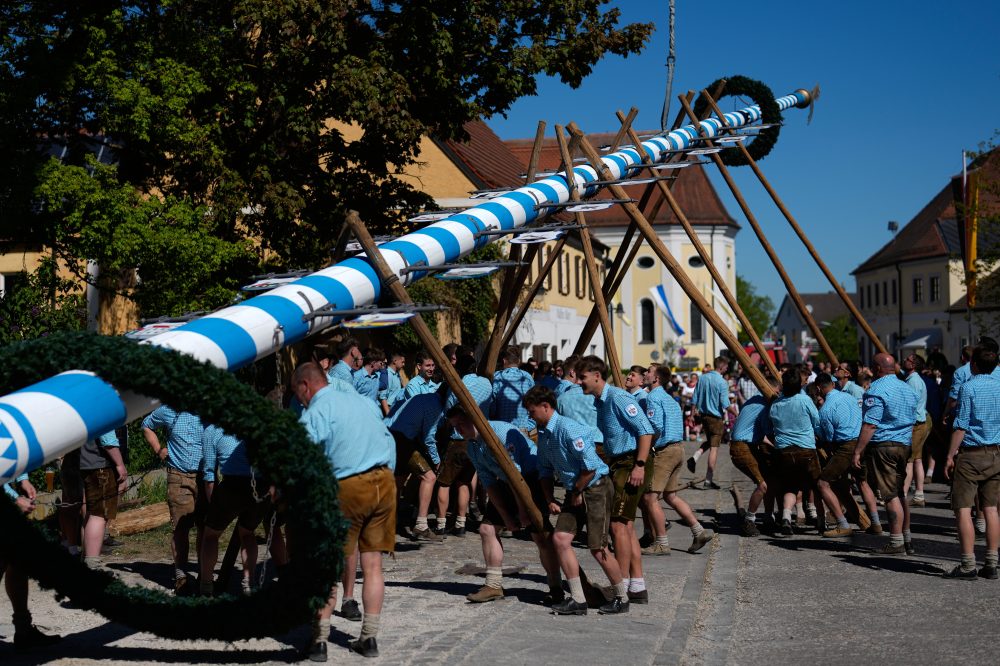

KÜHBACH, Germany — While a traditional brass ensemble filled the air with regional melodies and residents enjoyed cold beverages, the young men of this southern German community used lengthy wooden poles to hoist their fresh maypole skyward until it stood perfectly upright.
Beyond the local residents, visitors traveled from throughout Bavaria and neighboring regions to the community of approximately 4,500 people on Friday to witness the maypole installation — a tradition practiced for hundreds of years and deeply embedded in Bavarian cultural heritage.
“The Maypole is a symbol of togetherness,” Mayor Karl-Heinz Kerscher explained while observing the young people raising the pole. “All these young guys, when they give it their all, when they show their strength, that’s just proof that we’re powerful, that Bavaria means something, and that here in Kühbach it’s twice as beautiful.”
While May 1 serves as a national holiday throughout Germany, installing maypoles at village centers represents a cherished tradition practiced mainly in Bavaria, Austria, and additional southern German regions as an emblem of community unity, spring’s arrival, and fertility.
In Kühbach, significant effort and time goes into this ritual every three years when a fresh pole gets erected.
During the previous winter, the Kühbacher Burschen, a local organization boasting 240 members, selected an impressive spruce from a neighboring forest, felled it, removed all branches and bark, allowed it to dry, then applied three coats of white and blue paint — Bavaria’s official colors.
Along the tree’s sides, they mounted metal plaques displaying the village’s guild symbols, and most crucially, they maintained constant surveillance over their valuable maypole, which had been stored in a former lumber mill for weeks to prevent theft.
Taking each other’s fresh maypoles represents another cherished Bavarian tradition. When such theft succeeds, the robbed community must purchase back its maypole, creating significant expense: as much as 200 liters (422 pints) of beer plus an entire roasted pig with potato dumplings and brown sauce — costs that can easily reach 3,000 euros ($3,325).
By Friday morning, however, Kühbach’s maypole remained secure, and early that day the predominantly young participants, wearing their finest lederhosen and light-blue dirndl dresses, gathered at the sawmill to proudly transport it to their village center.
“Our motto is, ‘preserve traditions, shape the future’ — that really sums it up pretty well,” said Florian Oberhauser, 26, who leads the Kühbacher Burschen, or Kühbach Boys.
The 28-meter (92-foot) maypole was positioned horizontally on wooden wagons and transported into the village by two strong horses from the neighborhood brewery.
When the parade — featuring children seated in a long line atop the pole — reached the market square, the Catholic priest, who had recently concluded his May Day service, sprinkled the tree and young men with blessed water. Everyone gathered closely for prayer before the actual labor commenced.
Armed with extended wooden rods, the youth formed pairs on either side of the pole and encouraged one another with calls of “Hau-Ruck” while gradually raising the Maybaum, its German name.
Once the maypole stood upright against the clear sky, the marching band performed an additional fanfare, crowds filled the large festival tent, settled onto benches, enjoyed pork roast and sausages for lunch — along with additional beer.
Simone Nodlbichler, 41, who performed clarinet throughout the morning while her band accompanied the maypole parade through the village, past the church and into Kühbach’s market square, smiled brightly as she stored her instrument.
“This tradition is being passed down from generation to generation,” she explained while her two teenage daughters watched. “As you can see, both young and old are involved.”
“I think there’s a wonderful sense of community here, and it’s still very much alive,” she added.