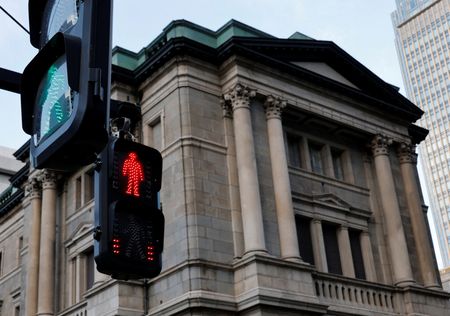

Japan’s central bank maintained its current interest rate policy on Tuesday, though a significant portion of its leadership pushed for higher borrowing costs amid growing concerns about inflation stemming from Middle East tensions.
The Bank of Japan concluded its two-day policy meeting by keeping its short-term rate unchanged at 0.75%, as most market observers had anticipated. However, three board members – Hajime Takata, Naoki Tamura, and Junko Nakagawa – broke ranks to advocate for an increase to 1.0%.
The ongoing conflict involving the U.S., Israel and Iran has created complications for Japanese monetary officials as they attempt to slowly move rates toward what economists consider a neutral level of approximately 1.5%. This geopolitical uncertainty has made policymakers more cautious about timing rate adjustments.
Financial markets are now closely watching for signals from Bank of Japan Governor Kazuo Ueda’s upcoming press conference to understand how the prolonged Middle East situation might influence future rate decisions.
Market analysts offered varied perspectives on the central bank’s action and its implications:
Singapore-based strategist Sim Moh Siong from OCBC characterized the decision as a “hawkish hold,” noting that the three dissenting votes suggest rate increases might have occurred without the war’s influence. “It looks like June could be the next live date in terms of rate hikes, but we’ll need to see what Ueda says this afternoon,” Sim explained. He also warned about potential yen intervention risks if the governor’s comments appear too dovish.
Kieran Williams from InTouch Capital Markets in London highlighted the significance of the 6-3 voting split compared to March’s 8-1 outcome. “The dissent from Nakagawa, who surprised markets given her reputation as one of the more dovish board members, suggests the hawkish shift could run deeper than the headline split implies,” Williams observed. He noted that Nakagawa’s term expires June 29, with her replacement expected to be more dovish.
Tokyo economist Kanako Nakamura from Daiwa Institute of Research expressed surprise at both the number of dissenters and upward revisions to fiscal 2026 inflation forecasts. “I expect the next rate hike to come as early as June,” she predicted, citing wage negotiations and the wage-price cycle as factors supporting higher inflation expectations.
Stock market strategist Kazuaki Shimada from IwaiCosmo Securities noted that while the decision was “a bit hawkish,” the day’s market decline was primarily driven by specific companies like Advantest and SoftBank Group rather than monetary policy concerns.
Several other financial experts weighed in on the implications:
Maybank’s Saktiandi Supaat emphasized the importance of Governor Ueda’s upcoming comments, suggesting they could trigger significant yen movements depending on their tone.
Olivier D’Assier from SimCorp stressed that investors want to see commitment to policy normalization and controlled withdrawal from bond yield suppression, warning that continued bond-buying could damage the central bank’s credibility.
Saxo’s Charu Chanana noted that while the headline decision wasn’t surprising, “the statement and vote split were more hawkish than the market would have liked.” She pointed out that the Bank of Japan is no longer simply waiting for sustainable inflation but is actively acknowledging building price pressures.
Ben Bennett from L&G Asset Management highlighted the central bank’s balancing act between inflation and growth risks, suggesting the hawkish bias should support the yen, which has been trading near the critical 160 level against the dollar.
Tokyo-based economist Masato Koike from Sompo Institute Plus found the hawkish tone somewhat unexpected given ongoing Middle East tensions. He emphasized that the upcoming press conference will be crucial for determining whether rate hikes might come as early as June.
ANZ’s Khoon Goh stressed that the three dissenters highlight the central bank’s challenging balancing act, with ongoing yen weakness serving as an additional policy consideration beyond inflation concerns.
Former Bank of Japan official Tohru Sasaki attributed immediate yen appreciation to the three dissenting votes and upward inflation forecast revisions, calling the overall decision “hawkish.”
The consensus among analysts appears to be that while geopolitical uncertainty has delayed immediate action, the central bank remains positioned to raise rates in the coming months, with June emerging as a likely timeframe for the next policy adjustment.