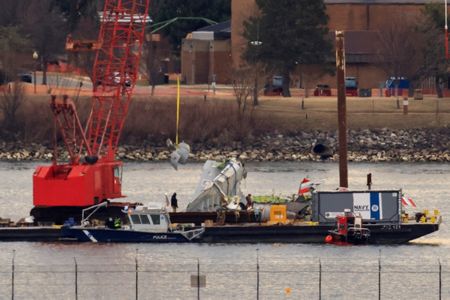

The nation’s top aviation official plans to acknowledge before lawmakers Tuesday that federal regulators ignored critical warning signs ahead of a devastating January aircraft collision that claimed 67 lives near Reagan Washington National Airport.
The National Transportation Safety Board concluded in January that multiple systematic breakdowns within the Federal Aviation Administration contributed to the deadly mid-air crash between a commercial regional aircraft operated by American Airlines and a military helicopter, marking the nation’s worst aviation tragedy in more than twenty years.
“Our airspace system was providing warning signals prior to that tragic evening. The issue was not a lack of data — it was a failure to translate that data into action,” FAA Administrator Bryan Bedford will tell a U.S. Senate Commerce subcommittee in written testimony. “That is the gap we are urgently closing.”
Bedford highlighted that the FAA has implemented multiple safety improvements, including a March decision to halt the practice of visual separation between aircraft and helicopters at major aviation facilities.
The March regulatory changes referenced two recent close-call situations, including a dangerous encounter between an American Airlines aircraft and a police helicopter near the San Antonio airport.
The administrator described an extensive internal restructuring currently underway at the FAA “that includes streamlining leadership roles (and) eliminating silos which hinder transparency and information sharing.”
Investigators determined the collision resulted from the FAA’s choice to permit helicopter operations near the airport without proper safeguards to maintain distance from commercial aircraft, combined with the agency’s inability to analyze data and implement recommendations for relocating helicopter routes away from the facility.
Data shows that beginning in 2021, Reagan airport experienced 15,200 air separation incidents involving commercial planes and helicopters, with 85 classified as close-call situations.
Following the 2025 tragedy, the FAA implemented helicopter traffic limitations around Reagan Airport and established similar restrictions at Baltimore, Las Vegas and Washington Dulles airports. The agency also decreased the rate of incoming flights at Reagan.
In related developments, the U.S. Department of Transportation is requesting Congressional approval for an additional $10 billion to advance air traffic control modernization efforts, building on $12.5 billion allocated in the previous year.
“With more than 18,000,000 flights managed and over one billion passenger movements traveling across our skies annually, our current system has reached its limits,” Bedford stated.