
MELBOURNE, Australia — Three judges on an Australian appeals court have delayed their ruling on whether an Indigenous activist can move forward with genocide charges against Britain’s King Charles III related to the treatment of Australia’s native peoples.
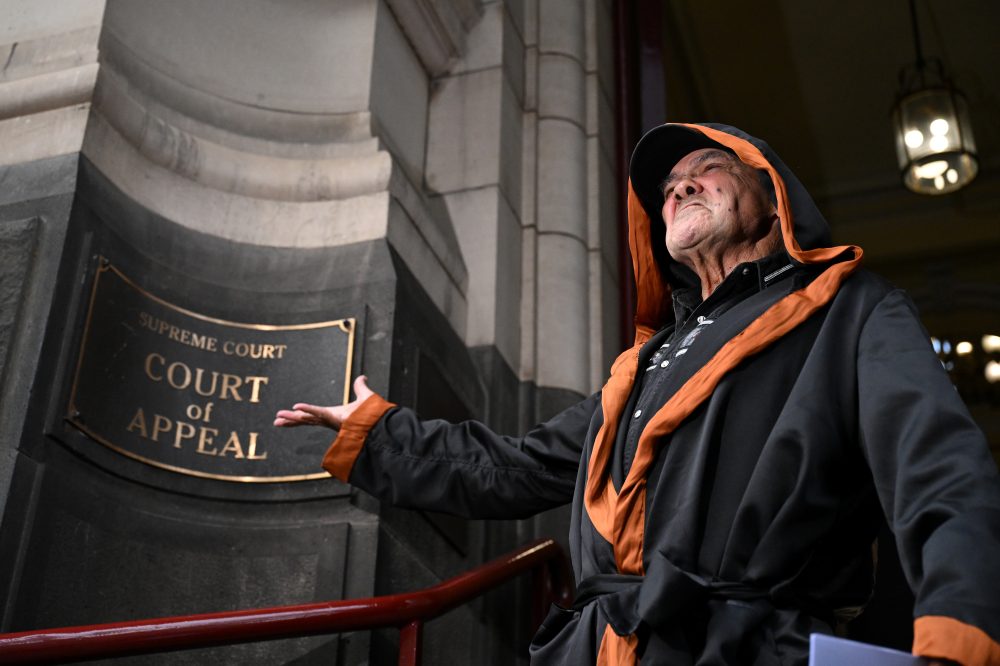
Uncle Robbie Thorpe, age 68, brought his case to Victoria state’s Supreme Court of Appeal after two lower courts denied his attempt to file a private prosecution against the monarch through Melbourne Magistrates’ Court. The title “uncle” serves as a respectful designation for Indigenous community elders in Australia.
Thorpe’s legal challenge claims the king, who serves as Australia’s head of state, along with the Australian government and its institutions, continue perpetrating genocide against Indigenous populations by preserving systematic disadvantages across various socioeconomic areas, leaving them as the nation’s most marginalized minority group.
Indigenous Australians represent 4% of the nation’s population. Government data shows they experience shorter lifespans compared to other Australians, face more severe health challenges, and encounter higher rates of incarceration and unemployment than other demographic groups.
Speaking with The Associated Press, Thorpe indicated that if his legal remedies in Australia are exhausted, he plans to bring the matter under the Genocide Convention before the International Criminal Court in the Netherlands.
“It’s clear that they’re unwilling, unable, reluctant to deal with these international legal issues like genocide,” Thorpe told the AP prior to the court session, speaking about Australia’s judicial system.
During the proceedings, he informed the judges that Indigenous people continue dying because their disadvantaged status in Australia keeps worsening.
“The Crown is responsible for all this mess,” Thorpe stated. “Australia’s got away with genocide of Aboriginal people since they arrived here.”
British colonization of Australia began in 1788, with violent seizure of Indigenous territories occurring without any treaty agreements.
“They totally failed to prevent (genocide). That’s the crime here. They failed to prevent genocide knowingly and they failed to punish anyone for it,” he continued.
Colonial authorities penalized Indigenous people for using their native languages and following their cultural practices in efforts to convert them to Christianity and Western ways. Multiple generations of Indigenous children were removed from their families under assimilation policies that have since been discredited.
For his court appearance, Thorpe donned a traditional possum-skin coat and brought a feather from an Australian wedge-tailed eagle, which holds significance as an Indigenous totem.
He asked the court to address him as Uncle Robbie or by his tribal designation Djuran Bunjileenee.
Justice Karin Emerton, who presides over the court, honored his request by calling him Uncle Robbie.
Court documents listed the king’s full name as Charles Philip Arthur George Windsor.
According to court filings, Thorpe seeks to bring charges against the king using Indigenous law that dates back over 65,000 years, state common law, and federal criminal statutes.
When dismissing Thorpe’s appeal last year, a judge determined that a magistrate lacked authority to consider Indigenous law and that genocide did not constitute an offense under common law.
The judge also ruled that any genocide prosecution under federal law would require approval from the federal attorney-general.
After Wednesday’s two-hour court session, Emerton announced that the three-judge panel would announce their decision at a future date.
Should Thorpe’s case fail, his remaining legal avenue would be Australia’s High Court before potentially seeking prosecution of the king in The Hague.