
WASHINGTON — After nearly every scheduled musical performer withdrew from a concert series celebrating America’s 250th anniversary — worried the event had become too connected to President Donald Trump — he made the connection official.
Trump declared he would become the main attraction at the Great American State Fair.
This eliminated any possibility that a president who has constructed his personal and political identity around commanding attention might step aside to prevent overshadowing a national milestone larger than himself. The decision also provides insight into how the president will likely handle hosting the coming World Cup.
From his television reality programs before entering politics, to countless hours entertaining at events both planned and spontaneous, to enthusiastically showcasing his various properties and White House renovation efforts, the president enjoys being a host. He even joked last year about potentially leaving office to return to full-time television hosting.
Trump can serve as a charming, engaging and compelling master of ceremonies — though he’s also someone who typically centers every occasion around himself.
“The president has an outsized personality,” said Timothy Naftali, former director of Richard Nixon’s presidential library and professor at Columbia University’s School of International and Public Affairs. “There’s a predictability to the way in which the president frames his actions — or any actions around any event associated with him — and that’s just part of who he is, and his makeup and his professional background.”
The fair serves as a prime example, starting June 25 and originally planned to showcase concerts but now launching with a Trump rally instead. This follows a UFC event at the White House on June 14. Trump has long been a fan of mixed martial arts and the event celebrates his 80th birthday, though the president has worked to present it as part of the anniversary celebrations.
Andrew Jackson opened the White House for an 1829 Inauguration Day celebration so chaotic that staff finally scattered the crowd by relocating whiskey barrels and ice cream to the lawn. Franklin D. Roosevelt prepared pre-dinner drinks for friends and staff at White House events he jokingly called “The Children’s Hour.” Audrey Hepburn was among the celebrities Ronald Reagan welcomed at the White House.
Trump regularly held first-term dinners with business executives but has more completely embraced the hosting role since his return to the White House. He constructed a patio space resembling one at his Mar-a-Lago resort and regularly visits Florida and his properties in Bedminster, New Jersey, and Sterling, Virginia, to lead fundraisers and other upscale events.
When asked whether Trump might overshadow events designed to unite the country and the world, White House spokesman Davis Ingle highlighted the president’s efforts to lead major renovations at the White House and throughout Washington. He stated that the “historic beautification” provides the city “the glory it deserves during our nation’s historic semiquincentennial celebration — something everyone should celebrate.”
Nevertheless, Trump has discovered unique ways to insert himself into the anniversary.
The State Department is creating passports featuring the president’s picture and officials have developed a new $250 bill displaying his image. The Trump Organization, managed by Trump’s children during his presidency, sought to trademark “Trump 250” logos and related products.
The U.S. Mint is also creating a 24-karat gold commemorative coin featuring Trump’s face, though this mirrors a half-dollar silver coin showing President Calvin Coolidge’s likeness to help commemorate America’s 150th anniversary in 1926.
Ulysses S. Grant launched a Centennial Exposition in Philadelphia to celebrate the 100th anniversary of the Declaration of Independence’s signing in 1876. Richard Nixon, in 1971, began a five-year “Bicentennial Era” before the 200-year milestone, though he stepped down before the major day occurred.
Nixon’s replacement, Gerald Ford, then fighting an ultimately losing reelection battle, started the week of July 4, 1976, by opening the Smithsonian Institution’s National Air and Space Museum and attending a Kennedy Center program featuring Bob Hope, OJ Simpson and others reading patriotic passages.
On Independence Day, Ford delivered remarks at historic Valley Forge, then traveled to Philadelphia’s Independence Hall, stating, “Liberty is a living flame to be fed, not dead ashes to be revered.” He also visited New York Harbor for a tall ship parade, oversaw naturalization ceremonies at Thomas Jefferson’s Monticello estate and held a state dinner for Britain’s Queen Elizabeth II.
However, “while Ford certainly hoped to use the bicentennial to promote his reelection campaign, he didn’t do it in such a self-aggrandizing, self-centered, narcissistic way,” said Marc Stein, a history professor at San Francisco State University and author of “Bicentennial: A Revolutionary History of the 1970s.”
Ford, Naftali added, “knew when to step out of the limelight and make sure the focus was on what mattered, which was the United States of America and the Declaration of Independence.”
Trump, by comparison, “generally has contempt for norms” and seldom references “the great sweep of history,” Naftali said.
Congress assigned a national organization, America250, with organizing commemorative events. Before the 2024 election, the group created a memo requesting that whoever became president would activate federal agencies and welcoming presidential participation in events and programs.
When asked about Trump, America250 Chair Rosie Rios said the group “has had a very supportive and collaborative relationship with the organizations planning initiatives on behalf of the president.”
But Rios’ organization operates separately from Freedom 250, a combination of public and private partnerships that the Trump administration created to fund and organize anniversary events — which has led to confusion.
America250 seeks to “inspire our fellow Americans to reflect on our past, strengthen our love of country, and renew our commitment to the ideals of democracy through programs that educate, engage, and unite us as a nation.”
This might appear different from the “Restoring Truth and Sanity to American History” executive order Trump signed last year. It aimed to counter a “revisionist movement” responsible for “replacing objective facts with a distorted narrative driven by ideology rather than truth.”
Stein, currently serving a one-year term as president of the Organization of American Historians, is helping coordinate “We Want More History,” an effort to organize local events celebrating the public’s appreciation for the subject in fact-based ways.
He said Trump’s version of history is “closer to propaganda, and it’s closer to cheerleading.”
The president has similarly applied his beyond-normal-boundaries approach to the soccer tournament the U.S. is co-hosting with Mexico and Canada.
He established a federal World Cup task force, and leads it. He received a peace prize from soccer’s governing body, FIFA, and announced he would be on stage to present the tournament’s golden trophy to the winning team.
Trump even supervised the tournament’s draw at the Kennedy Center, which he’s attempted to rename for himself, prompting legal challenges.
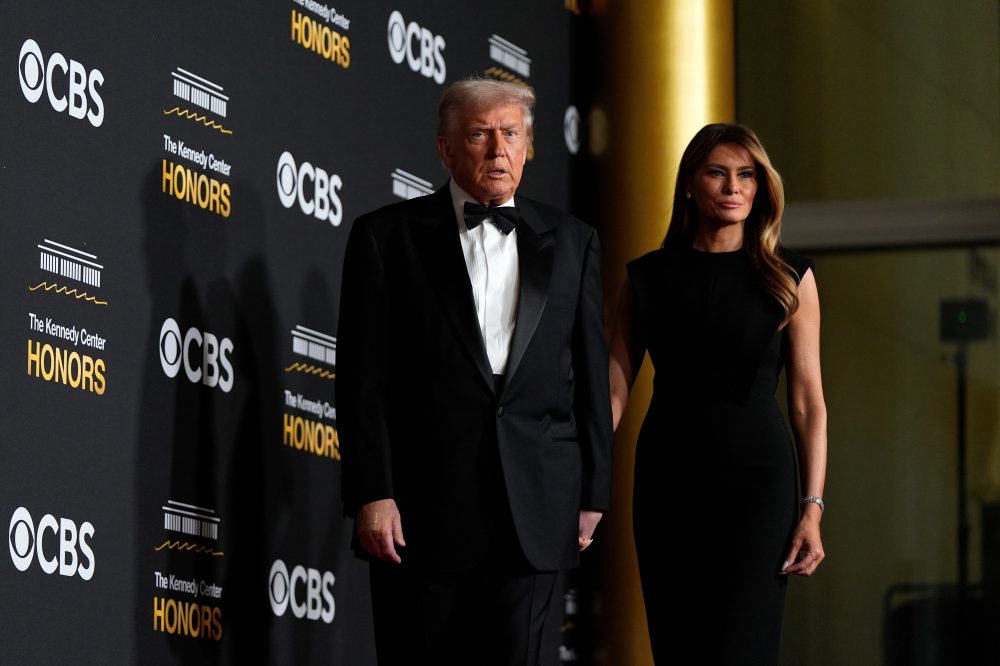
He returned to the same venue to headline December’s Kennedy Center Honors, observing, “We never had a president hosting the awards before.” He later posted on social media, “Would you like me to leave the Presidency in order to make ‘hosting’ a full time job?”
Naftali observed, “Whatever filters there were in the first term — and there weren’t many — are gone.”
“It’s undiluted Donald Trump.”