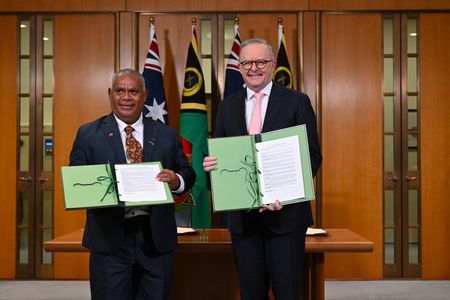

Australia and Vanuatu formally signed a long-awaited security and development agreement on Monday, ending months of delays that stemmed from concerns the deal could limit Vanuatu’s access to investment from outside countries.
Under the terms of the agreement — called the Nakamal Agreement — Australia will be consulted whenever a third party seeks to invest in Vanuatu’s critical infrastructure. Australia will also remain Vanuatu’s primary partner in security and policing matters.
The deal comes as Australia works to maintain its influence across the Pacific in the face of growing competition from China. Canberra had previously committed A$500 million, roughly $344.50 million U.S. dollars, to be paid out over 10 years as part of the arrangement.
Australian Prime Minister Anthony Albanese spoke at a joint news conference alongside his Vanuatu counterpart, Prime Minister Jotham Napat, emphasizing the agreement’s scope. “It encapsulates Vanuatu’s sovereign decision not to permit its territory to be used for any foreign military base or infrastructure and that Vanuatu’s critical infrastructure remains free from militarisation,” Albanese said.
The agreement had originally been scheduled for signing in September, but negotiations stalled after Napat indicated that a coalition partner had raised worries the pact might prevent Vanuatu from securing infrastructure funding from other nations.
China plays a significant financial role in Vanuatu, serving as the island nation’s largest external creditor. Chinese banks have funded Chinese contractors to carry out major construction projects there, including the presidential office complex, the parliament building, and a road network.
Vanuatu is also currently working toward its own separate economic agreement with China. Napat said Monday that deal is still waiting for approval from Beijing.
When asked whether that China agreement might include security provisions, Napat said, “We will share the agreement, there is nothing to hide.”