
Asian stock markets took a hit Thursday as investors moved away from chipmaker stocks after a remarkably strong quarter, while currency and bond markets held their breath ahead of a key U.S. employment report that could shape expectations around interest rate increases.
Oil prices slid to their lowest levels in four months, with Brent crude falling 0.8% to $71 per barrel. The drop came after U.S. President Donald Trump indicated that talks with Iran had gone well in Qatar, and as additional oil tankers began moving through the Strait of Hormuz.
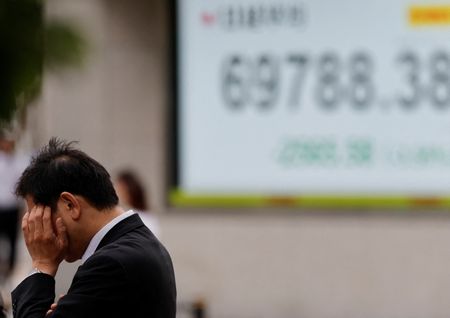
MSCI’s broadest measure of Asia-Pacific stocks outside Japan declined 0.8% on Thursday, while Japan’s Nikkei fell 1.1%, continuing losses from the first day of the new quarter.
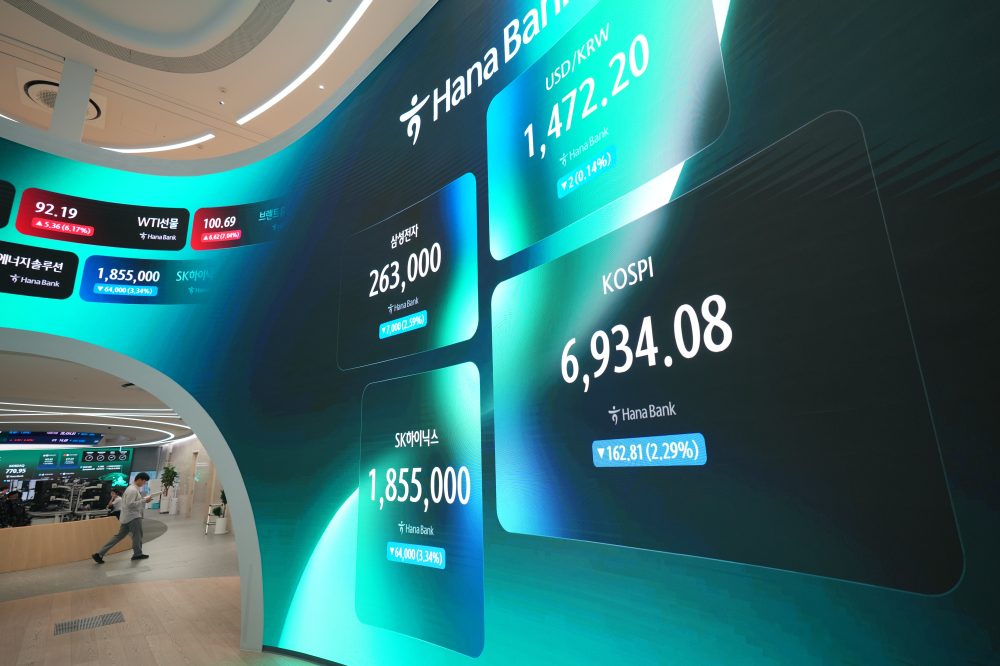
South Korea’s KOSPI index was among the hardest hit, dropping 2.7% — extending a 2% decline from Wednesday. The pullback followed a stunning 68% surge during the second quarter, driven by soaring demand for memory chips tied to artificial intelligence.
SK Hynix shares plunged 7.7% and Samsung fell 6.2%. The selloff came after a report revealed that Meta Platforms is developing a cloud business to sell off excess AI computing capacity. That news sent Meta’s own shares — the company that owns Facebook — up 8.8% in overnight trading.
Hong Kong’s Hang Seng index went against the regional trend, posting a gain of 1.8%.
In a broader trend, foreign investors sold off Asian stocks at the fastest pace in at least 16 years during the first half of 2026. The AI-fueled rally had pushed valuations so high that investors began trimming their biggest winners in South Korea and Taiwan while searching for cheaper alternatives.
All eyes are now on the U.S. non-farm payrolls report, which is being released Thursday this month because Friday is a federal holiday for Independence Day — which falls on a Sunday this year.
Economists surveyed by Reuters are forecasting a gain of 110,000 jobs for June, though estimates range widely from 25,000 to 200,000, leaving plenty of room for a surprise. The unemployment rate is expected to hold steady at 4.3%.
Chris Weston, head of research at Pepperstone, weighed in on what traders are hoping for: “For the equity traders, there is probably no single rigid playbook to work from. Ideally, equity players want a Goldilocks outcome: respectable job creation, a stable unemployment rate.”
Weston added, “Anything that avoids a marked increase in the implied probability of near-term rate hikes is likely to be welcomed by equity bulls.”
At the Sintra Forum, Federal Reserve Chair Kevin Warsh said inflation risks had eased somewhat in recent weeks, though his comments gave only brief relief to Treasury markets. Warsh also made clear he would hold firm to the 2% inflation target and would “disappoint” anyone expecting a looser approach to monetary policy. Markets are currently pricing in roughly 80% odds of a rate hike in September.
Treasury yields have been climbing as traders prepare for a potentially strong jobs number, which could further increase bets on a near-term rate hike. U.S. 2-year yields edged up 1 basis point Thursday to 4.1785%, and are up 9 basis points so far this week. The 10-year yield held at 4.4811% after rising 10 basis points over the same period.
Rising Treasury yields continued to support the U.S. dollar.
The euro slipped 0.4% against the dollar overnight after European Central Bank President Christine Lagarde said inflation and growth risks were becoming more evenly balanced. The euro steadied during Asian trading hours Thursday at $1.1379.
The Japanese yen was little changed at 162.59 per dollar, after hitting a fresh 40-year low of 162.84 on Wednesday. The decline has prompted the usual warnings of possible intervention from Tokyo, though previous interventions in April and May had only short-term effects — even after Japanese authorities spent nearly 12 trillion yen.
Gold bounced back 0.5% to $4,050 per ounce, recovering slightly after a difficult quarter.