
BENGALURU, India (AP) — The ongoing conflict with Iran has created severe energy disruptions across Asia, with ordinary citizens bearing the brunt of skyrocketing fuel costs and supply shortages.
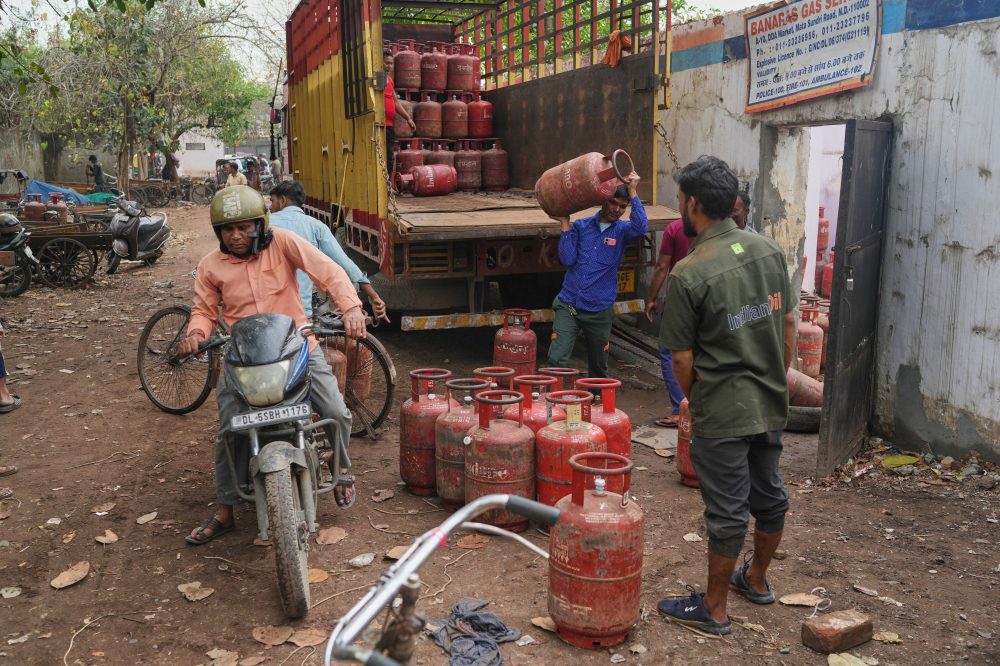
In New Delhi, taxi operator Ravi Ranjan faces mounting financial pressure as shipping interruptions from the Iran conflict force him to pay dramatically higher prices for household cooking fuel. The situation has worsened as India’s prime minister encourages citizens to cut back on driving and travel.
Ranjan’s expenses have tripled, he explained, with cooking fuel deliveries experiencing significant delays.
“I used to get a cylinder of LPG for 1,000 rupees ($11), now I pay 3,000 rupees ($31) in the black market,” he said.
Meanwhile, in Chennai on India’s coast, marketing professional Sushmita Sankar reports that both gasoline and cooking fuel costs are rising dramatically due to the conflict. Sankar notes that ethanol-blended gasoline — now the standard option at filling stations — appears to be reducing her vehicle’s fuel efficiency.
“Fuel expenses are increasing and with only ethanol mixed petrol available, I feel my car’s mileage has reduced in the last year or so,” she said. “Already our days are busy with work and taking care of our child’s school and other needs. Having to now spend a lot of time to fill my car or buy LPG is making things even more hectic.”
Responding to cooking gas shortages and rising crude oil costs, India has suggested allowing automobiles to operate on 85% or even pure ethanol. The country has also prohibited sugar exports through at least September to maintain domestic supplies and ensure sufficient raw materials for potential increases in ethanol blending.
Officials argue that increased ethanol use will decrease vehicle emissions, though motorists worry about reduced fuel efficiency. Environmental specialists also note that using corn, rice and other food crops for ethanol production could interfere with food and animal feed requirements.
Asia experienced the earliest and most severe fossil fuel disruptions from the Iran conflict’s impact on the Strait of Hormuz, a vital energy shipping route.
With countries preparing for additional impacts, governments seek to expand biofuel usage to reduce fuel import dependence. Indonesia and Malaysia are also advancing policies to increase fuel mixing with palm oil-derived alternatives, though specialists caution this could promote agricultural expansion and forest destruction.
Even with this conflict-driven focus, implementing higher fuel blends across Asia may require years due to the time needed for supply chain development, blend research and vehicle compatibility testing.
The prime minister asked Indians this month to make “nationally responsible choices” to conserve fuel by increasing public transportation use, carpooling and avoiding international travel.
India purchases nearly 90% of its crude oil from abroad, so the Iran conflict has impacted gasoline-dependent vehicles and millions of households and restaurants requiring LPG. Natural gas-dependent industries have also suffered effects. However, a national electrical system powered mainly by coal and some renewable sources has maintained electricity supply.
Following the Iran conflict’s start, Indian officials responded by diversifying oil suppliers and suggesting higher biofuel blends, though energy specialists say this has only partially reduced the impact.
Most Indian fuel stations now offer a 20% ethanol mixture after the nation reached its goal of nationwide blend distribution in 2025, five years earlier than the government’s original timeline. Officials are considering raising the blend percentage across all gasoline to 27% by 2030. The recent transport ministry announcement suggesting vehicles that operate on 85% ethanol or pure ethanol represents the clearest indication yet for auto manufacturers to start producing compatible vehicles. The schedule for these higher blends remains undetermined.
“Moving toward higher ethanol blends reflects the government’s long-term vision for energy security, lower emissions, and reduced dependence on imported crude oil,” said Chandra Kumar Jain, president of the Grain Ethanol Manufacturers Association.
India’s 20% ethanol blend resulted in a 2.5% decrease in crude oil imports in 2025, according to the Institute for Energy Economics and Financial Analysis.
While any oil import reduction benefits the country, a disadvantage of the accelerated fuel blending pace is policy uncertainty and confusion among car manufacturers, said Charith Konda of IEEFA.
Southeast Asia similarly views bioenergy as protection from the current crisis and future disruptions, according to Reza Yosri, an energy specialist at consulting firm Ramboll.
Indonesia aims to raise fuel blending to 50% biodiesel from the current 40% under a program initiated in March by the president, who declared, “We are going in a big way to biofuel.”
The biofuel program represents part of Indonesia’s drive for “energy sovereignty” following recent fuel disruptions, according to Putra Adhiguna of Jakarta-based Energy Shift Institute.
Fuel blending will also assist Indonesia in creating a domestic market for palm oil it exports worldwide, he explained. However, he emphasized the need to monitor land clearing and forest destruction.
In April, Malaysia authorized a plan to gradually raise its fuel mixing to 15% biodiesel and 85% fossil diesel, with a potential 20% blend being evaluated.
Rising fuel costs have “revived the idea,” explained Ahmad Rafdi Endut, a Kuala Lumpur-based energy analyst. Nevertheless, he warned that higher concentrations will require additional testing and consumers remain concerned about decreased mileage.
Although ethanol blending is frequently promoted as a gasoline replacement, specialists caution that the situation is more complex.
Shyamasis Das of the New Delhi-based Centre for Social and Economic Progress noted uncertainty about how higher blends would impact existing engines, and scaling up production for engines capable of running on higher concentrations will take time.
Motorists may experience compromises. Ethanol contains less energy per unit than gasoline, meaning vehicles typically use more fuel to travel the same distance, Das clarified.
Worries persist that crops required for ethanol production could compete with food supplies, increasing prices and worsening water shortages, Das added. In India, approximately 70% of ethanol derives from crops including sugarcane, corn and rice.
Creating one liter (34 fluid ounces) of ethanol can demand between 3,000 liters (792 gallons) and 10,000 liters (2,641 gallons) of water, a resource already strained in a nation experiencing groundwater depletion.
While biofuels can decrease vehicle emissions, their total climate effect depends on production methods.
Konda, the IEEFA analyst, suggested that electric vehicles represent a more effective long-term approach, combined with transitioning industries to renewable energy rather than fossil or biofuels.
The climate advantages of crop-derived ethanol can be constrained by elements including land usage and water consumption, analysts report.
Das, from CSEP, emphasized that producing ethanol from materials requiring no additional land or water — such as agricultural waste, municipal refuse and used oils — is essential.
“If the biofuel is not sourced from residues or waste, they are not usually treated as renewable,” he said.