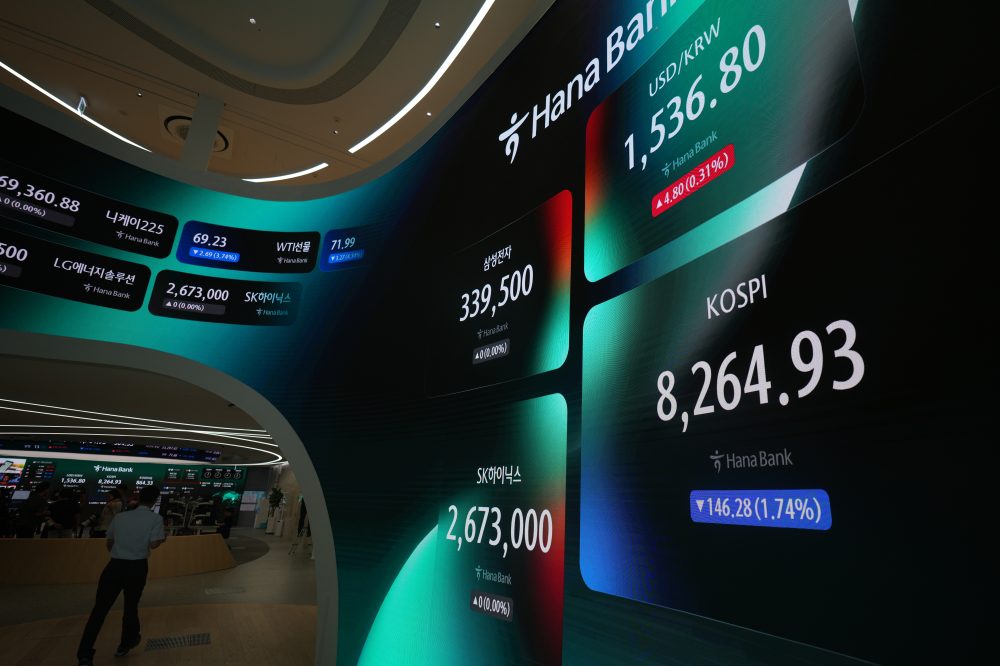

HONG KONG (AP) — Stock markets across Asia delivered a mixed performance Monday, with a pullback in artificial intelligence-related shares weighing heavily on indexes in Japan and South Korea, even as gains elsewhere helped cushion the blow.
U.S. futures moved higher and oil prices edged up, though both remained near the levels seen before the Iran war broke out in late February.
The situation between the U.S. and Iran grew more tense over the weekend after Iran launched new drone and missile strikes on Bahrain and Kuwait in retaliation for fresh U.S. airstrikes. The escalation is adding to concerns about the global economic outlook.
Tokyo’s Nikkei 225 index slipped 1% to close at 68,704.70, following a steep 4.2% drop on Friday. SoftBank Group, the multinational investment firm that holds a stake in OpenAI, tumbled 5.9% — coming on the heels of a 12.5% plunge the previous session.
South Korea’s Kospi index fell 2% to 8,246.50, after losing 5.8% on Friday. Samsung Electronics dropped 6%, and memory chip manufacturer SK Hynix declined 4.5%.
Taiwan’s Taiex index managed to climb 1.1%, recovering a portion of the 3.6% it lost on Friday. Taiwan’s market has been a major beneficiary of the global AI boom, home to a number of prominent tech companies including chipmaker TSMC.
Both Japan and South Korea have seen their markets surge in recent years, largely because major technology companies in those countries supply computer chips and other high-value components essential to artificial intelligence systems. Growing concerns about AI stock valuations have begun to eat into some of those gains.
Hong Kong’s Hang Seng index climbed 2.1% to 23,153.89, and the Shanghai Composite added a modest 0.2% to reach 4,034.08. Australia’s S&P/ASX 200 rose 0.4% to 8,798.00, while India’s Sensex finished virtually flat.
On Wall Street Friday, AI-related anxiety rippled through trading, though the major indexes finished with mixed results. The S&P 500 dipped less than 0.1% to 7,354.02, the tech-focused Nasdaq composite fell 0.2% to 25,297.62, and the Dow Jones Industrial Average declined 0.1% to 51,876.11. Among chip stocks, Micron Technology fell 6.7%, Intel dropped 3.4%, Nvidia lost 1.6%, and Advanced Micro Devices (AMD) shed 2.1%.
In the oil market Monday morning, Brent crude — the international benchmark — rose 0.7% to $73.27 per barrel, compared to roughly $72 a barrel before the war started. U.S. benchmark crude gained 0.8% to $70.02 per barrel.
ING commodities strategists Warren Patterson and Ewa Manthey warned in a Monday commentary that significant risks remain in the oil market due to the possibility of further U.S.-Iran escalation. They noted that recent attacks on ships have raised fresh concerns about the safety of vessels passing through the Strait of Hormuz.
The strategists said oil traders have been “too optimistic” about how quickly Persian Gulf oil supplies might recover. “This complacency is odd and clearly leaves significant upside risk if the supply recovery proves slow — or if we see significant re-escalation,” they wrote.
In currency markets, the U.S. dollar edged up to 161.81 Japanese yen from 161.71 yen, while the euro held steady at $1.1386.