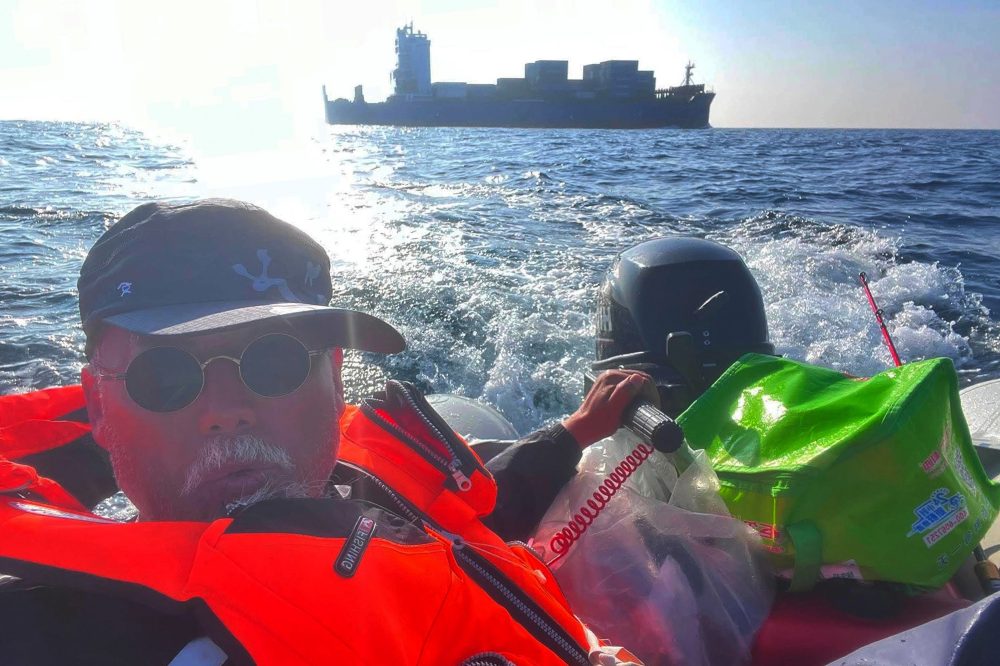

HONG KONG — A nearly 40-hour voyage on a small rubber dinghy with a fading phone battery and detention in South Korea — that’s part of the extraordinary ordeal Chinese dissident Dong Guangping went through to escape his homeland. He touched down in Canada late last week, reaching a country he had been trying to get to for more than ten years.
Dong had been imprisoned in China multiple times, including for activities honoring the memory of pro-democracy demonstrators who were suppressed in Beijing’s Tiananmen Square in 1989, as well as for previous escape attempts.
“It’s like living in a cage. Very suffocating,” he told The Associated Press during a video interview conducted from Toronto, describing the absence of free expression in China.
The 68-year-old said that following his release from prison, he was cut off from retirement benefits, could not renew his passport, and was kept under continuous police surveillance.
He had tried to flee China at least three times before: in 2015 to Thailand, where he was deported back to China; in 2019 when he attempted to swim to a Taiwanese island off China’s eastern coast; and in 2020 when he made it to Vietnam, only to be sent back once again.
Last month, he made another attempt.
In the early morning hours of May 24, Dong departed from Weihai — a coastal city in Shandong province in eastern China — aboard a gray rubber dinghy equipped with an engine, under clear skies. His destination was Japan, where he believed authorities would not force him to return to China.
The following day brought thick fog. When he noticed his phone — his only GPS navigation tool — was down to its last bar of battery, panic set in. His backup power bank had also given out. He quickly pivoted to his backup plan and set his course for South Korea instead.
He recalled the deep fear that gripped him, knowing his small vessel could overturn if conditions worsened. But he had no way to turn back, and he pushed past his fear of dying.
“Living conditions back in the country are so terrible that being alive is little different than being dead. So there is no point fearing death,” he said. “If you move forward, there’s a chance at life.”
As evening fell, he spotted lights in the distance and steered toward them. The first vessel he approached could not hear his calls for help and moved on. He eventually came across a fishing boat whose crew agreed to bring him aboard. He asked the fishermen to contact authorities on his behalf.
The South Korean Coast Guard took him into custody for allegedly breaking the country’s immigration laws. Officials sought a formal arrest warrant, but a court turned it down, ruling it was “difficult to recognize sufficient grounds and necessity” for his arrest.
Dong was then transferred to a refugee center in Incheon, a port city near Seoul. Earlier this month, the U.N. refugee agency reached out to him via video call, he said.
A manager at the refugee center later asked him about his height, weight, and eye color. Though he was initially nervous, it turned out to be a promising sign. His attorney informed him the request had come from the Canadian diplomatic mission, he said.
Roughly a week later, Dong boarded a plane and arrived in Toronto on Friday. He said he was still unsure exactly what legal steps were involved, but believed it came down to coordination between the South Korean and Canadian governments along with the U.N. agency.
“I feel very surprised, extremely surprised. It’s like still in a dream. It’s very fast,” he said.
He believes the resettlement status in Canada that his family secured back in 2015 — before Thai authorities sent him back to China — remains valid.
The Canadian Embassy in South Korea declined to comment on his situation. The U.N. refugee agency and the South Korean government did not respond to requests for comment in time for publication.
Dong said he feels at home now that he’s in Toronto, describing it as the first taste of genuine freedom he’s had in more than a decade.
“There’s not even a hint of fear,” he said.
He hopes to support himself by working as a truck driver or an Uber driver.
Despite his relief, Dong has not forgotten how Thailand and Vietnam both sent him back to China. In 2015, he and his family traveled to Thailand to seek refugee status through the U.N. refugee agency, but Thai authorities arrested him and returned him to China, according to Amnesty International. His ex-wife and daughter were able to settle in Canada. He fled to Vietnam in 2020 but was sent back in 2022. Each time he was returned to China, he was jailed. He said he intends to consult a lawyer about the possibility of suing both Thailand and Vietnam.
For Dong, the struggle is not over. He also plans to continue advocating for China’s democratization.
In the late 1990s, the former police officer distributed leaflets containing his writings on subjects including the Tiananmen crackdown. He was sentenced to three years in prison in 2001 on charges of inciting subversion of state power. He also spent more than eight months behind bars after being arrested in 2014 for participating in a memorial for victims of the crackdown.
“My ultimate goal is for China to achieve constitutional democracy,” he said.