
In the intensifying global competition between the United States and China over artificial intelligence technology, Chinese chipmaker Huawei is now outpacing industry giant Nvidia on its home turf.
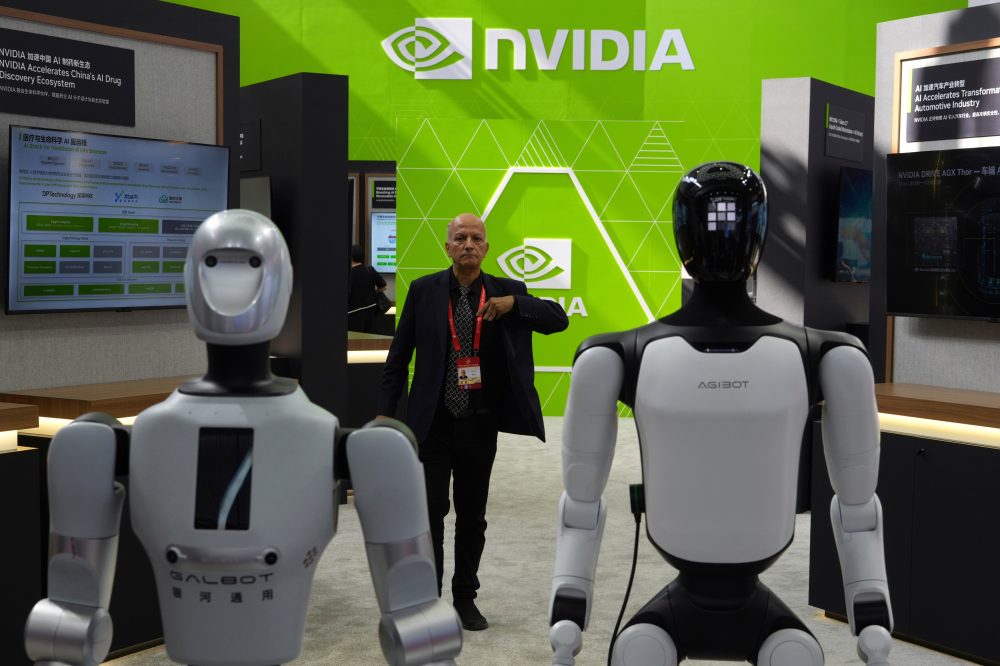
Nvidia CEO Jensen Huang attracted crowds of admirers during a visit to Beijing — even stopping for a bowl of traditional zhajiangmian noodles — while attending U.S. President Donald Trump’s May summit with Chinese leader Xi Jinping. Despite his rock-star reception, Huang’s company has struggled to capitalize on China’s booming AI market.
Washington’s export controls on advanced technology, put in place over national security concerns, effectively blocked sales of Nvidia’s powerful H200 AI chips in China. By the time Trump agreed to allow those sales to proceed, Beijing had already pivoted — actively encouraging Chinese companies to use domestically produced chips, with Huawei leading the charge.
Huang has been candid about the setback. “Well, we were in China for 30 years, and before the export control banned Nvidia out of China we had about 95% market share, and so we were competing just fine,” he told The Associated Press in a recent interview.
He also weighed in on the broader policy challenge: “We have to have, number one, make sure that we have national security and that we protect our nation, but we also simultaneously should go and compete and grow our technology industry and maximize our exports.”
The roots of this shift go back to 2019, when the U.S. began cutting off Huawei — and eventually China more broadly — from purchasing the world’s most advanced chips and chip-manufacturing equipment. That move accelerated China’s push for semiconductor independence, spurring local companies to develop their own chips and expertise.
Nvidia, headquartered in Santa Clara, California, along with its main rival AMD, still dominate the U.S. AI chip industry and hold a strong position globally. However, Huawei has made substantial gains inside China, fueled in part by Chinese AI companies like DeepSeek pushing for better chip performance at lower costs.
According to a report by Bernstein, a global equity research and brokerage firm, Nvidia held roughly 40% of China’s AI chip market in 2025 — nearly matching Huawei. But Bernstein projects Nvidia’s share will fall to around 8% this year, while Huawei’s is expected to climb to approximately 50%.
“Nvidia has definitely lost significant ground to Huawei, which (now) leads domestically,” said Antonia Hmaidi of the Mercator Institute for China Studies, who specializes in semiconductors.
Industry analysts say Huawei’s most advanced commercial AI chips — the Ascend 950 series — are now considered roughly comparable to Nvidia’s H200, one of Nvidia’s most powerful products.
“China now believes in its own self-sufficiency and supply capabilities,” said He Hui, director of semiconductor research at research and advisory firm Omdia.
Last September, Huawei announced it was launching some of the world’s most powerful AI computing clusters — combining the processing power of thousands of chips — despite being limited to Chinese-made semiconductors due to U.S. export restrictions.
When asked recently how Huawei’s chip technology stacks up against global competitors, including those in the United States, He Tingbo, head of Huawei’s semiconductor business, offered a measured response: “We have found pretty good solutions.” She added, “Who can walk faster? Huawei or other companies? I don’t know the answer. I think only time will tell.”
Experts note that no single country can manufacture a cutting-edge AI chip entirely on its own — the supply chain is inherently global.
Despite the competitive gains by Huawei, demand for AI chips in China still outpaces available supply, according to Rui Ma, founder of Tech Buzz China. Several recent smuggling cases involving Nvidia AI chips being brought into China illegally underscore just how much appetite remains for Nvidia’s technology.
Nvidia designs the world’s most powerful AI chips, relying on Dutch company ASML’s extreme ultraviolet lithography machines — which themselves depend on U.S. components — and Taiwan chipmaking giant TSMC to manufacture a significant portion of its top chips. China is currently barred from purchasing either Nvidia’s most advanced chips or ASML’s EUV machines.
Huawei’s high-performance chips still trail Nvidia’s most advanced offerings in several key areas. Analysts say that cutting-edge work in China — such as training large AI models like those developed by DeepSeek — still depends on Nvidia chips. Chinese universities and major tech companies also continue to seek access to chips like the H200 for research and development purposes.
Meanwhile, Nvidia’s overall global business continues to grow. The company projects approximately $91 billion in revenue for the May-through-July period, up from nearly $82 billion the prior quarter, not counting any data center revenue from China. Nvidia’s most recent annual revenue reached nearly $216 billion, compared to $126 billion for Huawei over a comparable period.
DeepSeek — the fast-growing Chinese AI company that competes with products like OpenAI’s ChatGPT and Anthropic’s Claude — announced in April that its latest V4 AI model was adapted to run on Huawei’s Ascend chips. Paul Triolo, a partner at DGA-Albright Stonebridge Group, said there is likely “significant effort going into collaboration between DeepSeek and Huawei” to train future models on domestic hardware.
That development signals the potential for Chinese chips to replace Nvidia’s in certain applications, according to Phelix Lee, an analyst at Morningstar. However, Lee cautioned that “we don’t expect an abrupt switch toward (Huawei’s) Ascend.”
Nvidia previously engineered a stripped-down version of its chip — the H20 — specifically designed to be sold in China without violating U.S. export rules. Through last year, the company was still moving H20 chips into China, though shipments were gradually tapering off, according to Brady Wang, a Taipei-based semiconductor analyst with Counterpoint Research.
Beijing’s official position on importing H200 chips has remained ambiguous. Nvidia has stated it has not sold H200 chips in China, and at a recent shareholders meeting, Huang said the company had “yet to generate any revenue, and we are uncertain whether any imports will be allowed into the country.”
Already the world’s largest supplier of telecommunications network equipment, Huawei has been expanding its global footprint, and its chip ambitions are no different. The company says it operates across 170 countries and regions.
While international demand for Huawei’s chips may exist, China’s domestic production capacity for advanced chips still falls short of meeting demand at home. Wang of Counterpoint Research noted that as China’s chip manufacturing capacity grows and prices become more competitive, Chinese chips could gain ground in markets like Southeast Asia and beyond.
“China’s strategy of pursuing technological self-sufficiency — and eventually exporting its technologies — is unlikely to change regardless of whether Nvidia can sell its chips in China,” Wang said.