
Asian oil refiners are working to redirect crude shipments from Saudi Arabia through the Suez Canal and around the southern tip of Africa, following warnings from Yemen’s Iran-backed Houthi militants that they would impose a naval blockade on Saudi Arabia.
The rerouting is the most recent consequence of the broader U.S.-Israeli war with Iran, which has significantly reduced oil supplies and forced refiners to seek alternative sources and shipping paths. On Tuesday, two oil tankers carrying Saudi crude bound for Asia turned around in the Red Sea in response to Houthi threats, while vessel traffic through the Strait of Hormuz also declined at the start of the week.
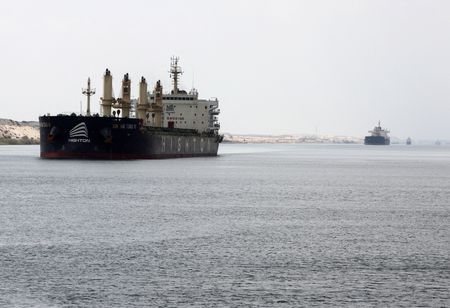
Instead of taking the typical eastward route from Saudi Arabia’s Red Sea port of Yanbu toward the Arabian Sea, shippers are now considering heading west toward Egypt, passing through the Suez Canal, and continuing around Africa’s Cape of Good Hope. Analysts and industry experts say this longer path could add up to four extra weeks of travel time and significantly increase freight and fuel expenses.
A Liberia-flagged vessel called Rodos, which picked up crude oil at Yanbu and was heading toward India’s west coast, was observed on Tuesday traveling westward with the Suez Canal listed as its destination, according to ship-tracking data from LSEG and Kpler.
South Korean refiner Hyundai Oilbank was also reported on Tuesday to be seeking a Very Large Crude Carrier to load oil at Yanbu, with the possibility of using both the Suez Canal and Egypt’s SUMED pipeline — a link between the Red Sea and the Mediterranean Sea — to transport the oil to South Korea, according to a shipping industry source.
Because a fully loaded Very Large Crude Carrier is too heavy to pass through the Suez Canal, shippers often offload a portion of the oil onto the SUMED pipeline before the vessel enters the canal. The ship then picks up that oil again on the Mediterranean side after passing through with a reduced load.
The shipping source noted that operators could choose to use the SUMED pipeline and Suez Canal on their own terms, or may be forced to do so if the Bab el-Mandeb Strait — the southern entrance to the Red Sea — becomes completely blocked. Cost calculations for the rerouting would be determined later, the source said. The Suez Canal and SUMED pipeline are already frequently used to move oil from the Red Sea to European markets.
Matt Smith, commodity research director at Kpler, said the change in tanker behavior signals that the industry is treating the Houthi threats as credible. “Changing behavior by tankers tells us that they are taking the threats seriously,” Smith said. He also noted that the timing is particularly difficult for Saudi Arabia, as the volume of its crude and petroleum products passing through the Bab el-Mandeb reached a record high last month, exceeding 4 million barrels per day.