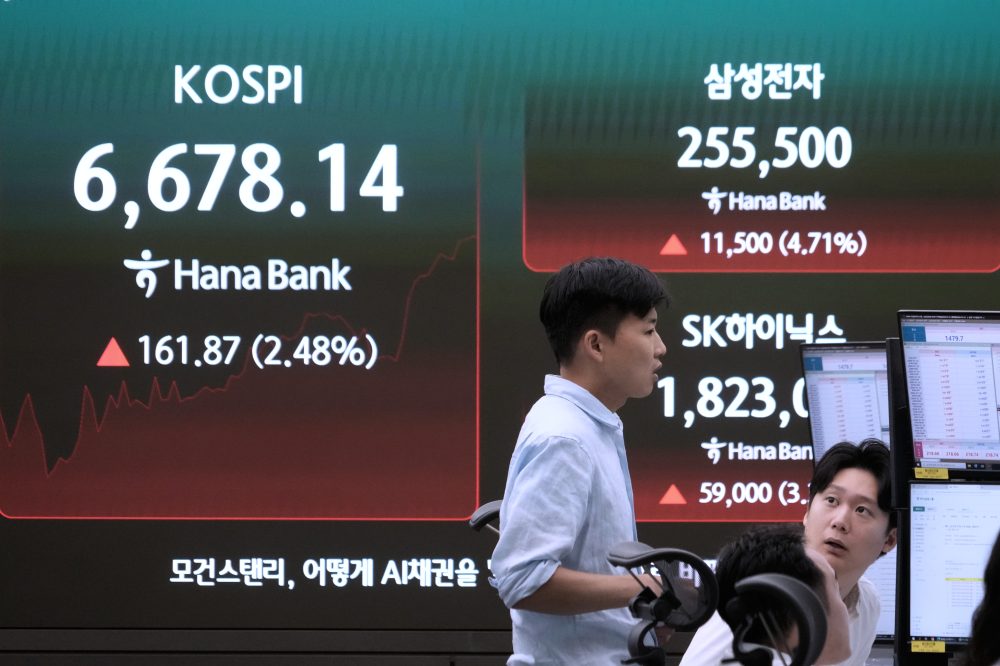

HONG KONG (AP) — Stock markets across Asia were mostly in positive territory Tuesday, with South Korea and Japan leading a recovery after steep drops driven by a wave of selling in artificial intelligence and technology-related shares.
U.S. futures moved slightly upward, while oil prices retreated.
South Korea’s Kospi index, which is heavily tied to AI and semiconductor stocks, surged 4.7% to reach 6,821.41 — bouncing back after a 4.5% drop the session before. Samsung Electronics shot up 7.4%, and memory chip manufacturer SK Hynix climbed 6.4%.
While the Kospi has risen more than 50% so far this year, it shed more than 20% over the past month as investors cashed out profits, growing nervous about the possibility of a bubble forming in AI-related investments.
Tokyo’s Nikkei 225 rose 2.8% to 65,926.41 following a holiday Monday, clawing back some of last week’s losses. Computer memory company Kioxia Holdings soared 15.9%, chip testing equipment firm Advantest jumped 6.9%, OpenAI backer SoftBank Group gained 6.1%, and chip equipment manufacturer Tokyo Electron added 1.3%.
Taiwan’s Taiex, another index that has ridden the AI wave upward, climbed 3.6%. Taiwan Semiconductor Manufacturing Co., known as TSMC, an advanced AI chipmaker, rose 2.8%.
Hong Kong’s Hang Seng index edged up less than 0.1% to 25,150.75, and the Shanghai Composite added 0.6% to close at 3,819.66. Australia’s S&P/ASX 200 gained 0.1% to 8,798.00, while India’s Sensex slipped 0.1%.
Oil prices pulled back Tuesday morning after rising the day before. Brent crude, the global benchmark, slipped 0.7% to $88.63 a barrel, falling below the $90 mark. Still, that remains well above the approximately $72 per barrel price seen before the war broke out in late February. U.S. benchmark crude dropped 0.3% to $82.24 a barrel.
Adding to market tension, Iran attacked another tanker in the Strait of Hormuz early Tuesday — a critical passage for global oil and gas shipments. The U.S. announced another wave of strikes targeting Iran, marking the 10th consecutive night of such action. Iran has been responding to those strikes by going after U.S. allies throughout the Middle East.
Even as the two nations exchanged fire, Iran’s interior minister traveled to Pakistan — which is serving as a key mediator — for diplomatic talks. Whether a new agreement can be reached remains uncertain.
ING commodities strategists Warren Patterson and Ewa Manthey offered a measured outlook in a Tuesday commentary: “There’s some hope of de-escalation between the U.S. and Iran. This won’t be an easy task. Large divisions remain between the U.S. and Iran.”
The analysts also flagged that a naval blockade by Yemen’s Iranian-backed Houthi forces against Saudi Arabia is adding further risk to global oil supplies.
On Wall Street Monday, the S&P 500 slipped 0.2% to 7,443.28. The Dow Jones Industrial Average fell 0.6% to 51,839.26, and the tech-focused Nasdaq composite edged down less than 0.1% to 25,508.07.
Several major AI and chipmaking stocks managed gains Monday. Nvidia rose 0.2%, Micron Technology climbed 1.9%, and Broadcom advanced 2%. Advanced Micro Devices, or AMD, added 1.6% after announcing a broader AI partnership with Microsoft.
In currency markets early Tuesday, the U.S. dollar slipped to 162.48 Japanese yen from 162.50 yen. The euro held steady at $1.1414.