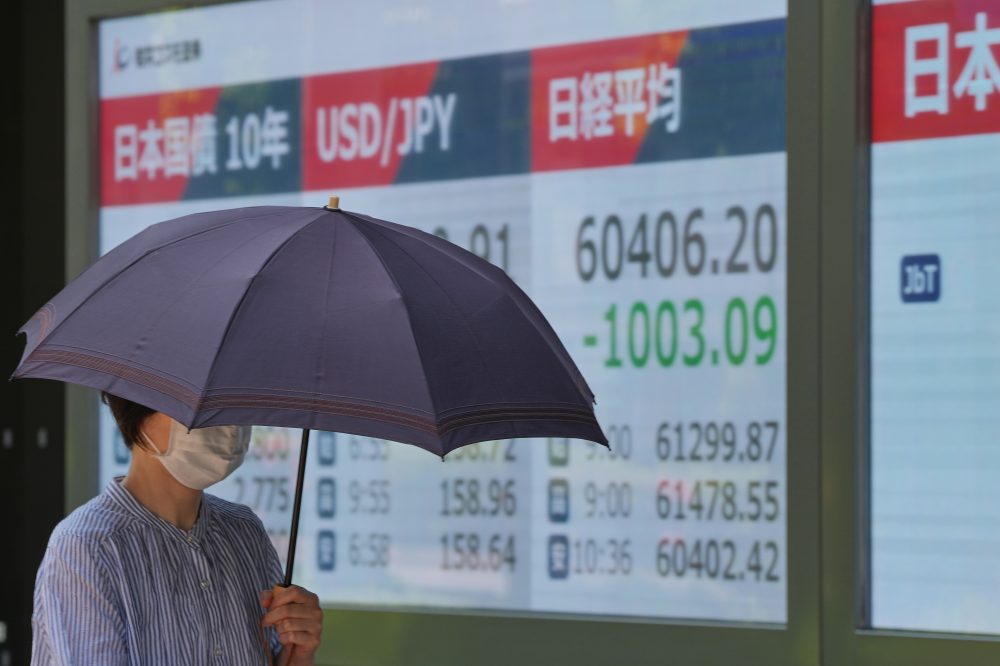

Asian financial markets experienced widespread declines Monday while crude oil prices surged following President Trump’s stark warning to Tehran that time is running out as diplomatic efforts to end the ongoing conflict remain stalled.
American market futures dropped more than 0.6% in early trading.
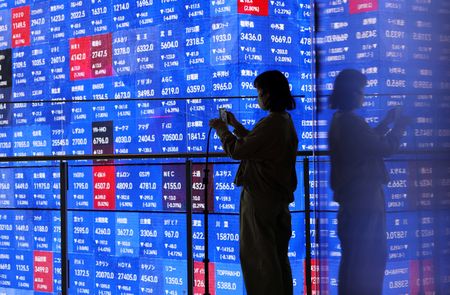
Japanese and South Korean exchanges retreated from recent record highs. The Nikkei 225 in Tokyo declined 0.9% to 60,843.09, with technology stocks leading the downturn after the index hit all-time peaks above 63,000 last week.
Japanese government bond yields on 10-year notes climbed to 2.8%, reaching the highest point since the late 1990s as part of a broader trend toward increased yields. The Bank of Japan’s gradual interest rate increases and rising energy costs have sparked inflation concerns, pushing yields up from approximately 2.55% just a week earlier.
Seoul’s Kospi recovered to gain 0.9% at 7,558.50 after earlier losses during the trading session. The index had crossed 8,000 on Friday, boosted by artificial intelligence-driven technology stock purchases, before declining on investor profit-taking.
Hong Kong’s Hang Seng dropped 1.6% to 25,543.32. Shanghai’s Composite index slipped 0.1% to 4,132.24 following disappointing Chinese retail sales data for April.
Australia’s S&P/ASX 200 fell 1.4% to 8,508.40.
Taiwan’s Taiex decreased 1.1%, while India’s Sensex declined 0.6%.
Crude oil markets rallied after Trump’s social media warning to Iran stating “the Clock is Ticking, and they better get moving, FAST, or there won’t be anything left of them” following discussions with Israeli Prime Minister Benjamin Netanyahu.
Market participants remain wary given Trump’s history of setting Iran deadlines before stepping back, creating uncertainty about the Strait of Hormuz situation and its effects on worldwide energy transportation, including oil and natural gas. The waterway remains largely blocked, while American naval forces have maintained a maritime blockade of Iranian ports since last month.
Weekend drone attacks on a United Arab Emirates nuclear facility heightened concerns about potential conflict escalation.
International Brent crude prices rose 1.9% to $111.31 per barrel, compared to roughly $70 per barrel in late February before the Iran conflict began. U.S. benchmark crude traded 2.3% higher at $107.83 per barrel.
“Re-escalation risks are increasing,” wrote ING commodities strategists Warren Patterson and Ewa Manthey in their research analysis. Despite increased shipping activity near the strait recently, they noted “this can change quickly.”
The analysts also highlighted oil market reactions to the absence of concrete progress on the Iran situation following last week’s closely watched summit between Trump and Chinese President Xi Jinping in Beijing. The White House reported both nations agreed the Strait of Hormuz must stay open.
American officials hoped Beijing might leverage its economic relationships with Iran to facilitate peace negotiations and reopen the strait. Trump mentioned in a recent interview that Xi indicated China “would like to be of help” in ending the conflict, though Beijing’s specific role remains unclear.
U.S. 10-year Treasury yields reached approximately 4.63%, up from 4.47% last Thursday and significantly higher than the nearly 4% level maintained before the Iran conflict.
Friday saw the S&P 500 benchmark drop 1.2% from its previous day’s record. The Dow Jones Industrial Average fell 1.1% while the technology-focused Nasdaq composite lost 1.5%.
Currency markets showed the dollar strengthening to 159.02 Japanese yen from 158.62 yen. The euro traded at $1.1626, up from $1.1622.