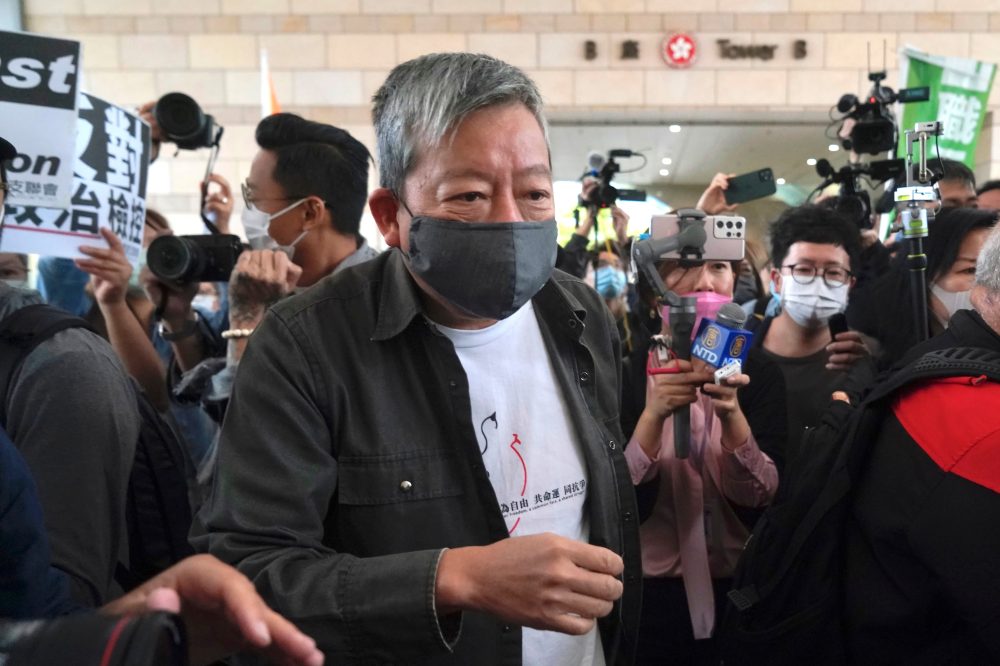

A Hong Kong courtroom concluded closing arguments Monday in a national security case targeting two former leaders who organized large-scale memorial events for the 1989 Tiananmen Square protests.
For many years, Hong Kong remained the sole location within China where citizens could publicly gather to remember the 1989 crackdown. These memorial gatherings were prohibited starting in 2020, and the two former coordinators faced charges in 2021 for allegedly encouraging subversion under national security legislation imposed by Beijing that has effectively silenced the city’s democracy advocacy movement.
The defendants, Chow Hang-tung and Lee Cheuk-yan, previously led the Hong Kong Alliance in Support of Patriotic Democratic Movements of China and have entered not guilty pleas. A conviction could result in prison sentences of up to 10 years.
Legal experts view this prosecution as evidence of diminishing Western-style freedoms in the city, which Beijing had committed to preserving for five decades following Hong Kong’s 1997 transfer from British control. Both Beijing and Hong Kong officials maintain the security legislation is essential for maintaining civic order.
Throughout the proceedings, prosecutors emphasized the alliance’s central goal of “ending one-party rule,” claiming the defendants encouraged others to pursue illegal methods to topple China’s Communist Party leadership. The prosecution maintained the accused were not seeking constitutional reforms.
During Monday’s session, prosecutor Ned Lai stated that speech, assembly and association rights have limitations, claiming Lee and Chow were trying to obscure the case’s focus through human rights defenses.
“The freedoms of speech, association and assembly mentioned by D2 and D4 are not ‘trump cards’ that can override the law,” Lai stated, using the defendants’ court identification numbers.
In earlier court sessions, Lee rejected the notion that “ending one-party rule” meant dismantling Communist Party authority. He contended it represented progress toward democratic governance, allowing citizens to choose their leaders, and that the Communist Party should abandon “dictatorship.”
Chow, a legal professional representing herself, maintained her previous writings were not meant to provoke action or animosity but rather to help Hong Kong residents better understand mainland China, where many citizens also aspire to democratic reforms.
A third co-defendant, Albert Ho, admitted guilt when proceedings started in January. Guilty pleas often lead to reduced sentencing.
The proceedings, originally planned for 75 days, are anticipated to conclude ahead of schedule. However, the presiding judges have not announced when they will issue their decision.
Massive crowds participated in Hong Kong’s yearly Tiananmen memorial events until officials prohibited them in 2020 citing COVID-19 health concerns.
Following the lifting of pandemic restrictions, pro-Beijing organizations held a festival at the former vigil location. Individuals who attempted to honor the event near the site on June 4, the anniversary date, were arrested.