
TOKYO (AP) — Stock markets across Asia posted gains during Wednesday morning trading, mirroring Wall Street’s strong performance that occurred as petroleum prices dropped amid speculation about possible renewed diplomatic discussions between the United States and Iran regarding their conflict.
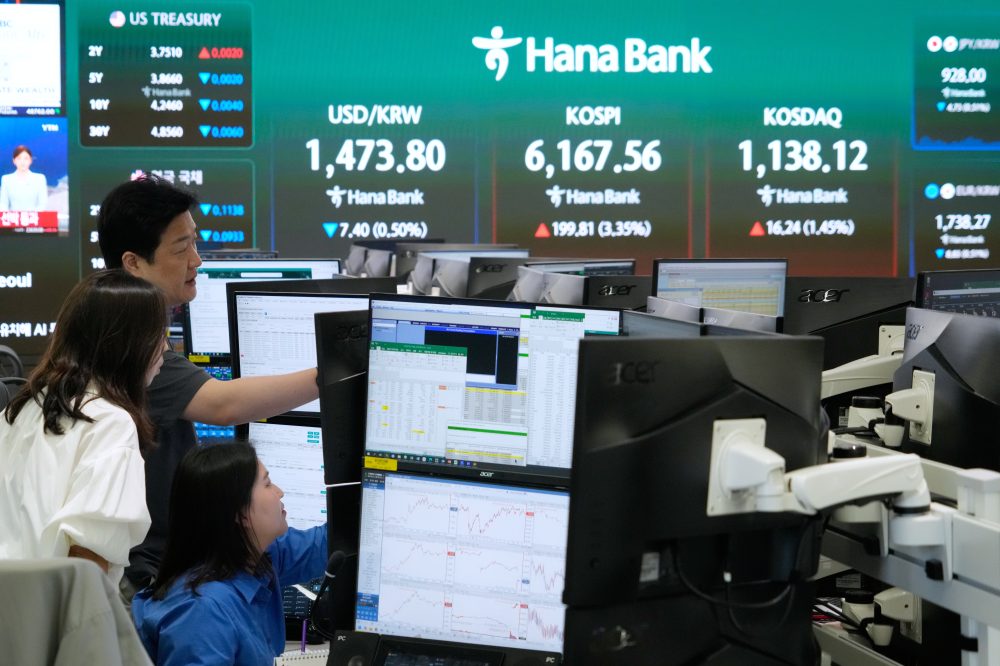
Japan’s Nikkei 225 climbed 0.5% to reach 58,162.84. Australia’s S&P/ASX 200 remained relatively flat, advancing less than 0.1% to 8,977.90. South Korea’s Kospi surged 3.0% to 6,145.18. Hong Kong’s Hang Seng increased 0.7% to 26,045.80, while the Shanghai Composite advanced 0.2% to 4,033.88.
Wall Street saw the S&P 500 increase 1.2% beyond its previous day’s gains, bringing the benchmark index that anchors many retirement accounts to within just 0.2% of its January record high.
The Dow Jones Industrial Average advanced 317 points, or 0.7%, while the Nasdaq composite surged 2%.
Wednesday saw benchmark U.S. crude oil edge up 1 cent to $91.29 per barrel. Brent crude increased 48 cents to $95.27, representing less than 1% growth following Tuesday’s 4.6% decline. Though prices remain elevated compared to the approximately $70 level before the conflict started in late February, they’re significantly below the $119 peak.
Reduced petroleum costs benefit businesses across various sectors by lowering operational expenses. However, some market experts cautioned that the conflict continues, suggesting the positive sentiment might be premature.
“The counterintuitive decline in crude appears driven by growing hopes that a second round of peace talks between Washington and Tehran could soon materialize, after the first attempt fizzled out. Traders are clearly choosing to price in the possibility of de-escalation rather than the immediate reality of restricted flows,” said Tim Waterer, chief market analyst at KCM Trade.
Asian economies rely heavily on access through the Strait of Hormuz, a critical shipping channel serving as the primary route for Persian Gulf crude oil to reach global markets. Disruptions in this waterway have limited oil supply to international markets, contributing to price increases.
The International Monetary Fund projects global inflation will accelerate to 4.4% this year from 4.1% in 2025, revising upward from its earlier prediction of 3.8%. The IMF also reduced its global economic growth forecast Tuesday to 3.1% for this year, down from the 3.3% projection made in January.
Overall, the S&P 500 gained 81.14 points to reach 6,967.38. The Dow Jones Industrial Average rose 317.74 to 48,535.99, and the Nasdaq composite increased 455.35 to 23,639.08.
Treasury markets saw yields decline as falling oil prices reduced inflation concerns. The 10-year Treasury yield dropped to 4.25% from Monday’s close of 4.30%.
Currency markets showed the U.S. dollar strengthening to 159.03 Japanese yen from 158.79 yen. The euro weakened to $1.1780 from $1.1797.