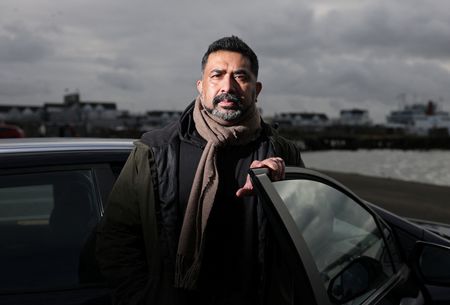

After nearly 40 years of calling Britain home, a man named Ali Haydor says there are days when he wishes he could conceal the color of his skin.
Haydor, who moved to Britain from Bangladesh at the age of five, has watched his home city of Southampton erupt in violent protests following the murder conviction of a British-born Sikh man. That man had falsely claimed his white victim had carried out a racist attack against him. A video showing police handcuffing the dying victim — released at the time of the June 1 sentencing — ignited public outrage and prompted politicians across party lines to call for an end to police guidance that allows for different treatment based on ethnicity.
Just one week later, gangs of masked individuals went door to door in Belfast searching for migrants, after a white man was stabbed multiple times and lost an eye in an attack carried out by a Sudanese immigrant.
Although such incidents are uncommon, they have become a rallying point for right-wing politicians and activists who have zeroed in on crime to stoke long-simmering tensions over national identity and immigration. For many ethnic minority residents, the result is a Britain that once felt like a stable, welcoming home now feels increasingly threatening.
“Anybody of colour is at risk at the moment,” said Haydor, who is 44 years old. “As much as we love our heritage and identity, sometimes (I wish) we could just hide it.”
According to the Migration Observatory, British attitudes toward immigration were more open than most of Europe in the early 2020s. However, multiple polls indicate those views have hardened since 2022. Surveys consistently show younger and more left-leaning voters tend to be more welcoming of immigration, while older and more right-leaning voters are less so.
British Social Attitudes surveys suggest much of the public concern is tied specifically to asylum seekers arriving by small boats, rather than people coming to work or study.
Reuters spoke with policy experts and 10 trade unions whose members have reported a noticeable uptick in racist incidents. These include patients refusing medical care based on a nurse’s race, an increase in racist comments in workplaces, and migrant workers describing repeated experiences of discrimination on the job.
The Royal College of Nursing reported a 55% increase in workers experiencing racial discrimination since 2022. Paul Rees, head of the Nursing and Midwifery Council, noted in 2025 that roughly one-third of the sector’s workforce is Black, Asian, or from a minority ethnic background. He said many of those workers report “they are today facing the kind of abuse they haven’t received in decades.”
Prime Minister Keir Starmer has repeatedly spoken out against racism in all forms and against the violence connected to it, cautioning that racist language is making a troubling comeback. But union leaders and experts argue that political messaging — from the government as well as other political figures — has helped create an environment where open racism is increasingly tolerated.
Populist political leader Nigel Farage, speaking after Southampton protesters clashed with police, claimed British institutions were biased against white people. Starmer firmly rejected that claim and accused Farage of trying to exploit a tragedy to deepen divisions.
Haydor, a Muslim who works as a private hire driver, said he had seen racism ease from the mid-1990s onward, only for it to resurface during politically charged moments — including the 2016 Brexit vote, which placed heavy emphasis on immigration. But in recent weeks, he said he has felt more uneasy than ever. Passengers have brought up the murder case and asked for his views. Two passengers told him that Muslims were “not compatible” with Britain and the West.
Hardeep Singh, deputy director of the Network of Sikh Organisations, said he reported a hate email to police that called for Sikhism to be made “extinct.” He described social media as “a cesspit of venom” and said he had not seen “anything like this vitriol ever before.”
In Belfast, the stabbing of a local man by a Sudanese refugee who had been granted permission to remain in Britain set off days of civil unrest. Rioters targeted the homes and businesses of ethnic minorities across Northern Ireland, burning properties and vehicles and forcing many families to flee.
Twasul Mohammed, who escaped Sudan’s civil war as a refugee in 2016 and now lives in the British province, told Reuters, “women and kids are terrified… I haven’t sent my kids to school since this has happened.”
She said many minority ethnic residents feel Northern Ireland has grown more hostile since riots in 2024 — part of a broader wave of violence that swept the UK after three young girls were murdered at a Taylor Swift dance class in the English town of Southport. The attacker was initially and falsely reported online to be an asylum seeker who had arrived by boat. In reality, a 17-year-old boy born in Britain to Rwandan parents pleaded guilty to those crimes.
Shortly after the unrest in Southampton and Belfast, a 36-year-old man was charged in Edinburgh, Scotland, following a series of attacks that Prime Minister Starmer said appeared to be motivated by anti-Muslim bias.
Police-recorded hate crimes in England and Wales rose for the first time in three years during the year ending March 2025, with racially motivated offenses climbing 6% to 82,490 incidents.
Britain is home to large and diverse immigrant communities, many of which trace their roots to the country’s colonial era. According to the 2021 Census, 18% of the population of England and Wales identified as Black, Asian, mixed, or another ethnic group.
While racism has deep historical roots in Britain — connected to transatlantic slavery and colonialism and persisting throughout much of the 20th century — the country has been seen as relatively successful at integrating diverse communities, with ethnic minorities increasingly visible in public life.
Rishi Sunak became Britain’s first prime minister of color when he took over leadership of the Conservative Party in 2022. He was later succeeded in that party role by Kemi Badenoch, who was born in Britain to Nigerian parents and spent much of her childhood in Nigeria.
A 2016 EU survey found that migrants in Britain from Sub-Saharan Africa, Asia, and South Asia reported the lowest levels of discrimination compared to those in other European countries surveyed.
But public opinion appears to be shifting. The British Social Attitudes survey found the share of people who believe immigration benefits the economy and culture dropped from 50% in 2022 to just 32% in 2025.
Immigration was a central issue in Britain’s 2016 vote to leave the European Union. Yet net migration climbed sharply after Brexit, as Britain brought in healthcare workers from India and Nigeria to fill staffing shortages and saw a surge in non-EU students enrolling at its universities. While net migration averaged 223,000 during the 2000s and 260,000 during the 2010s, it hit a record 944,000 in the year ending March 2023.
Farage’s Reform UK party — which has had to remove certain candidates and activists for making racist remarks — has led every major political poll over the past year. Among its policy proposals are mass deportations of anyone who arrived in Britain illegally and the removal of foreign nationals from social housing.
Interior minister Shabana Mahmood warned in March that the record immigration levels recorded under the previous Conservative government had placed serious strain on public services. In pushing for stricter citizenship rules, she cautioned that people who had settled in Britain decades ago could face a backlash if the system was not fixed.
Tougher visa regulations did cut net migration significantly in 2025 — dropping to 171,000 from 331,000 the year before. However, the number of asylum seekers arriving by small boats continued to rise, increasing 13% to 41,000 in 2025. While those figures are far smaller than the number of legal arrivals, opposition politicians and anti-migration activists argue they demonstrate the government has lost control of its borders.
For many people, all of this has contributed to a more tense and divided Britain.
Marcia Dixon, a 61-year-old whose parents came to Britain as part of the post-war Windrush generation of Caribbean migrants invited to help rebuild the country, said she worries the racism of the 1970s is making a comeback. She said parties like Reform use inflammatory language when responding to news stories involving people of color, and she expressed concern about younger people being exposed to that kind of rhetoric for the first time.
“It felt like things were improving,” Dixon said. “But some of that now feels like it’s being slowly rolled back. If I was younger, I’d probably feel more fearful.”