
TIVOLI, Italy (AP) — Centuries ago, Roman builders would travel to quarries near Tivoli to extract chunks of porous limestone called lapis tiburtinus — what we now call travertine — then transport the stone blocks on rafts down the river to construction sites.
This ancient process created the iconic Colosseum two millennia ago. The same method was used centuries later for St. Peter’s Basilica and Bernini’s magnificent colonnade.
The identical quarries that supplied Rome’s legendary travertine continue operating today, providing their signature hole-filled stone for modern religious structures, houses of worship, and mosques worldwide — plus banks, cultural institutions, government facilities and residential properties.
Although other nations produce similar sedimentary limestone, Roman travertine stands apart because workers extract it from underground sulfuric springs and pools surrounding Tivoli. Composed primarily of calcium carbonate minerals, this Roman stone developed over hundreds of thousands of years through calcium, sulfur and mineral deposits, displaying the area’s volcanic past, ancient forests and fossil remains in its layered bands.
Architects value the material for multiple qualities: durability, abundance and resistance to various weather conditions and environmental challenges. The cutting method and location determine its appearance, ranging from rough to smooth textures, warm white with irregular dark pockets to sandy tan with gray, brown or green streaks.
The Mariotti Carlo SpA stone-cutting company has shaped travertine to specification for four generations, completing some of the globe’s most notable architectural projects: Los Angeles’ Getty Center, Beijing’s Bank of China headquarters, and the Great Mosque in Algiers, Algeria.
During a recent work session, components for a temple reconstruction by The Church of Jesus Christ of Latter-day Saints, commonly called the Mormon church, sat arranged across Mariotti’s Tivoli warehouse floor — travertine chunks extracted from local quarries and shaped into custom puzzle-like sections for assembly at the New York City location.
Following their travertine supply work for the Latter-day Saint temple in Rome, church architects selected Mariotti to renovate the Manhattan Upper West Side temple. This temple stands opposite Lincoln Center and Julliard School, both constructed with Mariotti-processed travertine decades earlier when the stone first entered American markets.
“Travertine represents a classic stone recognized globally. It’s similar to spreading Rome’s illumination everywhere, since travertine’s light reflection qualities are truly unique,” explained Fabrizio Mariotti, who leads the family enterprise.
Throughout the Tivoli quarry areas, sulfur odors fill the atmosphere alongside continuous hammering, chiming and splitting sounds from massive jackhammers breaking ancient rock formations.
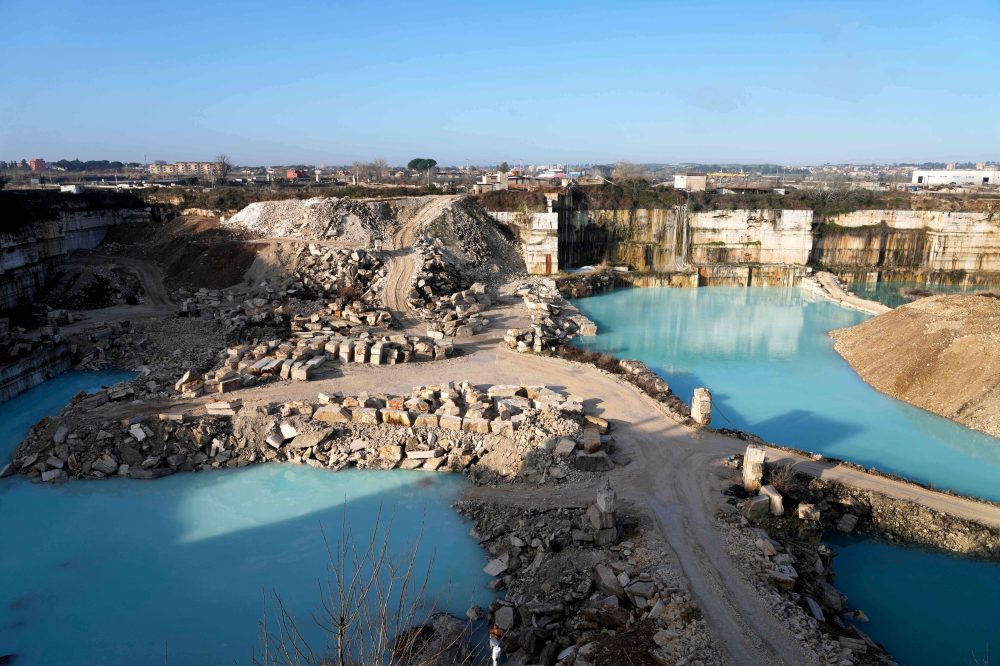
At Degemar quarries, excavated 30 meters below sea level, brilliant blue sulfur spring pools collect travertine debris while flatbed trucks transport 33-ton stone slabs to ground level.
This location provided Gian Lorenzo Bernini, the renowned Baroque sculptor and architect, with brilliant white travertine for the 284 columns and 88 pillars forming St. Peter’s Square colonnade, plus his other Catholic and Roman masterpieces.
Bernini visited so frequently to choose his stones that he maintained a residence overlooking the quarry, which remains standing.
Current quarry director Vincenzo De Gennaro points out that Bernini’s tower still contains the pigeon coop that housed homing birds carrying stone measurement orders from Rome to the quarry.
Today, the quarry serves clients across much greater distances: Riyadh’s new airport in Saudi Arabia and the Chinese governing party’s new Shenzhen headquarters, among others.
“This is exceptional, a unique stone because it lives and breathes, born from a mixture of mineral waters,” De Gennaro commented while navigating earth-moving equipment and walking past sulfur pools.
Anyone doubting travertine’s longevity need only examine Rome itself, he noted.
“We have the physical proof of a civilization spanning thousands of years that remains visible today, glowing continuously for 2,000 years,” he stated. “That serves as our warranty.”
Marco Ferrero, civil engineering professor at Rome’s La Sapienza University, explained that travertine’s attraction partly stems from its connection to ancient Rome “and consequently to the enchantment of the classical era.”
He said the stone captures Rome’s character in multiple ways: Travertine demonstrates strength, endurance and dignity without the flashiness of marble, which deteriorates faster when facing weather exposure.
“Here’s an appropriate comparison: Marble communicates in elegant Italian, in literary Italian, while travertine speaks in Roman dialect,” he observed. “It truly represents the Romans’ stone. Similar to Roman cooking, which features simple meals often using leftover ingredients, travertine remains an authentic and traditional material.”