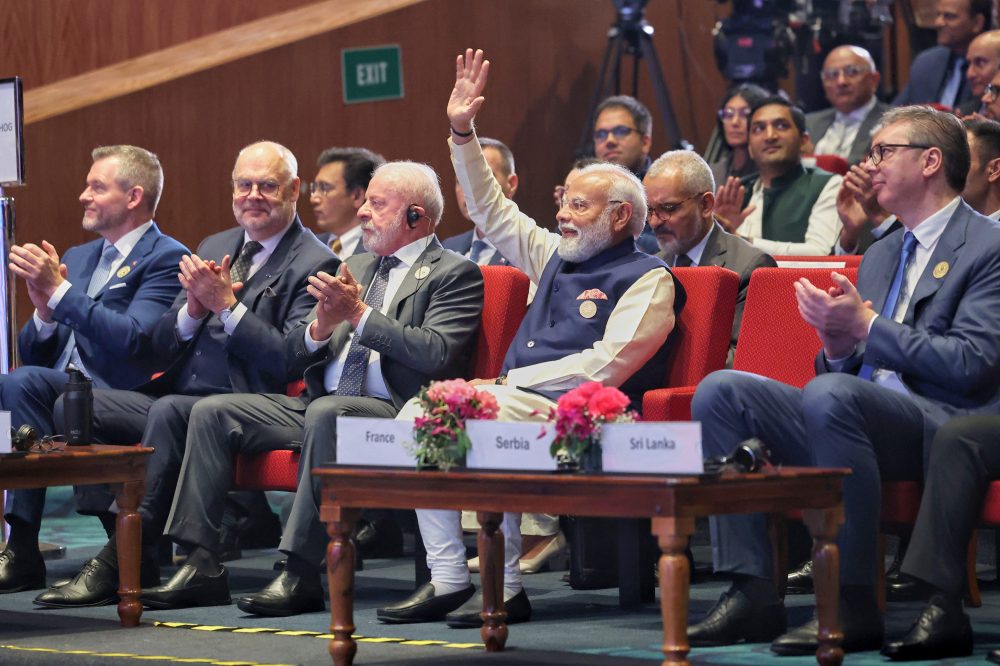

NEW DELHI (AP) — At a major technology conference in New Delhi on Thursday, India’s Prime Minister Narendra Modi promoted his nation as a crucial force in the worldwide artificial intelligence landscape, emphasizing India’s goal to create technology domestically and share it globally.
“Design and develop in India. Deliver to the world. Deliver to humanity,” Modi declared to an audience of international leaders, tech industry executives, and policy makers at the India AI Impact Summit in New Delhi.
Modi’s statements reflect India’s ambitions as one of the world’s rapidly expanding digital markets to capitalize on its expertise in creating extensive digital public infrastructure and establish itself as an affordable center for AI development.
The conference also featured addresses from French President Emmanuel Macron, Google CEO Sundar Pichai, and U.N. Secretary-General António Guterres, who proposed a $3 billion funding initiative to assist developing nations in establishing fundamental AI capabilities, including training, data accessibility, and affordable computing resources.
“The future of AI cannot be decided by a handful of countries, or left to the whims of a few billionaires,” Guterres declared, emphasizing that AI must “belong to everyone.”
India is utilizing the conference to establish itself as a connector between developed nations and the Global South. Government representatives point to the nation’s digital identification and electronic payment infrastructure as examples of how to implement AI affordably, especially in emerging economies.
“We must democratize AI. It must become a tool for inclusion and empowerment, particularly for the Global South,” Modi stated.
With close to one billion online users, India has emerged as a crucial marketplace for international technology corporations expanding their artificial intelligence operations.
In December, Microsoft revealed a $17.5 billion commitment over four years to enhance cloud computing and AI infrastructure within India. This followed Google’s $15 billion investment spanning five years, which includes establishing its first AI center in the nation. Amazon has similarly committed $35 billion through 2030, focusing on AI-powered digital transformation.
India is additionally pursuing up to $200 billion in data center investments in the upcoming years.
However, the nation falls behind in creating its own comprehensive AI systems comparable to U.S.-based OpenAI or China’s DeepSeek, revealing obstacles including restricted access to cutting-edge semiconductor technology, data facilities, and the challenge of processing hundreds of regional languages.
The conference began Monday with operational problems, as participants and vendors experienced extended waiting times and delays, with some reporting on social platforms that personal items and exhibition materials had been taken. Event organizers later announced the missing items were found.
Issues continued Wednesday when a private Indian university was removed from the summit after a staff member presented a commercially available Chinese-manufactured robotic dog while falsely claiming it as the school’s original creation.
The difficulties persisted Thursday when Microsoft co-founder Bill Gates canceled a planned keynote presentation. Officials provided no explanation, though the Gates Foundation stated the decision was made “to ensure the focus remains on the AI Summit’s key priorities.”
Gates has been facing scrutiny regarding his connections to deceased sex offender Jeffrey Epstein.