
OUIDAH, Benin (AP) — A remarkable transformation occurred in 1991 when Benin’s longtime military ruler unexpectedly lost an election he had arranged himself, bringing democratic governance to the birthplace of Voodoo traditions.
For years, Mathieu Kérékou had consolidated control by outlawing practitioners he labeled as sorcerers, viewing their influence as a threat to his authority. However, followers of the ancient faith would ultimately prevail.
Nicéphore Soglo, the opposition candidate who unseated Kérékou, restored Vodún (as the religion is called locally) as an integral part of the nation’s cultural identity and promoted the kind of acceptance that Kérékou would later adopt when he won reelection in 1996.
Three decades and multiple presidents later, this West African country stands as a democratic stronghold in an area known as “the coup belt” due to frequent military seizures of power since 2020. President Romuald Wadagni took office on May 24, succeeding Patrice Talon, who completed his two-term limit.
Remarkably, Benin’s commitment to democratic principles mirrors the endurance of Vodún faith, which withstood Kérékou’s authoritarian control until he was forced to become more flexible. Kérékou’s downfall demonstrated that even the most powerful rulers cannot destroy religious conviction in the homeland of Voodoo, according to practitioners and academics.
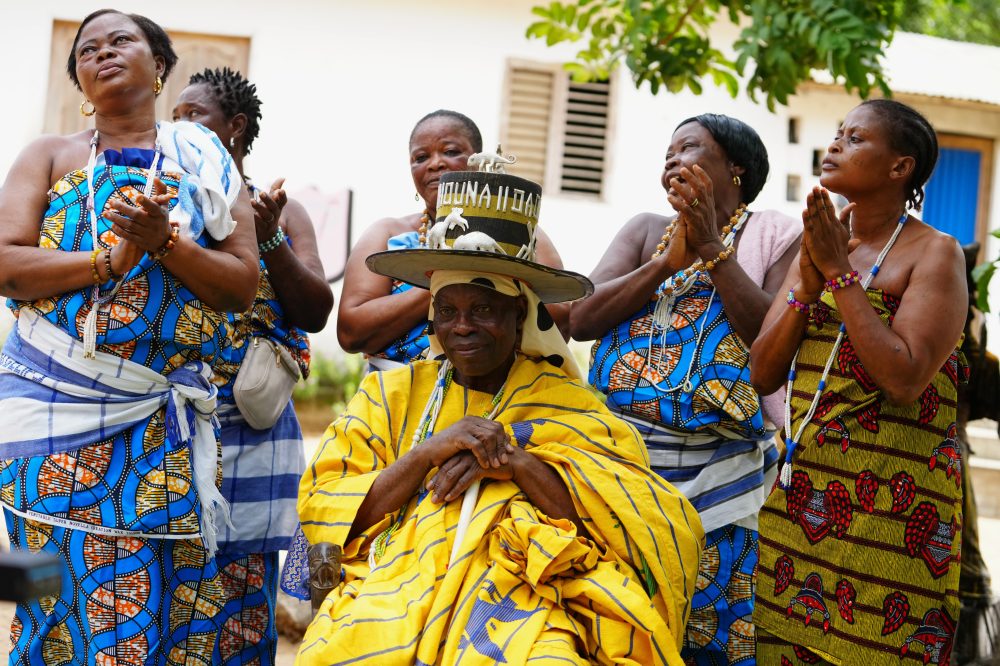
“The return to democracy recognized the existence of traditional religion,” Vodún supreme leader Daagbo Hounon Houna II told The Associated Press. “Kérékou acknowledged that (African) religions must be respected.”
Kérékou represented an unusual type of leader. Serving as a major in the armed forces of Dahomey, the country’s former name, he seized control through a 1972 military coup and established a Marxist-Leninist regime. However, his government takeover of private businesses contributed to financial ruin as the Cold War ended, creating additional demands for reform from the Catholic Church and other participants in the 1990 National Conference.
This era also witnessed a campaign against Voodoo practices. Kérékou viewed Vodún as primitive, despite maintaining his own spiritual counselors called marabouts. Religious leaders faced imprisonment and sacred sites were destroyed during development projects, infuriating worshippers.
Followers of Vodún are thought to have struck back against Kérékou, who became deeply afraid of being cursed into a zombie-like state. He enlisted a Malian marabout known as the Devil and explored various faiths while seeking spiritual protection, believers report.
Kérékou encountered “the heat, and there were parts of the country he couldn’t go to,” said Léon Bani Bigou, a former lawmaker who once served as Kérékou’s adviser. “This is precisely what led him to reconsider his position regarding Indigenous religions.”
The nation’s leader, originally raised in the Catholic faith, later converted to Islam under the name Ahmed Kérékou before adopting evangelical Christianity, possibly as a survival strategy, according to Gerrie ter Haar, an emeritus professor of religion and development at the International Institute of Social Studies of Erasmus University.
It’s understandable that Kérékou “remained terrified to become a victim of a Vodún curse and had to search for stronger spiritual power” he saw in evangelical Christianity, she said.
Approximately half of Benin’s 14 million citizens consider themselves Christians, based on U.S. State Department data. Nevertheless, Vodún represents “the first religion of all Beninese,” stated Mahougnon Kakpo, a prominent politician and lawmaker in Cotonou, Benin’s commercial capital.
“The rest is hypocrisy,” Kakpo said. “Kérékou himself practiced Voodoo.”
Vodún follows animist principles through its connection to supernatural forces. Practitioners find divine presence and guidance in natural elements, from stones to waterways. Religious rituals include animal offerings, spoken chants and energetic dance movements.
Vodún originated in Ouidah, a coastal city along the Gulf of Guinea that previously served as a significant slave-trading center. This location houses the headquarters of Houna II, the Vodún supreme leader.
During a recent morning visit, Houna II arranged his heavy ceremonial clothing while taking his place in an ornate chair to explain Voodoo’s persistence, his words accompanied by chants from the female priests around him.
Voodoo’s “sworn leaders were not afraid to confront anyone, to leave behind what their ancestors bequeathed them no matter the cost,” he said. “It has been shown that the more you attack their religion, the more you raise their spirits.”
Kérékou joined other post-independence African rulers who attempted to substitute religious leadership with their own authority. However, he was unsuccessful and eventually reversed course. This explains why Kérékou earned the nickname “the chameleon” among his citizens.
Gnassingbé Eyadéma, while leading Togo, effectively promoted worship of his own image, presenting himself as a rescuer figure. Eyadema, who justified certain attacks against his enemies by labeling them as witches, maintained continuous rule from 1967 through 2005.
In Zaïre, now known as Congo, Mobutu Sese Seko seized power through force and portrayed himself as a “god-chief,” widely feared for his supposed connection to supernatural powers. He governed with minimal opposition for thirty years.
Kérékou’s 1991 electoral loss represented the initial instance of a current president being removed through voting in West Africa. Five years afterward, he returned as a civilian democratic leader, abandoning his Marxist-Leninist symbols. He also supported establishing the National Voodoo Board, along with an official celebration held annually on January 10 beginning in 1996.
Kérékou was unable to eliminate Vodún “because he was attacking a centuries-old social practice deeply rooted in the daily lives of Beninese people, a resource to which he and officials in his regime had been able to turn in the exercise of power,” said Narcisse Martial Yedji, a political sociologist at Université d’Abomey-Calavi. “Kérékou could not win over all the guardians of Voodoo traditions. Voodoo is not private property.”
The religion demonstrated remarkable endurance, he explained, and currently “priests claim that most public authorities resort to magical-religious practices and other rituals deeply rooted in the Voodoo collective consciousness.”
By 2001, while pursuing his final term, Kérékou was actively seeking support from Voodoo followers in Ouidah, where spiritual seekers can be observed carrying protective charms near the ocean.
At that location, within a wooded area beside marshland, a Vodún follower named Irène Kpatenon indicated the remains of a tree that served as his shrine where he sometimes left fruit offerings, explaining that he learned “Voodoo spirits like sweet things.” Kpatenon had recently requested divine help in finding well-paid employment.
Visitors to Ouidah often walk the sandy trail leading to the memorial called “the Door of No Return” honoring the unfortunate victims of the trans-Atlantic slave trade. Even within that tragic history lies a tale of defiance that Houna II recalled with pride.
Enslaved Africans brought to Caribbean islands, particularly modern-day Haiti where the faith is called Vodou, organized uprisings against their captors.
During a Vodou ritual called the Bois Caïman pact of 1791 — which involved sacrificing a pig for its blood — certain slaves planned the revolt that established Haiti as the first independent Black nation in 1804.
Haitian Vodou faced persecution and was stigmatized for generations as mere superstition while being influenced by Catholic beliefs. Similar to Benin’s experience, Vodou in Haiti persisted and continues to shape cultural traditions.
“Voodoo is life,” said Dossavi Yovo, a priestess in Houna II’s temple, warning against the faithless practice of combining Christianity with Vodún. “If you want to practice Voodoo, you have got to dedicate yourself to it.”