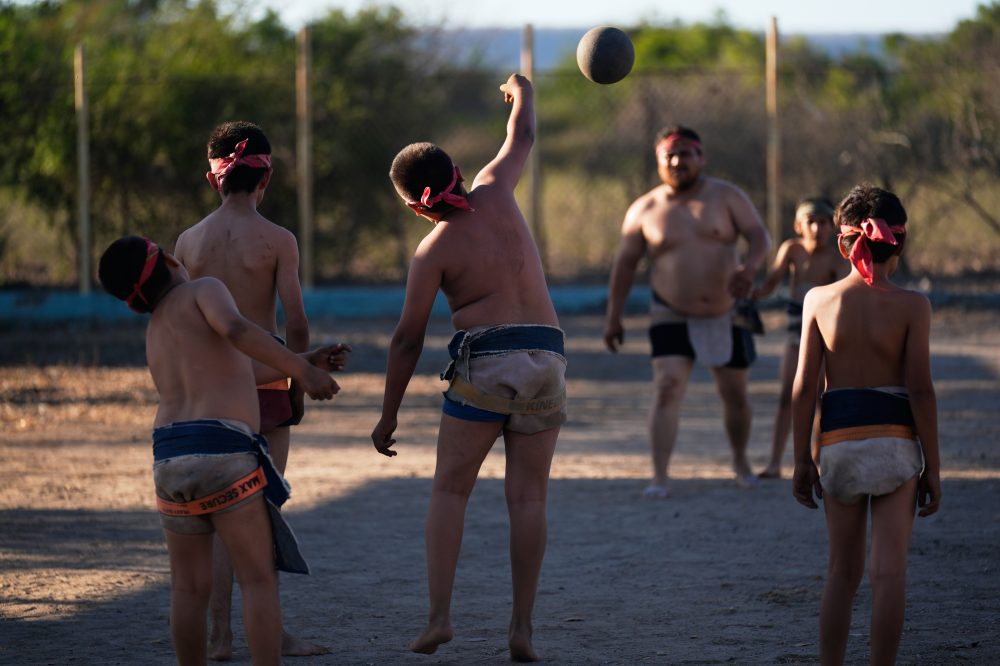

LOS LLANITOS, Mexico — In a dusty field along Mexico’s Pacific shoreline, five young cousins ranging from 8 to 13 years old remove their clothing and footwear. Adults nearby assist them in putting on traditional pre-Hispanic gear called “fajado” — loincloths and leather belts wrapped around their waists.
The Osuna youngsters take hold of a solid rubber ball weighing 3.2 kilograms — approximately 7 pounds, making it seven times heavier than a standard soccer ball — and start their game. Players can only strike the ball with their hips, requiring them to jump high in the air or drop low when the ball bounces near the earth.
With Mexico set to co-host the 2026 FIFA World Cup, the country is reflecting on a sport that dates back 3,400 years — ulama, one of humanity’s oldest team competitions. This ceremonial practice was almost completely destroyed during Spanish colonization and only endured in isolated areas of northwestern Mexico until experiencing a renaissance in the late 1900s. Now, officials and contemporary players are using soccer’s global popularity to bring attention to this ancient game once more.
Though players recognize that tourist interest helped revive the sport, many express concern that promoting an “exotic” image damages a tradition that defines their cultural identity.
“We must rid the game of the notion that it is a living fossil,” said Emilie Carreón, a researcher at the National Autonomous University of Mexico, UNAM, and director of a project aimed at studying and practicing the sport.
The Osuna family exemplifies this mission. Following the death of ulama player Aurelio Osuna, his wife María Herrera, 53, has carried on his work by instructing their grandchildren in the ballgame within their small Sinaloa village, located 1,000 kilometers (620 miles) northwest of Mexico City.
“This seed will bear fruit someday,” she said.
The Popol Vuh, the holy Mayan text, describes how the universe began through a ballgame where light battled darkness to create balance between life and death and set everything in motion.
Before the Maya civilization, the Olmecs — Mesoamerica’s earliest known society — participated in this sport. This reenactment of opposing forces was widespread among various pre-Hispanic cultures. Archaeological evidence includes ancient rubber balls discovered throughout Mexico and nearly 2,000 ball courts spanning from Nicaragua to Arizona.
Historical records show the game in codices, stone engravings, and sculptures, revealing multiple variations and purposes — from fertility and war rituals to political demonstrations and even human sacrifices.
Although some participants faced execution — potentially the defeated players — Guatemalan archaeologist and anthropologist Carlos Navarrete clarified this happened only during certain time periods and in specific areas. The physically challenging game primarily served as a major social gathering, attracting crowds for entertainment and gambling.
Spanish conqueror Hernán Cortés admired the display presented by Aztec ruler Moctezuma, but the Spanish eventually prohibited ulama and commanded the demolition of its courts, likely considering the practice as opposition to Christian beliefs. According to the Catholic Church, “the ball was the living devil,” Carreón explained.
The sport — involving striking the ball with hips, forearms, or mallets — only persisted along Mexico’s northern Pacific coastline, where Jesuit-led colonization was gentler and ulama became incorporated into Catholic celebrations, according to Manuel Aguilar Moreno, an art history professor at California State University.
During the opening ceremony of the 1968 Mexico City Olympics, audiences witnessed muscular men twisting their bodies in surprising ways to maintain the rubber ball’s movement for extended periods. This demonstration inspired research about the ballgame and preservation efforts in subsequent decades.
Luis Aurelio Osuna, 30, Herrera’s oldest son, started playing hip ulama after classes, following his father’s example from decades earlier in Los Llanitos, a ranch near the port city of Mazatlán. Today his three children also participate.
Osuna and his mother instruct the children on ball-striking techniques and explain the complex regulations, including a point system where scores can be gained and lost.
Their motivation combines love for the game with practical concerns in a state where criminal organizations are widespread.
“We need to find a way to keep them entertained with good things,” said Osuna.
Hip ulama squads can include up to six participants, and the Osuna family occasionally competes in tournaments or demonstrations.
Years ago, competitions were major occasions connected to religious celebrations, sometimes lasting an entire week. However, those times have passed as enthusiasm declined and rubber balls became difficult to obtain.
During the 1980s, filmmaker Roberto Rochín recorded the work of possibly the final rubber ball craftsman in Sinaloa’s mountains. The artisan created them using methods similar to the Olmecs, who learned that combining heated rubber sap with plant materials produced strong, flexible, and long-lasting material. This civilization manufactured some of the world’s earliest balls.
Throughout the 1990s, employees from a Mexican Caribbean resort traveled nationwide seeking Sinaloan families who could demonstrate the ballgame as entertainment in the Riviera Maya, where the sport had disappeared.
“It’s pure spectacle: they paint their faces and put on feathered costumes,” Herrera said. Still, she recognizes its importance. “That’s where the revival began.”
The ballgame started expanding and gaining recognition beyond Mexico’s borders. Osuna, playing with his father’s team, eventually performed hip ulama in an Italian Roman amphitheater. The attention was so significant they were recruited for a deodorant advertisement, he recalled.
As the World Cup nears, government agencies and companies are organizing exhibitions in Mexico City and Guadalajara, and including ulama players in advertising campaigns celebrating Mexican culture — a development that has created conflicted reactions.
“We’re not circus monkeys,” says Ángel Ortega, a 21-year-old ulama player from Mexico City who recently participated in a TV commercial alongside football players.
Ilse Sil, a player and member of the UNAM project led by Carreón, thinks institutional backing will help preserve ulama, but officials must promote the game in communities and schools to attract more young participants, as it remains a niche sport with roughly 1,000 players primarily in Mexico and Guatemala.
In Los Llanitos, Herrera’s grandchildren enjoy playing. Location doesn’t matter to them — whether in the dirt field, on a proper court, or even in their home hallway — but they always use their treasured inheritance: a handcrafted rubber ball from Sinaloa’s mountains that’s decades old. They claim it absorbs impacts more effectively.
Eight-year-old Kiki shows the greatest passion. He declares his commitment to continue training until he achieves his goal of captaining his own team.