
Scientists have made a groundbreaking discovery in China’s Yunnan Province that’s changing our understanding of when complex animal life first emerged on Earth.
Researchers have uncovered approximately 700 fossils of small, soft-bodied creatures that lived between 546 and 539 million years ago during what’s known as the Ediacaran Period. These ancient specimens show that animal life was diversifying in Earth’s early oceans much sooner than scientists previously understood.
The fossil collection, called the Jiangchuan Biota, consists of carbonaceous films – dark, flattened carbon layers that formed when organisms were compressed during fossilization. This preservation method captured incredible detail, including internal organs and structures used for feeding and movement.
What makes this find particularly important is that it demonstrates rapid animal diversification was already happening during the Ediacaran Period, well before the famous Cambrian Explosion that scientists have long studied. The Cambrian Explosion saw the emergence of early forms of most major animal groups we see today.
“We found a fossil site which gives us new information about the rise of complex animal life, before the Cambrian Explosion. We found evidence of animal groups that are otherwise found only about 520 million years ago – after the peak of the Cambrian Explosion – existing in the late Ediacaran Period, more than 20 million years earlier,” explained paleontologist Frankie Dunn from the University of Oxford, who co-authored the study published Thursday in Science journal.
During the Ediacaran era, Earth looked vastly different than today. The planet was emerging from an extreme ice age known as Snowball Earth, continents sat in completely different locations, and oxygen levels in the atmosphere were far lower than current levels.
Within this alien environment, the first animal life was taking hold in the seas. The oldest confirmed animal fossils date to roughly 574 million years ago and resembled fern fronds or feathers. Previously known Ediacaran animals included sponges and cnidarians – the group that includes jellyfish and corals.
“If you were to peer back into the Cambrian, you would be able to recognize much of the animal life around you, but this is not the case during the Ediacaran, where recognizable animals would likely be few and far between. Our new site shows a world in transition, moving into the complex animal-dominated world we see around us today,” Dunn noted.
Among the most significant discoveries were the oldest known members of deuterostomes – a vast animal group that includes vertebrates like humans, though these ancient creatures bore little resemblance to modern forms.
The fossil collection featured bilaterian animals – creatures with bodies that could be split into matching halves. While most animals today share this body plan, it represented a revolutionary development during the Ediacaran Period.
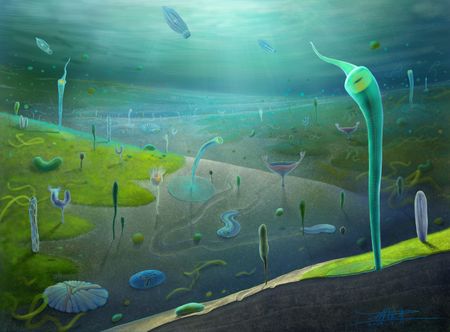
The specimens included animals with U-shaped bodies that anchored themselves to the ocean floor with stalks and used paired tentacles on their heads to capture food. These were early relatives of modern starfish and acorn worms.
Researchers also found what they nicknamed the “bugle worm” due to its resemblance to the musical instrument. This creature had a worm-like body attached to the seafloor and featured a proboscis that could turn itself inside out.
“When we were collecting fossils in the field, we were all surprised by how diverse the fauna was and how abundant the fossils were,” Dunn said.
“We expected to see more and more evidence of animals in the Ediacaran, but animals like the bugle worm tell us that not all of these will be forms that we could predict from the living diversity of animal life or even from the Cambrian Explosion,” Dunn added. “This tells us that there is still a lot to learn about the radiation of animal life and the nature of the transition from the Ediacaran to the Cambrian.”