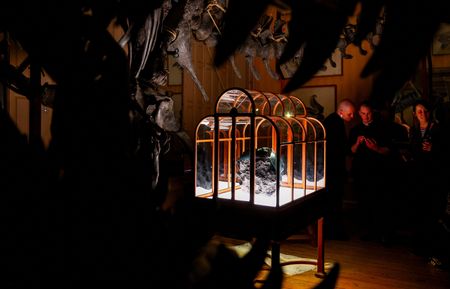

Researchers in Amsterdam have created an extraordinary handbag using collagen extracted from Tyrannosaurus rex fossil remains, marking a groundbreaking demonstration of laboratory-produced leather technology.
The distinctive teal-colored purse was revealed Thursday at Amsterdam’s Art Zoo museum, where it sits displayed on stone within a cage beneath a T-rex replica. The unique creation will go up for auction next month with bidding expected to start above half a million dollars.
The innovative material was developed by extracting ancient protein fragments from dinosaur fossils and introducing them into cells from an unidentified animal species to generate collagen, which was then processed into leather.
“There were a lot of technical challenges,” explained Thomas Mitchell, CEO of The Organoid Company, one of three firms involved in producing the so-called “T. rex leather” handbag.
The Organoid Company, a genomic engineering firm, previously partnered with creative agency VML in 2023 to produce a massive meatball by combining woolly mammoth DNA with sheep cells.
Che Connon, CEO of Lab-Grown Leather Ltd., which handled the leather production from the engineered collagen, noted that the T-Rex connection provided additional “oomph” to the project.
“It’s not just about a green alternative to leather, it’s a technological upgrade,” Connon stated regarding laboratory-produced leather.
However, several scientists not involved in the project have raised doubts about calling it “T. rex leather,” arguing that material from other animals would be necessary for the process.
Melanie During, a Dutch vertebrate paleontologist from Vrije Universiteit Amsterdam, explained that collagen in dinosaur bones exists only as broken fragments that cannot recreate authentic T. rex skin or leather.
Thomas R. Holtz Jr., a University of Maryland paleontologist, echoed similar concerns, noting that any collagen found in T. rex fossils originates from bone interior rather than skin. He added that even perfectly matched proteins would lack the complex fiber structure that gives animal leather its characteristic qualities.
Mitchell responded to the criticism by saying, “I would say that when you do something new for the first time, there is always criticism.”
“And I think we’re really grateful for that criticism. It’s the bedrock of scientific exploration… I think this is the closest anyone has gotten and will probably ever get to create something that’s T. rex,” Mitchell added.