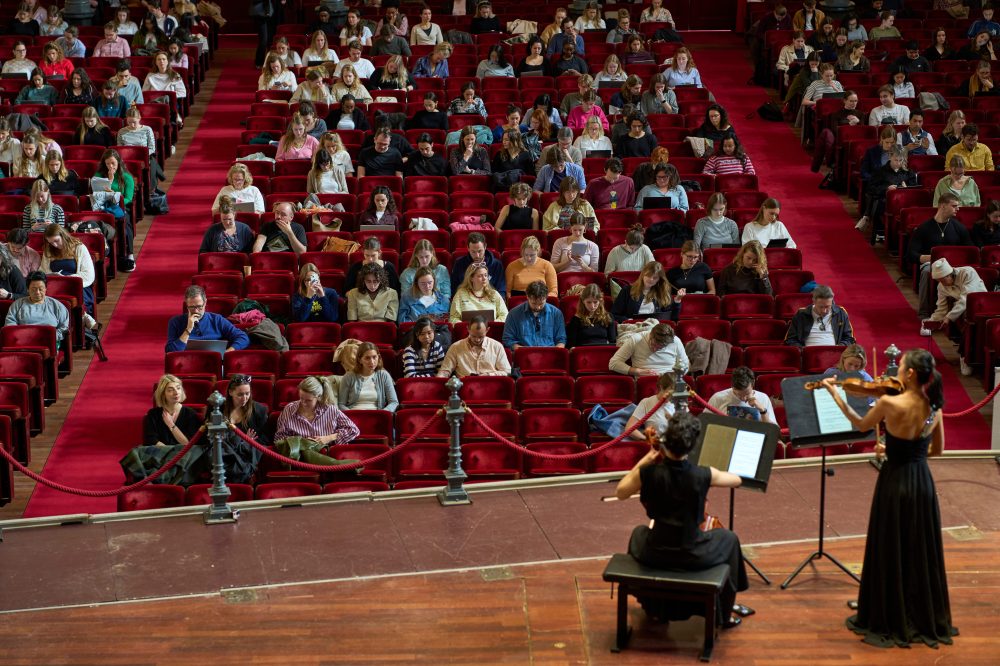

AMSTERDAM — Inside one of the world’s most renowned concert venues, students open laptops and textbooks while live classical music echoes through the ornate hall, creating an unusual but effective study environment.
At Amsterdam’s prestigious Concertgebouw, the luxurious crimson seats that typically hold concert-goers now accommodate college students preparing for finals and working on research papers. Musicians Hyunjin Cho on violin and Efstratia Chaloulakou on cello perform from the stage, but the audience isn’t expected to listen quietly — they’re supposed to study.
This innovative concept emerged during the coronavirus outbreak when Entree, the concert hall’s youth organization, launched the sessions to help students concentrate better while exposing them to classical compositions. The program has gained tremendous popularity since its inception.
During one recent gathering, performers played works including Johann Pachelbel’s famous Canon in D, pieces by Handel and Schubert, and even soundtrack selections from Studio Ghibli animated movies. The music resonated throughout the historic space, whose walls display golden nameplates honoring legendary composers like Ravel, Mahler, Wagner, and Mozart.
Twenty-one-year-old Kyra Mulder found the atmosphere beneficial while working on assignments for her occupational therapy program at Amsterdam University of Applied Sciences. “It’s actually very calming and helping in concentrating on the work that we have to do, which is something that surprises me because normally I don’t really listen to classical music,” Mulder explained. “So that’s a new experience for me.”
Throughout the performance, additional students entered carrying coffee cups alongside their electronic devices and textbooks, settling into seats with their materials balanced on their knees. Posted signs display the venue’s complimentary wireless internet password, and admission costs only 2.50 euros, equivalent to about $2.85.
Simon Reinink, the Concertgebouw’s general director, views these sessions as part of broader efforts to attract younger patrons. “It’s one of the many ways to welcome younger audiences to the Concertgebouw,” Reinink stated. “And it’s such an inspiring place to study with great music in this wonderful, beautiful environment.”
Reinink hopes participants will not only benefit academically but also develop an appreciation for classical music that brings them back as regular audience members. “It is one of ways to more or less seduce younger audiences to discover the Concertgebouw and hopefully they will be enthusiastic and … they will come back,” he explained.
Dr. Bas Bloem, a neurologist at Radboud University Medical Center in Nijmegen, Netherlands, notes that background music affects people differently regarding concentration. “So it’s not a one size fits all. And I don’t think it’s been well researched, but I think the reason why music in the background can be so soothing almost, is that it creates a state of flow,” Bloem told The Associated Press.
“And I think music in the background can help you to reach a state of flow. And everybody knows when you reach a state of flow, you can go on endlessly and be enormously productive,” he added.
Medical student Thijmen Broekman discovered that combining the musical backdrop with studying in an unfamiliar location enhanced both his learning experience and musical enjoyment simultaneously. He reported no difficulty balancing listening and studying. “It’s a really quiet environment and nice, quiet music,” Broekman noted. “So that helps me to concentrate.”