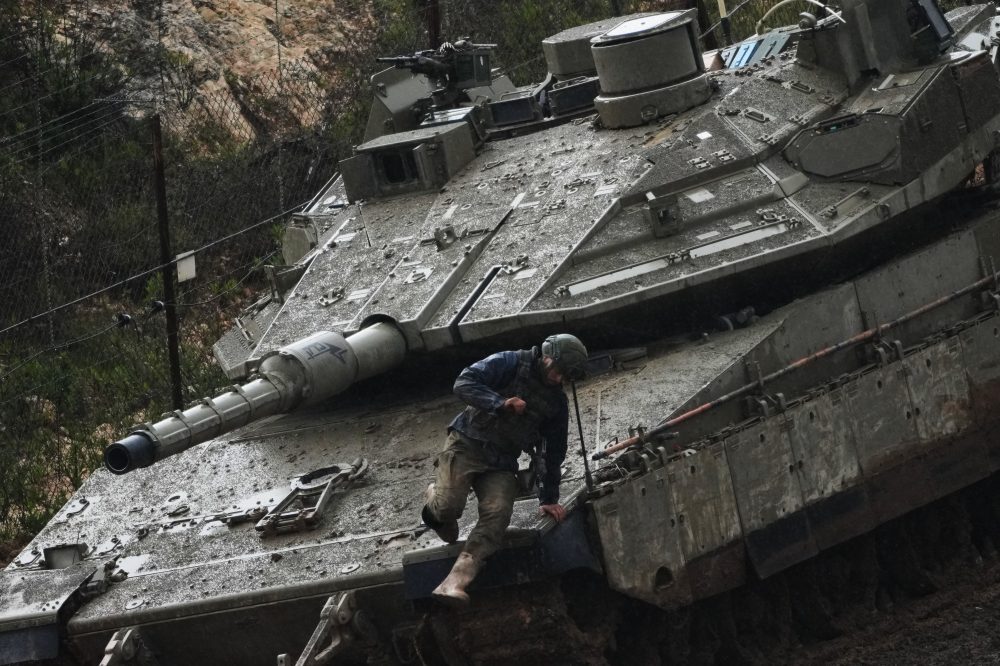

BEIRUT (AP) — Israeli officials are signaling plans for a prolonged military occupation of southern Lebanon, drawing comparisons to their devastating campaign in Gaza following Hamas’ October 7, 2023 assault, as fighting intensifies between Israeli forces and Hezbollah militants.
Israeli leadership argues they must establish a controlled buffer zone in the evacuated southern region to protect northern Israeli communities that have endured continuous rocket bombardments since the Iran-supported Hezbollah organization entered the broader conflict. Lebanese residents worry this strategy could result in the indefinite displacement of more than one million civilians, widespread destruction of residential areas, and permanent territorial losses.
Defense Minister Israel Katz announced this week that Israeli forces would establish a “security zone” extending to the Litani River, reaching approximately 30 kilometers (20 miles) from the border in certain areas. Katz stated that military units would demolish residential structures allegedly used by militants and prevent civilian returns until northern Israel achieves security.
The operation would replicate Israel’s Gaza strategy, where military forces devastated and evacuated much of the eastern portion of the Palestinian territory, Katz explained on Tuesday. Israeli officials have declared they will maintain their presence in the enclave until Hamas surrenders weapons as part of a U.S.-mediated ceasefire agreement.
“We have ordered an acceleration in the destruction of Lebanese homes in contact-line villages to neutralize threats to Israeli communities, in accordance with the model of Beit Hanoun and Rafah in Gaza,” Katz stated, referencing border communities that suffered near-complete destruction.
Following a 2024 ceasefire that ended Israel’s previous conflict with Hezbollah, Israeli military units slowly retreated from southern Lebanon while maintaining control of five strategic elevated positions along the border.
Returning Lebanese discovered destroyed homes, damaged infrastructure, and completely demolished villages. Israeli officials claimed they had eliminated Hezbollah military installations that could facilitate an October 7-style assault and continued targeting suspected militant locations almost daily following the truce.
Hezbollah renewed its offensive operations after Israel and the United States initiated conflict with Iran on February 28, claiming Israel had repeatedly broken ceasefire terms. Israeli officials accused Lebanon’s government of failing to fulfill commitments to disarm Hezbollah, despite taking unprecedented measures to criminalize the organization.
During the current hostilities, Israel has conducted intensive aerial bombardments throughout Lebanon, resulting in over 1,000 fatalities — primarily outside border regions — and forcing more than one million people from their homes. Israeli forces have instructed residents to evacuate extensive southern areas, stretching from the border to the Zahrani River, approximately 55 kilometers (34 miles) inland.
While Israeli military commanders describe their ground operations as limited, political leadership discusses more expansive objectives.
Finance Minister Bezalel Smotrich, a far-right cabinet member, declared this week that the current conflict must conclude with “fundamental change.”
“The Litani must be our new border with the state of Lebanon,” Smotrich said.
Israel previously invaded southern Lebanon in 1982 during the nation’s civil conflict. Hezbollah, formed that same year, conducted guerrilla warfare that ultimately forced Israeli withdrawal in 2000.
In the current campaign, Israel has destroyed seven bridges crossing the Litani River, marking the northern boundary of a U.N.-monitored buffer zone created after earlier conflicts. Israeli officials claim Hezbollah utilized these bridges for transporting fighters and weapons, and that their military will oversee remaining crossing points.
Intense combat has erupted in Khiam town, whose capture would isolate the south from Lebanon’s eastern Bekaa Valley, another region with significant Hezbollah activity.
Following the bridge bombings, Lebanese President Joseph Aoun accused Israel of attempting to separate the south from the remainder of the country “to establish a buffer zone, entrench the reality of occupation, and pursue Israeli expansion within Lebanese territories.”
United Nations peacekeepers report that bridge destruction and continuing battles have disrupted their missions and endangered personnel safety.
“This is the closest fighting activity we have seen to our positions,” stated Kandice Ardel, spokesperson for the U.N. mission called UNIFIL. “Bullets, fragments, and shrapnel have hit buildings and open areas inside our headquarters.”
Ardel noted that peacekeepers at observation stations have witnessed increasing Israeli troop presence and “engineering assets,” though no new military installations have been constructed yet.
Mohanad Hage Ali, a senior researcher at the Carnegie Middle East Center in Beirut, said Israel has already established “different shades” of control.
“The first line of borders is a no-man zone. This is basically a large parking lot that is facing Israel,” Ali explained. “There is nothing there, no movement, nothing at all.”
Lebanese civilian movement faces restrictions further north. During the previous year’s olive harvest, agricultural workers encountered difficulties reaching their orchards due to frequent Israeli attacks and required escorts from Lebanese military units and UNIFIL peacekeepers, who coordinated with Israel.
Sarit Zehavi, founder and president of the Alma Institute and former Israeli military officer, predicted Israel would likely establish a more comprehensive controlled area extending further north.
Zehavi admitted that Israel was unlikely to eliminate Hezbollah and risked maintaining a permanent presence in southern Lebanon.
“But the other alternative is to take the risk that we will be slaughtered. It’s as simple as that,” she stated.
Lebanon’s government has abandoned longstanding diplomatic restrictions by proposing direct negotiations with Israel. Officials have also implemented measures against Hezbollah since the last conflict, outlawing its operations and claiming to have eliminated hundreds of military installations.
However, neither the United States nor Israel has demonstrated interest in such discussions while focusing on the broader Iranian conflict.
Should negotiations materialize, Israel could demand significant concessions in exchange for relinquishing militarily captured territory — a modernized version of the historical “land for peace” approach.
Israel has occupied portions of Syria following Syrian President Bashar Assad’s removal and is negotiating with Damascus’ new leadership regarding updated security arrangements. In Gaza, Israeli officials have pledged to retain half the territory until the militant Palestinian Hamas organization surrenders its weapons, as both sides accuse each other of violating the October truce.
Lebanese civilians who abandoned their homes remain in uncertainty — with some fearing permanent exile.
Elias Konsol and his neighbors evacuated the Christian border village of Alma al-Shaab with UNIFIL assistance. He reunited with his mother, who wept in his embrace, at a church near Beirut where funeral services honored a resident killed in an Israeli attack.
Konsol insisted there were no weapons or Hezbollah fighters in his village, yet evacuation was still mandatory.
“We no longer know our fate,” he said. “We don’t know if we will see our homes and village again.”