
MACAPA, Brazil — Highway construction crews building roads through Brazil’s Amazon rainforest have stumbled upon remarkable archaeological treasures that shed new light on the region’s Indigenous history thousands of years before European contact.
Workers expanding the BR-156 highway in Brazil’s Amapa state have uncovered nine archaeological sites containing pottery vessels believed to be burial urns and small carved objects resembling human faces. The mandatory archaeological surveys required before road construction have revealed evidence of complex Indigenous societies that thrived long before Columbus reached the Americas.
“What we now about the region’s past is also tied to the opening created by these projects, which gives our relationship with them a somewhat ambivalent character,” explained Lúcio Flávio Costa Leite, director of the Archaeological Research Center at Amapa’s Institute for Scientific and Technological Research. “At the same time, the knowledge we gain about these sites leads us to pay closer attention to these regions, including by adopting permanent protection measures.”
The excavated pottery displays various styles and crafting methods that demonstrate cultural connections stretching from Brazil’s Para state all the way to Caribbean communities, challenging earlier assumptions that the Amazon was sparsely populated before European arrival.
Archaeological team member Manoel Fabiano da Silva Santos, working with Brazil’s National Department of Transport Infrastructure, described the soil layers as a chronological record of human occupation.
Santos discovered Portuguese ceramics and metal fasteners in the surface layers, evidence of European settlement. “Digging deeper, we uncovered pottery and ceramics associated with earlier Indigenous presence, marking the site’s transition before and after the arrival of colonizers,” Santos explained.
The recovered artifacts will join Amapa’s state archaeological collection, which Costa Leite oversees and contains approximately 530,000 items. The collection’s most ancient piece dates to roughly 6,140 years ago, demonstrating continuous human habitation throughout Amapa’s history.
These discoveries provide valuable information about how early Indigenous groups lived, conducted burials, and interacted with their rainforest environment.
“Here is something I often debate with my students — we usually think of technology as computers and microchips,” Costa Leite noted while examining shelves of ancient ceramics. “But all of this required careful reading of the landscape and deliberate choices of materials.”
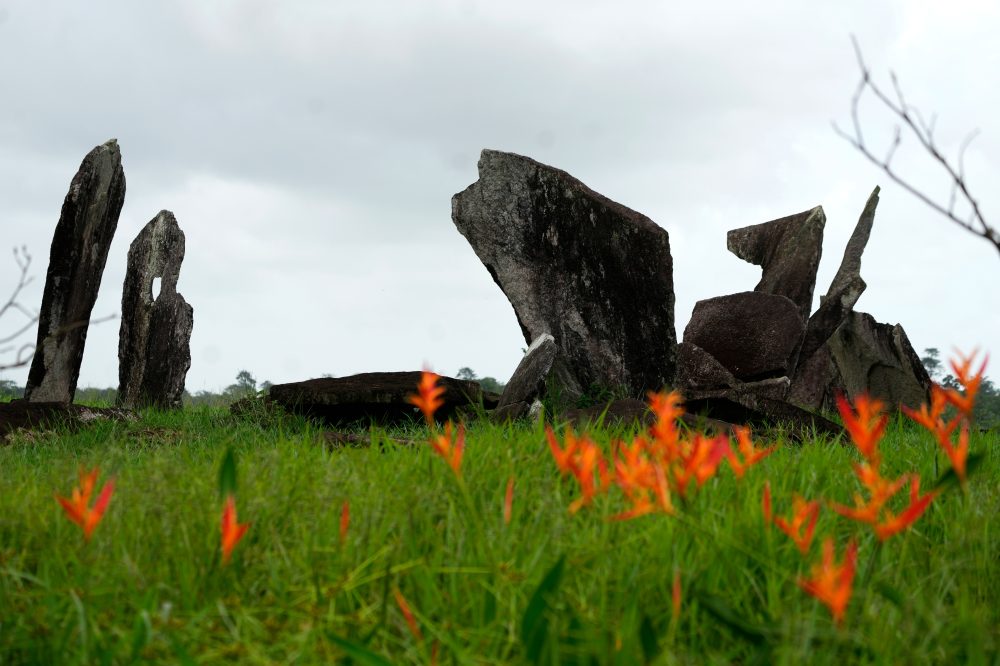
Among Amapa’s most remarkable archaeological sites is located in Calcoene, featuring a thousand-year-old stone circle comprising 127 carved standing stones arranged in a 30-meter diameter formation. The monument sits in grassland surrounded by rainforest near a meandering river.
This Archaeological Park of the Solstice has earned the nickname “Stonehenge of the Amazon” due to similarities with the famous British landmark. Research led by archaeologist Mariana Petry Cabral from the Federal University of Minas Gerais revealed that the stones were deliberately positioned to mark the sunrise during the Northern Hemisphere’s winter solstice.
“It’s hard to say exactly what all the stones mean, but what we do know is that they are not from the site itself. They were brought from other nearby locations,” Cabral noted.
Further investigation revealed the site also functioned as a cemetery, with radiocarbon analysis showing continuous use for hundreds of years starting approximately 1,100 years ago.
Scientists discovered the site in 2005, and visitors can tour it with advance permission from Amapa’s Institute for Scientific and Technological Research. Plans are underway to designate it as a national park, which would increase public access.
Brazilian law protects all archaeological locations from alteration, providing additional safeguards for the surrounding rainforest ecosystem.
Current archaeological and ecological research demonstrates that Indigenous peoples not only inhabited the Amazon for millennia but actively managed its landscape through sustainable long-term practices, according to Eduardo Neves, an archaeology professor at the University of Sao Paulo.
Neves has spent over three decades studying Amazon archaeology and currently directs the Amazon Revealed project, which began in 2023 and uses satellite technology to locate archaeological sites hidden beneath the forest canopy.
Satellite imagery has revealed roadway systems connecting archaeological locations and buried landscape patterns indicating repeated settlement and intentional environmental modification. These features suggest the existence of large population centers, Neves explained.
While archaeologists had theorized about such connections, modern technology has revealed their extensive geographic scope. The scans show road networks linking settlement clusters throughout the forest, particularly visible in southern Amazonas state and Acre.
“When people think of an Indigenous tribe, they often imagine a small village isolated in the middle of the forest. But evidence shows a high degree of interconnectivity linking different settlements,” Neves said.
“Amapa is a key piece that helps us see how dynamic and active these populations were, and how they maintained networks of exchange that have been in place for millennia,” Cabral added.