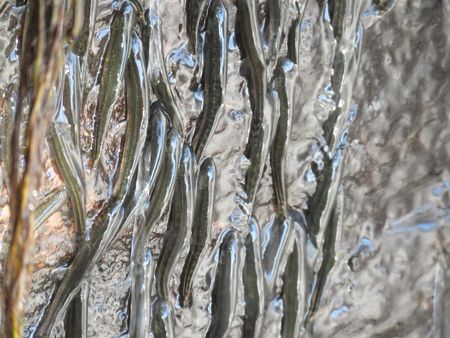

Scientists have witnessed an extraordinary sight in Central Africa: thousands of tiny fish scaling a towering 50-foot waterfall using nothing but their fins and determination.
Researchers studying the upper Congo Basin documented this remarkable behavior in a species called Parakneria thysi, commonly known as shellear fish. These aquatic acrobats tackle the vertical face of Luvilombo Falls during seasonal flooding periods in April and May.
The climbing fish measure just 1.5 to 1.9 inches in length – only the smaller members of the species attempt this feat. Larger fish, which can grow up to 3.9 inches, appear too heavy to support their own weight during the ascent.
The journey to the summit requires nearly 10 hours of grueling effort. The fish move in brief spurts followed by rest periods, navigating through areas moistened by waterfall spray rather than direct water flow.
Lead researcher Pacifique Kiwele from the Université de Lubumbashi explained the significance of this finding: “This discovery highlights the importance of maintaining the continuity of watercourses, particularly in the context of the Congo Basin, where studies on fish behaviour are virtually nonexistent.”
Kiwele emphasized the wonder of the discovery, stating: “It prompts scientists to be even more vigilant in their observations, as anything is possible. Who would have believed it without being close enough to check, and document it with photographic and film material, that indeed some fish are able to climb waterfalls? It illustrates that there are wonders out there that surpass our imagination.”
While other fish species worldwide have demonstrated waterfall-climbing abilities, this marks the first documented case in Africa, according to the research team.
The scientists captured this behavior on four separate occasions during 2018 and 2020, publishing their findings in Scientific Reports journal.
The climbing technique involves using pectoral fins to grasp wet rock surfaces, with pelvic fins providing additional support. Tiny hook-shaped structures called unculi help secure their grip, while side-to-side body movements propel them upward.
To put this achievement in perspective, if scaled to human proportions, it would equal a person climbing hundreds of feet straight up.
The ascent carries significant risks. Sudden water bursts can dislodge climbing fish, especially when they must flip upside down to navigate overhanging rock sections. While fish falling into the pool below can likely attempt another climb, those landing on rocks may face fatal injuries.
Scientists believe the fish undertake this challenging journey to reach upstream areas with better living conditions, reduced competition, and fewer predators.
The species faces two primary human-related threats: illegal fishing operations using fine-mesh mosquito nets that easily capture the small fish, and water diversion for irrigation that has sometimes left the Luvilombo River severely depleted.
This finding underscores how much remains unknown about fish behavior throughout the Congo Basin region.
“It is quite possible that other fish species living in rapid habitats are capable of overcoming similar vertical obstacles,” Kiwele noted, revealing plans for additional research to investigate preliminary observations of climbing behavior in other fish families.