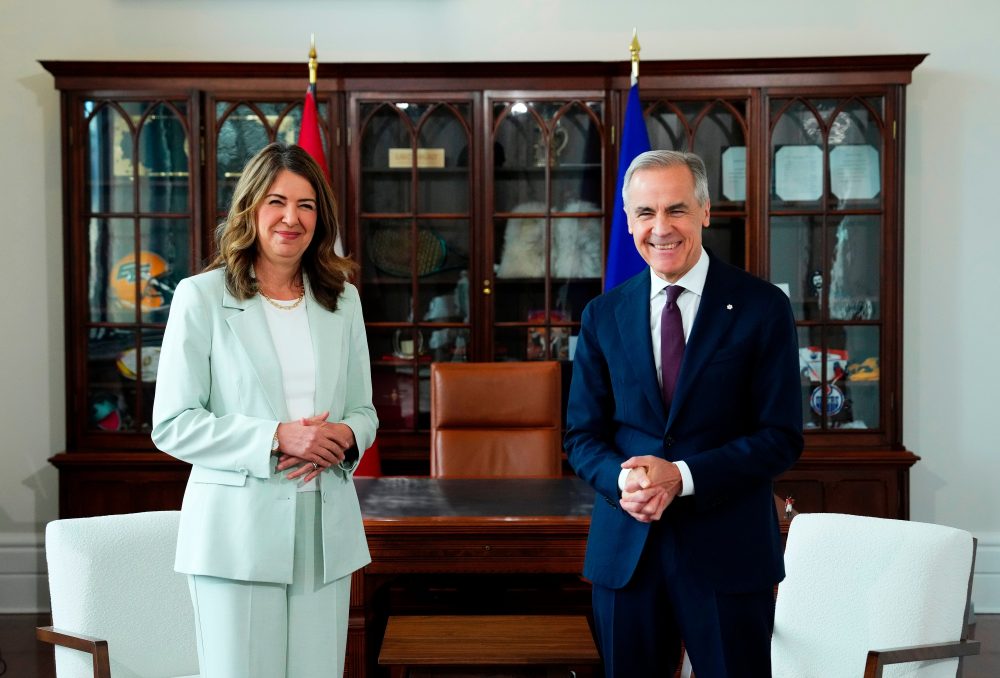

Canada’s petroleum-wealthy Alberta province has announced plans for an October public vote regarding potential separation from Canada, though the province’s top official clarified Thursday that the ballot won’t directly address independence.
Danielle Smith explained that citizens would instead decide whether the time has come for a binding referendum on departing Canada.
“I want to be clear. I support Alberta remaining in Canada, and this is how I would vote on separation in a provincial referendum. It is also the position of my government,” Smith stated during broadcast comments.
The ballot measure will ask whether Alberta should continue as part of Canada or pursue constitutional legal measures toward conducting a binding independence referendum.
Even a “yes” result in such a binding vote would not automatically create independence. Federal government negotiations would be required. According to a 1998 Supreme Court decision, provinces lack authority to withdraw from Canada unilaterally.
Daniel Béland, a political science professor at McGill University in Montreal, observed that Smith has publicly rejected independence, leading some to draw parallels with Britain’s former Prime Minister David Cameron before the Brexit referendum, which he supported as a method to handle a vocal party faction despite opposing U.K. departure from the European Union.
“Politically Smith seems committed to do so to appease supporters of her own party who want a referendum. If she doesn’t follow suit, she might face a potentially perilous mutiny within her partisan ranks,” Béland stated.
Thursday morning saw three United Conservative Party of Alberta caucus members approve a committee motion requesting Smith and her cabinet schedule the referendum for Oct. 19.
Prime Minister Mark Carney’s federal Liberal government had not immediately responded to Smith’s declaration.
Carney has been collaborating with Smith on Pacific coast oil pipeline construction aimed at satisfying many Albertans.
“As part of his emphasis on economic development in the aftermath of the trade war between Canada and the U.S., Mark Carney is clearly more favorable to pipeline building and the energy industry than his predecessor Justin Trudeau,” Béland noted.
Béland predicted referendum failure.
“Support for Alberta independence is slightly below 30% and the percentage of people truly committed to the cause is below 20% according to polling data so the odds of a ‘yes’ vote appear to be very low right now but campaigns matter,” he explained.
Opposition Federal Conservative Leader Pierre Poilievre previously stated that he and all Conservative Parliament members would advocate for Alberta’s continued Canadian membership during any referendum campaign.