
(Editor’s note: John Hall works as a professional commodities analyst.)
Over the last five weeks, I’ve been providing information designed to help farmers with their 2026 crop planning choices. Today, I’m focusing on corn market dynamics – both supply and consumption patterns. The information presented comes from WASDE reports, with production figures shown in million metric tonnes.
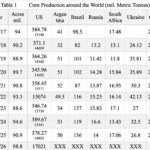
My first analysis examines global corn production locations. I’ve also added U.S. acreage planted and production measured in million bushels.
Key observations include:
• China ranked as the world’s second-largest corn producer. The country relies on corn primarily to support its massive pig farming operations.
• While Argentina’s output remains steady, Brazil shows signs of growth. Brazilian reports indicate their expanding ethanol sector might absorb most of their increased production.
• Russia and Ukraine present a notable situation. The conflict that started in 2014 and intensified in February 2022 has disrupted their export capabilities, particularly after bombing campaigns targeted ports and affected grain market stability.
Moving to domestic consumption patterns, USDA maintains reliable statistics for Feed and Seed, Ethanol, and Exports, though feed and residual data proves more challenging to track. The 2017-18 and 2025-26 feed usage numbers appear questionable, so they shouldn’t be overanalyzed. These represent the most accurate estimates currently available.
Food, seed, and ethanol sectors remain relatively stable, while exports show modest growth for 2025-26. Media reports suggest expanded E15 usage could boost ethanol consumption.
The U.S. Treasury Department has issued updates indicating that usage revisions may result from the One Big Beautiful Bill expected later this year.
Examining America’s corn export rivals reveals that overall global exports have stayed fairly constant. With world population growth slowing, increased sales must come at competitors’ expense. The United States shows notable growth in 2024-25.
I credit this improvement to recent trade agreements. While some major trading partners had shifted to competitors, these trade deals have brought them back. The data clearly shows how the Russian-Ukraine war impacted their export volumes. Our main challenge in serving their former customers involves distance and shipping costs to those markets.
Looking at worldwide corn buyers, most of these purchasing nations maintain friendly relationships with the United States. I believe we previously lost some business due to higher prices, but we’ve recovered most of those sales through strategic trade agreements.
Our analysis concludes with ending stock levels. The data shows U.S. ending stocks in both metric tonnes and millions of bushels. I’ve included USDA’s average price information as reference to demonstrate the typical pattern: when ending stocks drop, prices generally rise, and when stocks increase, prices typically fall.
China controls nearly two-thirds of global ending stocks. The country takes food security very seriously since it requires depending on other nations. Their food security approach has transformed from strict, government-controlled self-reliance (1949–1970s) to a market-based strategy emphasizing “absolute security of staple foods.”
Under President Xi Jinping’s leadership, the strategy emphasizes 95-percent grain self-sufficiency, rigorous farmland conservation, and agricultural innovation, shifting from quantity-focused to quality and diversification priorities. In 2004, a new strategy emerged prioritizing “guaranteed supply” through international commerce while maintaining tight control over domestic wheat and rice production. Consequently, the government maintains a year’s worth of grain reserves and distributes it to farmers gradually. This approach also enables them to regulate farmer pricing.
I realize this represents substantial information. I intend to reference this material in upcoming discussions to assist with your planting choices.
(Note: I compile research from Allendale, DTN, USDA, University Land Grants and other reliable sources for this article. This represents not just my personal view, but a consensus among trade experts. Seeking a marketing advisor or strategy discussions? Reach me at [email protected], or call 410-708-8781.)