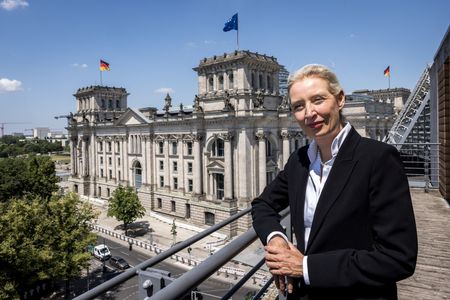

BERLIN — The head of Germany’s far-right Alternative for Germany party is pushing for a resumption of Russian energy imports, arguing that cutting ties with Moscow has crippled the German economy and cost hundreds of thousands of jobs.
Alice Weidel, the AfD’s leader, told Reuters that Germany must abandon its boycott of Russian oil and gas to revive an economy that has been struggling since sanctions were imposed following Russia’s 2022 invasion of Ukraine.
“Cheap energy from Russia was the secret of the success of ‘Made in Germany’. We need it back,” Weidel said. “The loss of this energy has set us back years. Hundreds of thousands of jobs have been lost. It has made us dependent on the United States, which sells us energy at far higher prices.”
Before sanctions took effect, Russia provided more than a third of Germany’s crude oil imports and over half of its natural gas supply. The situation worsened further when the undersea Nord Stream pipeline was destroyed by explosions in September 2022, sending energy costs soaring and leaving German industry reeling.
The economic fallout continues to weigh heavily on Germany. Car manufacturer Volkswagen is reportedly weighing cuts of up to 100,000 positions as the industrial sector remains in a prolonged slump.
Weidel’s remarks come ahead of September elections in two eastern German states — Saxony-Anhalt and Mecklenburg-Vorpommern — where the AfD currently leads in polling. She described those contests as crucial stepping stones toward national leadership.
“Saxony-Anhalt and Mecklenburg-Vorpommern are decisive milestones,” Weidel said. “If we win in Saxony-Anhalt, then Mecklenburg-Vorpommern will probably follow. I can see the AfD in the chancellery either by the next elections or the ones after.”
If the AfD gains control of those state governments, the party would use that power to challenge Berlin’s immigration policies, which the AfD considers overly generous and a financial burden on local governments. It would also disrupt Germany’s tradition of broad coalition governance and give the AfD a significant foothold toward national rule.
Mainstream parties, including the Christian Democrats led by Chancellor Friedrich Merz, have refused to work with the AfD. An AfD victory in Saxony-Anhalt would put pressure on what political observers have called a “firewall” — the agreement among established parties to keep the AfD out of governing coalitions.
The AfD’s pro-Russia message may carry particular weight in eastern Germany, a region that was under Soviet control until the fall of the Berlin Wall more than 35 years ago. Many residents there hold a more favorable view of Russia and are skeptical of the United States.
Weidel’s statements follow a recent visit to Russia by senior AfD lawmaker Markus Frohnmaier, who met with Alexei Miller, the chief of Russian energy company Gazprom, and called for the Nord Stream pipeline to be reopened. Frohnmaier pushed back against criticism of the trip, noting that American investors were reportedly exploring the possibility of reviving the Nord Stream route.
“We have to be careful in Germany that we don’t miss the window of opportunity to get back into the Russian market,” Frohnmaier said. “Mr. Miller said it would take a three-month timeframe for the gas supply to be resumed.”
Not everyone is receptive to the AfD’s position. Roderich Kiesewetter, a lawmaker from the Christian Democrats, accused the AfD of distorting public debate with its stance on Russia.
“The romanticisation of Russia is being used by the AfD, in particular with an eye on the upcoming elections in eastern Germany,” Kiesewetter said.
Weidel rejected characterizations of her party as extremist — a label applied by Germany’s domestic intelligence agency last year — insisting the AfD represents ordinary citizens.
“The way we see ourselves and the way our political rivals judge us, are miles apart,” she said. “People describe us as far-right. In truth, we are a party for the regular person. We will not turn everything on its head if we get into power.”