
COPENHAGEN, Denmark (AP) — Marine archaeologists working in Copenhagen Harbor have located the remains of a Danish warship that went down more than two centuries ago during a fierce battle with Admiral Horatio Nelson’s British naval forces.
Divers are racing against time to excavate the wreckage of the Dannebroge, working through thick mud and near-zero visibility conditions 49 feet below the surface. The excavation site will soon become part of a massive housing development project along Denmark’s coastline.
Denmark’s Viking Ship Museum, overseeing the extensive underwater dig, revealed their discovery on Thursday – marking exactly 225 years since the 1801 Battle of Copenhagen took place.
“It’s a big part of the Danish national feeling,” said Morten Johansen, the museum’s head of maritime archaeology.
While much has been documented about the historic confrontation “by very enthusiastic spectators, but we actually don’t know how it was to be onboard a ship being shot to pieces by English warships and some of that story we can probably learn from seeing the wreck,” Johansen explained.
During the Battle of Copenhagen, Nelson’s British forces launched an assault on Denmark’s naval defenses that had formed a protective barrier around the harbor entrance.
The devastating maritime confrontation lasted several hours and resulted in thousands of casualties, earning recognition as one of Nelson’s most significant victories. Britain’s goal was to break up Denmark’s participation in a coalition that included Russia, Prussia and Sweden.
The Danish flagship Dannebroge, under the command of Commodore Olfert Fischer, found itself at the heart of the intense fighting.
Nelson’s forces concentrated their attack on the 157-foot vessel. Artillery bombardment devastated the ship’s upper sections before explosive rounds ignited fires throughout the vessel.
“(It was) a nightmare to be on board one of these ships,” Johansen noted. “When a cannonball hits a ship, it’s not the cannonball that does the most damage to the crew, it’s wooden splinters flying everywhere, very much like grenade debris.”
The confrontation reportedly gave rise to the expression “to turn a blind eye.” Nelson, who had lost vision in his right eye, allegedly stated after choosing to disregard orders from a commanding officer: “I have only one eye, I have a right to be blind sometimes.”
Nelson ultimately proposed a temporary halt to fighting, and Denmark’s Crown Prince Frederik later agreed to end hostilities.
The badly damaged Dannebroge floated northward before a massive explosion destroyed what remained. Historical accounts describe the blast as creating thunderous noise that echoed throughout Copenhagen.
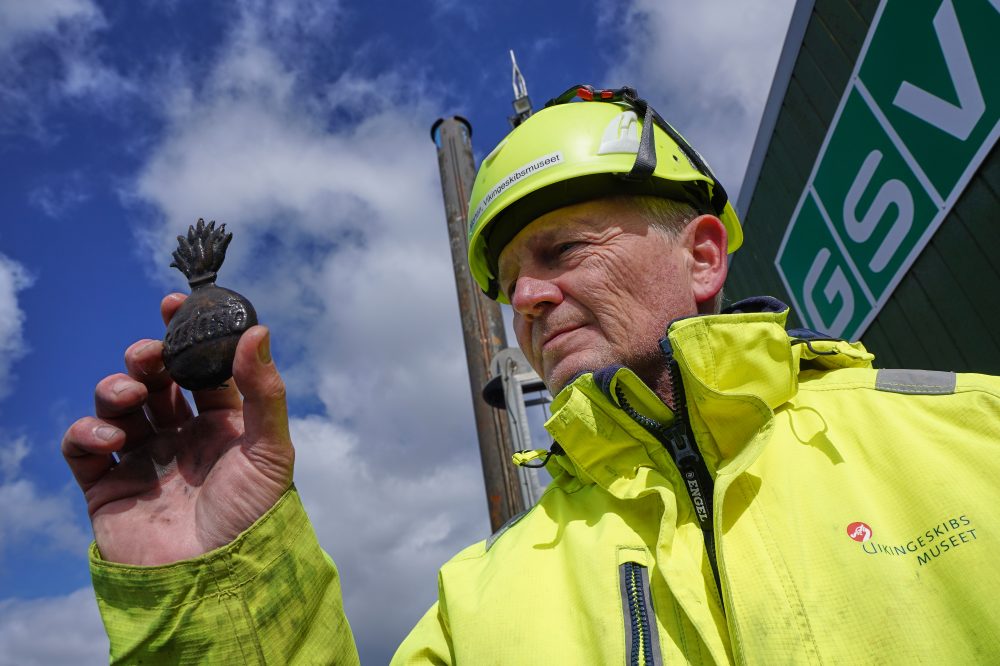
Underwater excavation teams have recovered two artillery pieces, military clothing, rank insignia, footwear, glass containers and even a portion of a sailor’s jawbone – possibly belonging to one of 19 crew members still listed as missing from that fateful day.
The archaeological site will eventually be covered by construction activities for Lynetteholm, an ambitious development plan to create a new residential area within Copenhagen Harbor, with completion scheduled for 2070.
Maritime archaeology teams started surveying the location in late 2023, focusing on an area believed to correspond with historical records of the flagship’s final resting place.
Researchers confirm that recovered timber dimensions align with historical ship blueprints. Tree ring analysis of the wood samples corresponds to the vessel’s original construction date. The excavation area contains numerous cannonballs, creating additional challenges for divers working through murky water filled with disturbed sediment.
“Sometimes you can’t see anything, and then you really have to just feel your way, look with your fingers instead of with your eyes,” explained diver and maritime archaeologist Marie Jonsson.
The 1801 naval engagement has become a cornerstone of Danish historical identity, documented extensively in literature and artwork.
Research teams believe their findings could provide fresh perspectives on this pivotal moment in Scandinavian history while revealing intimate details about the individuals who participated in the battle two and a quarter centuries ago.
“There are bottles, there are ceramics, and even pieces of basketry,” Jonsson observed. “You get closer to the people onboard.”