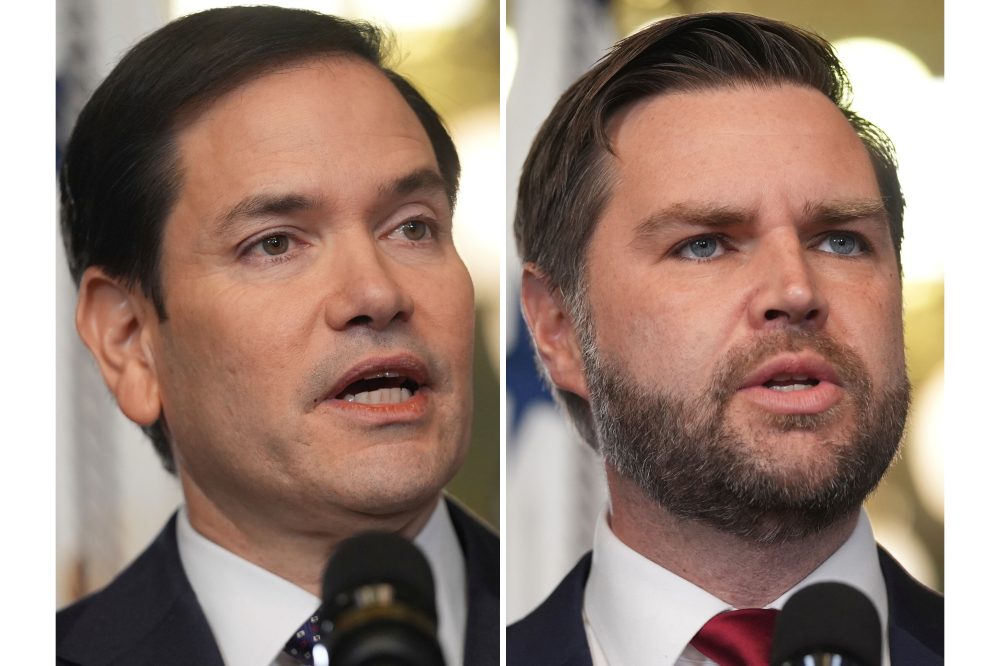

WASHINGTON — During a recent Cabinet briefing, President Donald Trump requested updates on the Iran conflict from two of his top officials who are widely viewed as leading contenders for the 2028 Republican presidential nomination.
Secretary of State Marco Rubio delivered a forceful endorsement of the military action, describing it as “a favor” to both America and the global community. His hawkish stance contrasted sharply with Vice President JD Vance’s more measured response.
Vance, who has historically advocated for limiting American military involvement abroad, offered a restrained assessment. He noted that America now possesses “options” that weren’t available previously and emphasized preventing Iran from acquiring nuclear capabilities before shifting the conversation to Easter greetings for deployed service members.
This Cabinet room moment captured the fundamental differences between two politicians who must navigate their current administrative duties while positioning themselves for future campaigns. Republican presidential hopefuls are already beginning quiet outreach efforts in crucial early primary states like New Hampshire.
Curt Mills, who leads “The American Conservative” magazine and opposes the Iran conflict, observed the stark contrast in their approaches. “It’s very obvious from the way that Rubio talks about Iran and the way that Vance talks about Iran that they are of different casts of mind,” Mills explained. He noted that Vance appeared to be “literally trying to talk about anything else other than the war” when he pivoted to Easter discussions.
Neither Vance’s office nor the State Department provided responses to requests for comment, though officials referenced previous remarks where Rubio expressed hope that Vance would seek the presidency while not ruling out his own candidacy.
The political implications for both men remain uncertain as the 2028 race approaches. Rubio’s strong war support could become problematic depending on how the conflict evolves, while Vance risks appearing disloyal if he distances himself too far from Trump’s policies.
Vance, an Iraq War veteran, maintains that Iran must not obtain nuclear weapons while continuing to express skepticism about foreign interventions. Trump has acknowledged their philosophical differences, telling reporters that Vance was “philosophically a little bit different than me” when the Iran operation began.
“I think he was maybe less enthusiastic about going, but he was quite enthusiastic,” Trump stated.
When reporters have pressed Vance about his Iran views during public appearances, he has deflected questions. During a March 13 North Carolina visit, he twice avoided direct answers about potential concerns, stating it was crucial that Trump could consult advisers “without his team then running their mouths to the American media.”
Days later at the White House, Vance accused a reporter of “trying to drive a wedge between members of the administration, between me and the president” when asked about his position.
Rubio’s support for aggressive foreign policy predates his diplomatic role. Early in the Iran conflict, he called Trump’s decision “a wise decision,” insisted there “absolutely was an imminent threat” from Iran, and declared the operation “needed to happen.”
Recent polling from The Associated Press-NORC Center reveals Republican divisions on Iran policy, with roughly half saying military action has been appropriate. About 20% believe it hasn’t gone far enough, while approximately 25% think it’s excessive.
At Vance’s North Carolina event, 62-year-old Alice Swanson expressed interest in seeing both men run together in 2028 but favored the vice president. “I think he fully believes and supports exactly what his convictions are,” Swanson said, while acknowledging Vance’s quieter stance since the war began. “I can see both sides,” she added while supporting Trump’s decisions.
Tracy Brill, also 62 and from Rocky Mount, praised Rubio but declared, “I love JD Vance.” She defended politicians changing positions, noting “They’ve all changed their positions at one point or another.”
However, at the recent Conservative Political Action Conference, 72-year-old retired military contractor Joe Ropar from McKinney, Texas, said Rubio’s unwavering Iran support influenced his 2028 preference. “I’m not looking at JD Vance for president, and it’s for stuff like that,” Ropar explained. “I don’t 100% trust him.”
Benjamin Williams, a 25-year-old marketing specialist from Austin working with Young Americans for Liberty, believes both Trump and Vance are “tied to this war” and is considering other potential candidates.
Former New Hampshire Governor Chris Sununu anticipates roughly six prominent Republicans will enter the 2028 contest. Both Sununu and former RNC Committeewoman Juliana Bergeron confirmed that multiple prospective candidates have contacted them recently about New Hampshire’s political landscape, though they declined to identify specific individuals.
Republican strategist Jim Merrill, who advised Rubio’s 2016 New Hampshire campaign, predicts Iran will become a major 2028 issue similar to how Iraq affected Democratic primaries in 2004 and 2008. “If for some reason things don’t go as anticipated, there will be contrasts drawn,” he said.
Despite their differences, Sununu questions whether Iran policy will significantly distinguish Vance and Rubio given their shared administration roles. He believes both will claim credit for success or share blame for failure. “They’re tied together with the success or failure of Iran. It doesn’t really separate one versus the other, at least I don’t think that’s how the electorate will see it,” Sununu concluded.