
NEW YORK — When the dust settles on the 2026 World Cup, the tournament’s biggest legacy may not be the name of the champion, but rather a question left unanswered: how much of soccer’s American-style transformation will stick once the games move out of North America?
Throughout the competition, FIFA leaned heavily into elements borrowed from U.S. sports culture. Mandatory water breaks effectively carved each match into four segments. The winning team walked away with championship rings. The final featured a full halftime entertainment production. For many longtime soccer fans, the sport they knew was beginning to look like something else entirely.
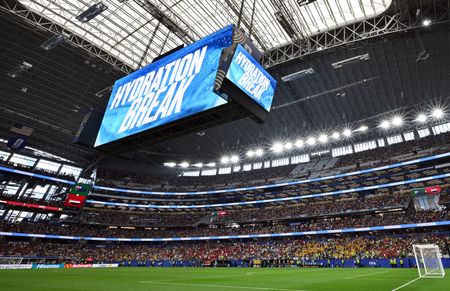
The mid-match breaks were officially justified as a player welfare measure, given the heat and humidity of a North American summer. But once in place, they took on a life of their own. Coaches used them as tactical timeouts. Broadcasters recognized them as natural commercial opportunities. And supporters accustomed to the uninterrupted flow of the game found themselves watching something that felt more like four quarters than two halves.
Whether those breaks become a permanent fixture is now a serious question in soccer circles. FIFA has a ready-made argument for keeping them — player safety — and the commercial value of guaranteed mid-half pauses is not lost on the sport’s decision-makers. But the idea would face fierce pushback in Europe, where uninterrupted play is considered a core part of the game’s identity. UEFA has already made clear it will not allow hydration breaks lasting longer than one minute under its own rules.
The halftime show at the final ran 27 minutes — nearly double the traditional 15-minute break — and drew inevitable comparisons to the Super Bowl. Spain, the winning nation, received championship rings in a ceremony that felt straight out of North American professional sports. Neither change altered how the game is actually played, but together they reinforced the impression that FIFA was not simply hosting the World Cup in the United States — it was reshaping the World Cup to fit American sporting expectations.
There was a certain irony at play. American host cities witnessed firsthand what makes international soccer unique: massive traveling fan groups, city centers draped in national flags, supporters singing for hours before and after matches, and national teams carrying a sense of cultural identity that no franchise-based sports league can easily replicate. The U.S. appeared to be soaking in soccer’s global culture even as FIFA was busy importing American entertainment values into the sport.
Politics also cast a long shadow over the tournament. FIFA President Gianni Infantino’s notably close relationship with U.S. President Donald Trump became one of the most talked-about off-field storylines. Critics argued that Infantino’s proximity to Trump went well beyond the normal diplomatic relationship expected between a global sports organization and a host country’s leader.
That tension came to a head in the disciplinary case involving Folarin Balogun. After Trump publicly commented on the matter and praised FIFA’s handling of it following his own involvement, questions arose about whether political pressure had influenced the process. FIFA maintained that its judicial bodies operated with full independence, but the episode left many with the uncomfortable feeling that the boundary between sports governance and political influence had grown dangerously thin.
Refereeing was another source of ongoing controversy. Officials were tasked with enforcing new rules and interpretations while managing the usual pressures of a major tournament. The result was frequent debate — not just over individual calls, but over whether the laws of the game had become too complex for anyone to fully understand in the moment.
Video review technology remained central to major decisions, but it did not eliminate arguments. In many cases, it simply moved the dispute from a referee’s on-field judgment to the interpretation of slow-motion replays and technical rulings. Conspiracy theories spread rapidly on social media, and FIFA’s refereeing chief Pierluigi Collina pushed back against allegations of bias, stating that match officials acted with complete independence.
The expanded 48-team format drew a mixed response. More nations participated, more matches were played, and more countries got a chance to compete on the world’s biggest soccer stage. But with 104 total matches, the tournament felt less like an intense, focused event and more like a sprawling sports season crammed into a few weeks. That scale served FIFA’s financial goals and worked with the geography of three host nations, but whether it made for a better sporting competition remains up for debate.
Despite all the noise, the tournament still delivered what World Cups always do — unexpected heroes, stunning upsets, heartbreak for some nations and joy for others. But when future generations look back on 2026, the most significant takeaway may not be a single match or a winning team. It may be the precedent set for how the sport is packaged, presented, and governed. The real consequences of that precedent, analysts say, will become clearer in 2030.