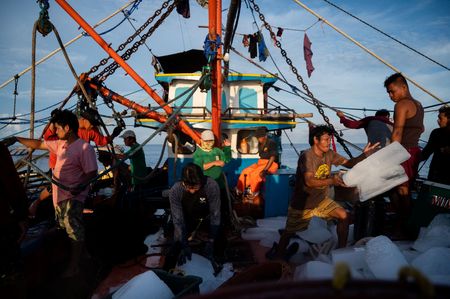

Ten years ago, the Philippines scored a major legal win against China’s territorial claims in the South China Sea — but for the fishermen of Masinloc who once relied on Scarborough Shoal for their livelihoods, that victory has meant very little on the water.
The shoal, one of the most fiercely disputed stretches of ocean in Asia, has remained under China’s effective control since 2012. In 2016, the Permanent Court of Arbitration — an international tribunal — determined that Beijing’s broad maritime claims had no legal foundation. The tribunal also noted that the shoal’s waters, known to China as Huangyan Dao, are traditional fishing grounds used by several nations including the Philippines, China, and Vietnam. However, the ruling stopped short of determining which country holds sovereignty over the shoal itself.
Fishermen from the coastal town of Masinloc once tried to access the shoal under the cover of darkness, hoping to avoid Chinese vessels. Now, many say they’ve stopped going altogether, citing an intensified Chinese effort to block and chase them away.
Rony Drio, 59, hasn’t returned to the area since 2024. His fellow fisherman Henrilito Empoc, 47, last visited in 2022. Both men now fish much closer to shore.
When news of the 2016 ruling spread, Empoc said the reaction among fishermen was one of hope. “When we heard that we had won, what came to our minds and hearts was the freedom to fish again and the hope of a better livelihood,” he recalled.
That hope, however, quickly faded. Empoc says he has witnessed Chinese vessels fire water cannons at Filipino fishing boats, and has had his anchor lines cut by Chinese personnel in efforts to force him out. “They took away our right to fish,” said Empoc, who now drives a motorized tricycle taxi to help make ends meet.
Drio described an incident from a few years ago in which Chinese personnel ordered him and another fisherman out of the shoal’s lagoon. Because the water was too shallow for their boat, the two men were forced to drag it over jagged coral. “The coral hurt our feet, but what hurt more was what they were doing to us,” he said.
China’s embassy in Manila did not respond to a request for comment on the fishermen’s allegations. Beijing has consistently refused to recognize the tribunal’s ruling, maintaining that it holds “indisputable sovereignty over Huangyan Island and its adjacent waters.”
Scarborough Shoal has remained a persistent flashpoint between Manila and Beijing. Earlier this year, tensions flared again after China installed a floating barrier at the entrance to the shoal’s lagoon — a structure that was eventually removed following protests from the Philippines. Beijing has also floated a proposal to turn the shoal into a nature reserve, a plan Manila has condemned as a “clear pretext for occupation.”
Diplomats and analysts have expressed concern that ongoing confrontations in the South China Sea could spiral into armed conflict. In June 2024, a Filipino sailor lost a finger during a violent clash with the Chinese coast guard while on a resupply mission to Second Thomas Shoal, where the Philippines maintains a grounded warship.
Philippine officials argue the tribunal’s ruling has bolstered the country’s legal standing and supported a policy of publicly documenting confrontations at sea. The decision has also helped expand defense ties with allies, including deepened military and maritime cooperation with the United States, Japan, and Australia.
Jay Batongbacal, director at the Institute of Maritime Affairs and Law of the Sea at the University of the Philippines, said China’s aggressive behavior has actually worked against its own interests. “Without China’s actions, the number of allies and security partners for the Philippines definitely would not have increased,” he said.
But for fishermen like Drio and Empoc, geopolitical gains offer no comfort. “We won in 2016, but it doesn’t feel like a victory to me,” Drio said.