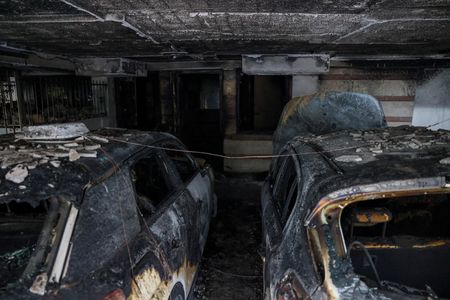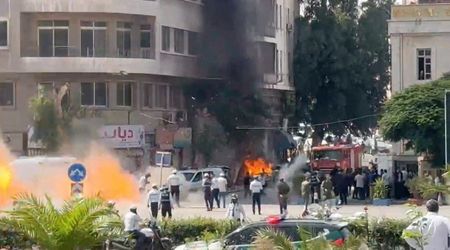

Preliminary investigations into Tuesday’s twin bombings in Damascus — which occurred near a hotel where French President Emmanuel Macron was staying overnight — suggest the cell responsible was connected to Islamic State, according to a senior Syrian security official.
The two explosions wounded 18 people and cast a shadow over Macron’s visit to the Syrian capital, which marked the first trip to the country by a European Union head of state since the removal of Bashar al-Assad from power.
What Is Islamic State?
Islamic State is a Sunni Muslim extremist organization that rose to prominence in Iraq and Syria, eventually declaring a so-called “caliphate” — a form of Islamic government — and claiming authority over all Muslims worldwide. At its peak, the group largely supplanted al Qaeda as the dominant jihadist force.
Between 2014 and 2017, the group controlled vast stretches of Iraq and Syria, governing millions of people under its harsh interpretation of Islamic Sharia law. It maintained a base just a 30-minute drive from Baghdad and even held the Libyan coastal city of Sirte. The group carried out public executions and torture as tools of control, and its fighters either carried out or inspired attacks in dozens of cities across the globe.
A sustained military campaign led by a U.S.-led coalition eventually dismantled the caliphate in both countries.
Where Does It Operate Now?
After being driven out of its strongholds in the Syrian city of Raqqa and the Iraqi city of Mosul, Islamic State retreated into the rural interiors of both countries. Today, the group maintains a notable presence in Syria, Iraq, parts of Africa, Afghanistan, and Pakistan.
Its fighters are spread across independent cells, its leadership operates in secrecy, and its total numbers are difficult to pin down. The United Nations estimates around 10,000 members remain in the group’s core territories.
Africa has emerged as the primary focus of Islamic State’s activities. The group’s African operations accounted for 86% of its global activity during the first three months of 2026, according to the Armed Conflict Location and Event Data Project, a crisis monitoring organization. The largest faction, known as ISWAP, is based primarily in northeastern Nigeria, while other branches are active across the Sahel region, as well as in Somalia, Mozambique, and Congo.
In July, Morocco’s counterterrorism agency announced it had disrupted attack plots against sensitive sites and public security locations carried out by a cell loyal to Islamic State’s Sahel affiliate.
Many foreign fighters have gravitated toward the group’s Khorasan branch — known as ISIS-K — which takes its name from a historical term for a region encompassing parts of Iran, Turkmenistan, and Afghanistan.
In the Philippines, Islamic State-linked groups remain active in the southern part of the country, particularly in Mindanao, where pro-Islamic State militants seized control of the city of Marawi in 2017.
Recent Attacks
Leaders across the Middle East and their Western allies have raised alarms that Islamic State could use the 2024 fall of Bashar al-Assad’s government as an opportunity to reassert itself in Syria and neighboring Iraq.
The group has declared a new operational phase in Syria, targeting the government of President Ahmed al-Sharaa. Since February, it has carried out a series of attacks, including one that killed four Syrian government security personnel near Raqqa.
Since Assad’s removal from power, Islamic State has been reactivating dormant sleeper cells, scouting potential targets, and distributing weapons including guns, silencers, and explosives, according to sources who spoke with Reuters. A report by the U.N. Office of Counter-Terrorism revealed that President Sharaa and two senior cabinet ministers had been targeted in five foiled assassination attempts by the group.
Islamic State has also been linked to so-called lone-wolf attacks that are difficult to detect in advance. A 2025 shooting at a Jewish Hanukkah event at Sydney’s Bondi Beach — described as Australia’s worst mass shooting in nearly 30 years — raised concerns about the group’s influence on individual attackers. Police said Islamic State appeared to have influenced the gunmen, who killed 15 people.
In 2024, Islamic State-Khorasan claimed responsibility for a mass shooting at a concert hall near Moscow that left 149 people dead. The group has also been connected to several other planned attacks in southern Russia and Azerbaijan in recent years, a pattern that has alarmed intelligence agencies.
Goals and Tactics
Islamic State’s overarching goal remains the spread of its extreme interpretation of Islam and the establishment of rule over Muslims. However, the group has significantly changed its methods following the collapse of its territorial holdings and a series of other setbacks.
Iraqi security officials say the organization has undergone a major shift — transitioning from a conventional military-style force into a dispersed underground movement. Rather than massing fighters in large formations, the group now relies on hidden cells, loosely affiliated operatives, and discreet courier networks to communicate and coordinate attacks.
The group has also moved toward a more decentralized structure, giving smaller units and individual members greater independence and reducing dependence on direct orders from senior leadership. Intelligence sources on the ground in Iraq and Syria say this model has helped the group withstand ongoing counterterrorism efforts in the region.