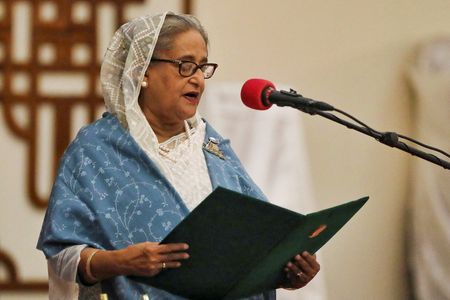

Deposed Bangladeshi Prime Minister Sheikh Hasina has revealed plans to return from exile in India around December, alongside senior members of her political party, intending to voluntarily appear before the courts — despite facing a death sentence back home.
Speaking in an exclusive telephone interview with Reuters lasting nearly an hour, the 78-year-old said she and fellow members of the Awami League — currently a banned organization in Bangladesh — plan to go back to the country they escaped two years ago and present themselves to the justice system.
“They may arrest me on my return, they may even kill me,” Hasina said during the late Thursday into Friday conversation.
“Still, I have to go,” she continued. “My party leaders and workers are being subjected to tremendous repression. If death comes, I want it to come on my own soil, where my parents are buried and where their blood was shed.”
Hasina fled Bangladesh in 2024 after widespread protests brought an end to her 20-year run as prime minister across several terms. In November, the country’s war-crimes court handed down a death sentence against her in absentia, finding her responsible for ordering a violent crackdown on a student-led uprising. She has denied all charges while living in exile.
Her potential homecoming could deepen political fault lines in the garment-export nation as the government in Dhaka works to restore order after two turbulent years. At the same time, it could help ease the strained relationship between Bangladesh and India, which worsened significantly after New Delhi gave Hasina refuge. Bangladesh has repeatedly called on India to extradite her.
Hasina said she has not consulted any foreign government about the timing or decision to return. This interview represents the first time she has laid out a specific timeframe, stated her intention to surrender, or disclosed that other exiled Awami League figures would do the same. Among those also facing a death sentence is former Home Minister Asaduzzaman Khan Kamal. Reuters was unable to reach the other party members or confirm their whereabouts.
“The authorities in Dhaka want to take me back, they are repeatedly sending letters to India seeking to have me sent back,” she said. “I will go myself.”
Spokespeople for the Bangladeshi government did not respond to requests for comment on Hasina’s statements. India’s foreign ministry also declined to respond, though in April the ministry indicated it was reviewing Bangladesh’s extradition request and expressed a desire to “engage constructively with the new government and further strengthen bilateral ties.”
Hasina spent half a century as a central figure in Bangladeshi politics, first thrust into public life after the assassination of her father — an independence leader — and most of her family during a military coup. She was once celebrated as a champion of democracy and credited with driving significant economic growth in the Muslim-majority country of 170 million people. However, her extended time in power drew accusations that her administration suppressed opposition and weakened democratic institutions — claims she rejects.
A United Nations report found that the crackdown that ultimately led to her removal from power killed as many as 1,400 people.
“Cases have been filed against almost all of our leaders and workers, and many of them are in hiding,” Hasina told Reuters from her exile residence in Delhi. “So I said that this time I am returning home, and one day, all of you should come. All together, we will all surrender in court.”
She stopped short of providing a specific date for her return or identifying which court she would surrender to.
“I believe in justice and I feel that once proceedings start, it will be clear to the people how farcical the court is — and that I want to prove it,” she said.
Numerous Awami League members have reportedly faced arrest, legal action, and physical violence since her government was removed from power, according to media accounts and government officials.
Hasina said she has had no direct communication with Dhaka regarding her return plans. “Democracy, voting rights, the political rights of the Awami League and justice are not subjects for secret talks,” she said.
She expressed no fear about the prospect of imprisonment, noting she has been jailed multiple times throughout her political career. After returning from an earlier period of exile in 1981 following her father’s assassination, she was detained repeatedly while campaigning against military rule. She was imprisoned again in 2007 by a military-backed caretaker government on corruption charges, only to be released and go on to win elections in 2008.
Hasina said threats against her life as crowds moved toward her home were what ultimately drove her to flee Bangladesh this time around.
“When a government works for a long time, mistakes can happen — no government is above error,” she said. “But the right to judge the good and bad, the right and wrong of a government belongs to the people. I leave that judgment to the people.”
She noted that she has been holding virtual meetings covering 125 of Bangladesh’s 300 parliamentary constituencies as part of ongoing efforts to reorganize the Awami League.
“They may have convicted me, and I may not be able to contest elections,” she said. “But why should they suspend the Awami League? If we have done badly, let the people decide.”