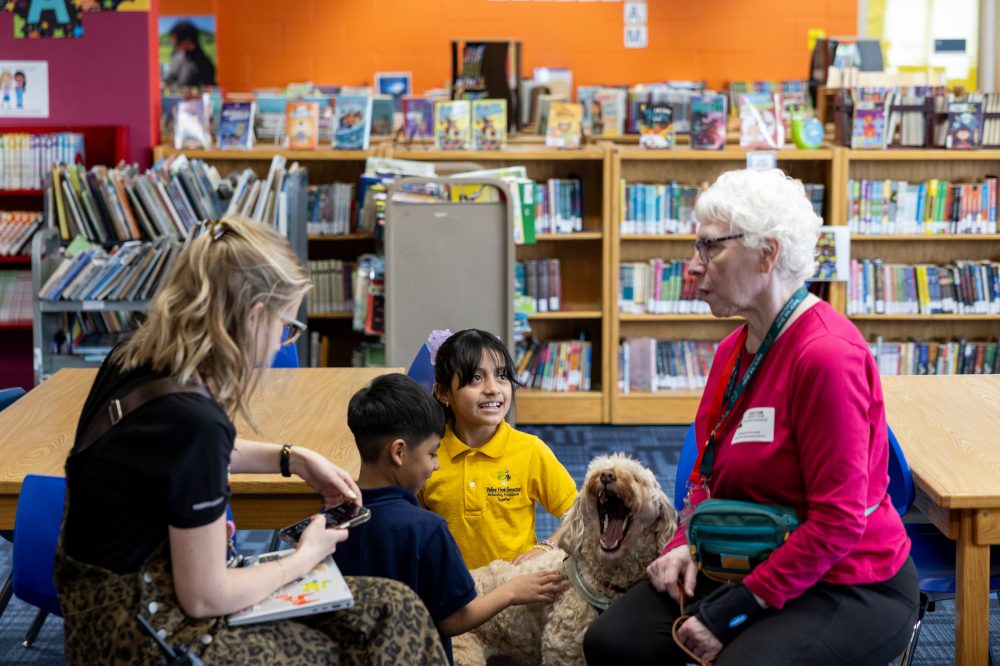

COLUMBIA HEIGHTS, Minn. — A young student cautiously walked toward the therapy dog positioned near the school library, extending her hand to stroke the animal’s soft golden fur. Social worker Nicole Herje watched closely.
“How does it feel when you pet Sage?” Herje asked.
“I like it,” the child responded. “In Ecuador, I had a dog.”
Just months before, this student and numerous others at Valley View Elementary had been hiding indoors to escape immigration enforcement agents swarming their Minneapolis-area neighborhood. School attendance dropped dramatically as families chose to keep children home during the enforcement operation under the previous administration.
Sage the goldendoodle serves more than just comfort. The dog represents part of a comprehensive approach to heal the mental trauma experienced by children who saw arrests happen, lost family members to deportation, or spent frightening weeks confined to their homes. Four students from the school were actually detained themselves and transported hundreds of miles to a detention facility in Texas.
Before “Operation Metro Surge” concluded in February, immigration enforcement resulted in over 4,000 arrests and multiple shootings, including two deaths, creating psychological scars in young children that mental health experts warn could persist for years.
Columbia Heights Public Schools, similar to other districts, provided remote learning options for students who stayed home during the enforcement period, though virtual classes stopped after spring break. Now that many have returned to campus, educators are concentrating on helping them heal.
“What we know about trauma is that our bodies hold on to the fear,” Herje explained.
During February, the children connected to Zoom sessions from different areas of their houses: family rooms and bedrooms with closed curtains, underneath clothing racks in closets, on sofas with a Mexican flag displayed on the wall. Many kindergarten students struggled to remain seated. One child walked away to perform cartwheels.
Anxiety continued long after the thousands of immigration agents deployed by President Donald Trump to the Twin Cities area had departed. The situation worsened when one of their fellow students, preschooler Liam Conejo Ramos, was apprehended by Immigration and Customs Enforcement upon returning home from school, still carrying his Spiderman backpack and wearing a bright blue hat with bunny ears.
This explains why, during their virtual learning time, Herje conducted a special lesson about feelings with the kindergarten class. Students discussed what brought them joy and sadness, peace and anger. They expressed missing their friends and wanting to come back to school.
“When you’re happy, you laugh and jump and dance and play, and you want to share that feeling with everyone,” Herje said, reading from the children’s book “The Color Monster.” “Anyone want to raise your hand and tell us something that makes you feel happy?”
“When I’m happy, I want to go to school when I see my friends,” one student replied.
Herje then asked: What made them sad?
“When my grandma, she go (to) Ecuador,” another student answered.
Every child had experienced one of the most intense immigration enforcement campaigns in U.S. history. They witnessed masked agents driving through neighborhoods in SUVs, followed by protesters using loud whistles. They saw videos of crying and screaming immigrants being arrested, shared repeatedly on social media. Many times, parents were separated from their families.
Increasing research reveals how trauma affects children, including those too young to comprehend what’s happening. Extended exposure to high-stress situations can alter a baby’s brain development, according to Rebecca Parlakian, the senior director of programs at early childhood advocacy group Zero to Three.
“When a child is experiencing sustained and consistent traumatic experiences where they have lost the sense of basic safety, we see that the brain reorganizes itself for survival, which actually translates to structural anatomical changes in the brain,” Parlakian explained.
Trauma symptoms can differ significantly based on the individual child, their age, and what they witnessed or endured. Robyn Tabibi, a family physician in St. Paul who frequently works with expecting parents, described treating a 3-year-old who lost multiple family members to deportation and had to relocate with his mother to avoid being targeted.
“He gradually stopped eating, became listless, refused to play anymore,” Tabibi said. “He’s in this new space, and he is so traumatized.”
Even children from families without immigration worries developed anxiety disorders.
Sarah Anikpo was born in the U.S., and her Liberian-born husband became a citizen in 2020. So Anikpo, a psychiatric physician assistant, didn’t consider discussing the enforcement operation with their 9-year-old son Zeke, despite helicopters flying over their South Minneapolis area.
Then an ICE officer fatally shot Renee Good, a U.S. citizen who had recently dropped her son at his elementary school. Demonstrations began. Zeke’s school district cancelled classes for two days.
Following that incident, Zeke couldn’t sleep in his bedroom. He described a “grey man” appearing in his nightmares and became worried about flashing lights outside his window. A classmate became upset, asking Zeke to pray for her mother and grandmother, who had gone back to Mexico. This made him both angry and scared.
“We couldn’t talk him out of it,” Anikpo said. “He definitely didn’t feel safe.”
The anxiety affecting immigrant families — including those with legal status — may have lasting effects on an entire generation of American students, according to specialists. The Brookings Institute calculates 4.6 million U.S. citizen children live with a parent who lacks documentation or has temporary legal status, and over 200,000 have parents who were detained or deported during the previous administration.
“Children in mixed-status families often live with chronic anticipatory anxiety that a loved one could be detained or deported,” a group of psychiatrists wrote in a special report for Psychiatric News. “These fears have been shown to lead to school absenteeism, academic disengagement, and heightened emotional distress.”
Valley View staff have identified students requiring additional support, including two fifth-graders and a second-grader who, like Liam, had been held at Dilley Detention Center in Texas, where court documents indicate children lacked sufficient food and medical care. Herje conducted group therapy sessions with Sage the goldendoodle for these students.
Coming back to school is what many truly needed. Herje has observed happy reunions between young friends who hadn’t met in person for months.
Herje asked them previously what makes them feel loved. One student responded: “When I’m in love, I find my best friend.”