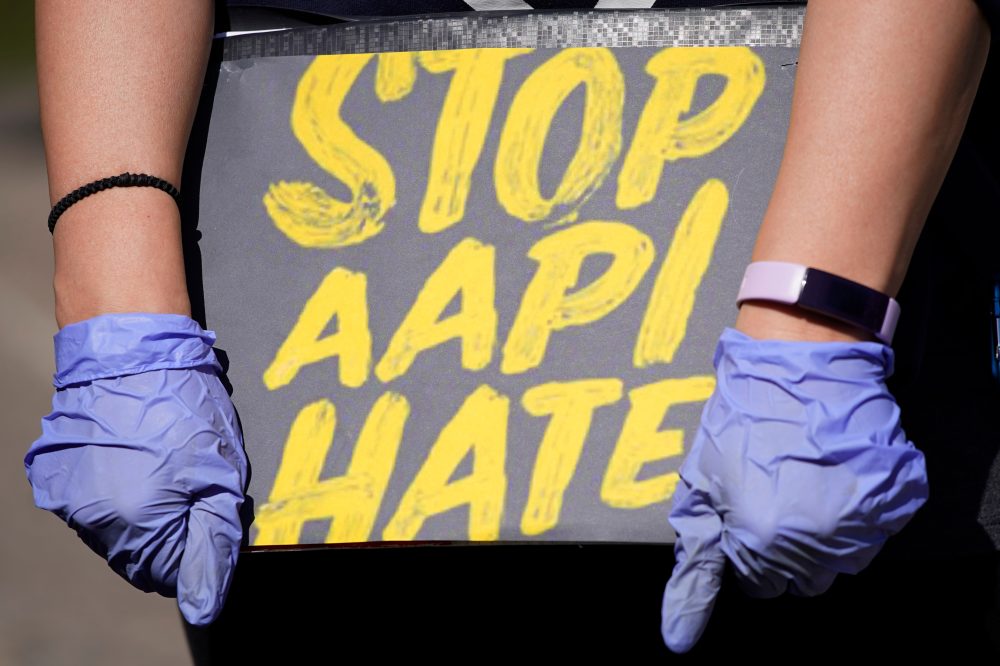

The organization that gained national attention for documenting anti-Asian incidents during the pandemic is now focusing its efforts on voter engagement through a new political initiative.
Stop AAPI Hate has established Stop AAPI Hate Action, a separate nonprofit designed to increase Asian American and Pacific Islander voter registration and turnout at polling stations. The creation of this political advocacy branch comes as a response to President Donald Trump’s actions and Republican legislative efforts to modify electoral districts and weaken portions of the Voting Rights Act.
The group revealed Thursday that this new venture will leverage Stop AAPI Hate’s established reputation for highlighting issues of racism, discrimination and community solidarity. This represents a significant expansion for the organization, which has engaged in policy development and advocacy activities for six years, according to co-founder Manjusha Kulkarni, who spoke exclusively with The Associated Press.
“Those pieces — alongside what we’re seeing from our community in terms of data — really motivated and inspired us to make this move,” Kulkarni said. “Because we see how our communities are being harmed and exactly what needs to be done to address the harm, and prevent it in the future.”
The new organization has been structured as a social welfare entity, allowing leadership to participate in political campaign activities within specific legal boundaries.
Research from an AAPI Data/AP-NORC poll indicates that most Asian Americans, Native Hawaiians and Pacific Islanders view President Donald Trump’s immigration and border security policies during his second term as more detrimental than beneficial.
The organization’s yearly assessment, published during AAPI Heritage Month in May, revealed that approximately half of AAPI adults reported that either they or someone in their personal circle experienced negative consequences from immigration policies or anti-immigrant sentiment in 2025. During the previous year, Trump enacted restrictions on H-1B visa recipients — many of whom originate from Asian nations — and imposed a $100,000 yearly charge for highly skilled international workers.
Additionally, Chinese citizens encounter numerous anti-China regulations across different states.
Navia Gutta, 28, was disturbed by an incident that occurred last summer at a Chipotle location in Atlanta, where a woman confronted her and a companion, labeling the two Indian Americans as “murderers” and “rapists.” The situation intensified when the woman threatened to contact U.S. Immigration and Customs Enforcement to send them “back” to India, which she described as a “dirty country.” Both individuals were born in the United States.
“Our hands were shaking and we full-on cried in the car,” Gutta said. “It made me realize that I grew up still very privileged, and I felt like I lived in a bubble up until then, because nothing like that had ever happened to me.”
She subsequently reported the incident to Stop AAPI Hate, and after extensive conversations with a staff member, was motivated to volunteer with the organization.
“It made me realize I would love to be a part of this solution,” Gutta said. “I would love to educate people. I would look at these issues and continue educating myself further because I think politics can be really scary.”
Stop AAPI Hate Action is preparing to actively participate in the November midterm elections. However, this doesn’t involve automatically endorsing all Democratic candidates, Kulkarni explained. The organization’s primary objective is backing candidates who align with fundamental principles regarding immigration policy and civil rights.
“It is really, at its core, about harnessing the pain felt at an individual level and turning it into a collective power,” Kulkarni said. “This really has been an existential threat to our community.”
The organization also seeks to avoid competing with or replicating existing AAPI-centered civic participation groups. Their strategy extends beyond traditionally blue states and battleground areas. A key objective involves converting red districts with substantial Asian American populations to blue. There are regions in Republican-controlled states “that deserve to be reached out to,” according to Andy Wong, Stop AAPI Hate Action managing director of advocacy.
“The ones in Iowa and Nebraska and Alaska and other places where there are competitive purple districts — many of them with GOP incumbents,” Wong said. “We are going to reach voters in those places,” by recruiting phone bank volunteers fluent in Korean, Vietnamese, Cantonese and Mandarin.
This outreach campaign begins in July, with plans to target individuals who typically vote only during major general elections. To establish connections, they intend to pair volunteers with voters sharing similar ethnic backgrounds.
This new political organization is designed for long-term impact rather than short-term results, according to Stop AAPI Hate personnel. The Asian American and Pacific Islander demographic represents one of the most rapidly expanding populations in the United States, creating opportunities for new voter recruitment with each election cycle.
However, political parties have ignored this reality and failed to invest in voter outreach and civic engagement efforts, Kulkarni noted. “We’ve really been an afterthought. We’re 24 million people.”
Stop AAPI Hate views the coming years as a chance not only to attract voters but also to strengthen AAPI influence as a unified voting constituency. Kulkarni references data suggesting that Latino, Black and Asian Americans who shifted rightward during the 2024 election are moving back toward the left.
“Where you see that especially is the South Asian or Indian American community specifically. You’ve seen that in some of the others, in the Japanese American community,” she said. “How do we harness that?”
The organization must establish infrastructure to maintain engagement beyond major election periods, Wong emphasized. They also aim to support Asian Americans and Pacific Islanders already active in their communities to develop leadership roles in their areas.
“They’re putting in the phone calls. They’re showing up at public hearings, delivering comments,” Wong said. “It’s about building long-term civic and political power.”