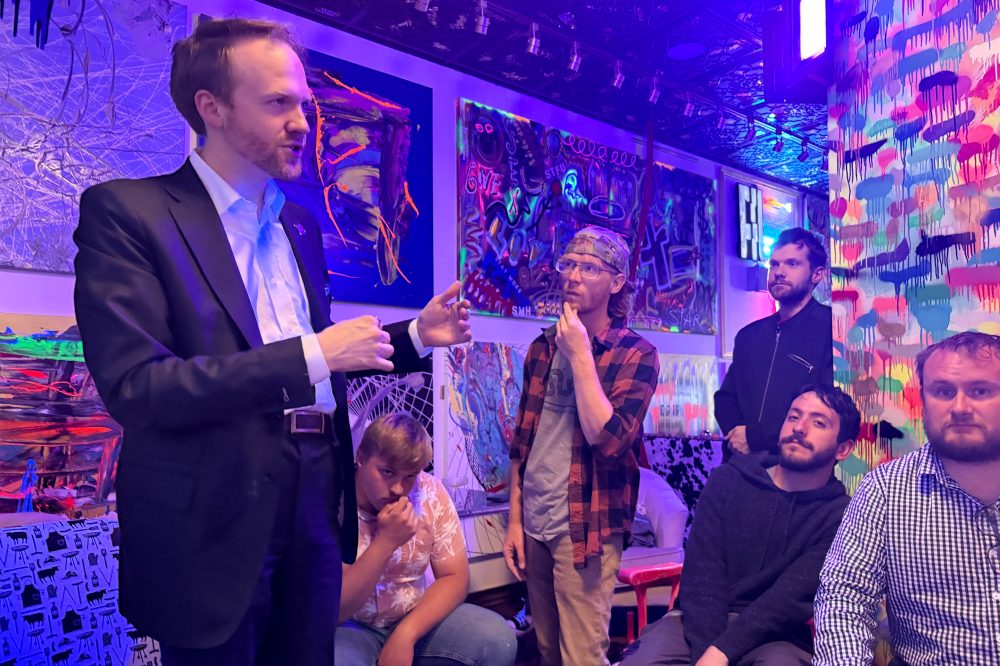

COVINGTON, Ky. — More than a dozen young Republicans met recently at dEcORa, a bar with vibrant neon lighting in northern Kentucky, sharing drinks and voicing their growing discontent with the presidential administration they once enthusiastically supported.
Their initial excitement for Donald Trump has transformed into deep frustration.
“I absolutely do not regret voting for Trump in 2024,” stated Nathaniel Showalter, 34, seated near a spray-painted concrete column. “I can’t wait for him to get out of office.”
During their evening gathering beneath the bar’s dim lighting, participants expressed feeling abandoned by the Republican establishment — the same system they once cheered Trump for challenging, but now believe he’s perpetuating. This growing discontent has created a widening divide between younger and older conservatives as the party begins contemplating its post-Trump future.
The bar patrons view Trump’s conflict with Iran as a violation of his campaign commitments. They’re experiencing economic conditions that seem as unstable as before his presidency began. Additionally, they’re grieving the death of Charlie Kirk, the 31-year-old conservative activist they considered their primary advocate with White House access.
Tuesday’s primary defeat of Republican Rep. Thomas Massie — who had gained younger, anti-establishment supporters while clashing with Trump — eliminated one of their strongest congressional allies.
“There seems to be a concerted effort to keep the next generation out on the right,” explained TJ Roberts, the group’s tall leader. The 28-year-old state representative was the only suit-wearing attendee. “There’s this sense of entitlement among the establishment on the right. ‘Well, I’m better than the alternative.’ Well, sure, but a stomach flu is preferable to stomach cancer. I’d rather have neither.”
Roberts organizes monthly political discussions for the group, this time including The Associated Press, expressing concern that young people like those at dEcORa were “going to live a shorter, less prosperous life than your parents.”
“We have to make sure that young Republicans have a voice in Washington, D.C.,” he emphasized.
The energetic group, consisting entirely of men in their twenties and thirties, gathered around a table decorated with kaleidoscope artwork. They exchanged crude humor and engaged in debates, occasionally mimicking Trump or conspiracy theorist Alex Jones.
While opinions on Trump’s presidency vary — some favor his second term more than others — they were united in their anger regarding the Iranian conflict.
For many attendees, Operation Epic Fury represents more than just “a complete betrayal of his promises,” as 32-year-old Michael Gartman described it. They see it as proof that their concerns have been overshadowed by the political establishment, defense contractors, and major donors whom they believe are advancing Israel’s interests.
Logan Edge, a 30-year-old gun lobbyist wearing a Hawaiian shirt and sporting a Lincoln-style beard, imitated Trump discussing Miriam Adelson, the billionaire whom Trump once said counseled him on Israel.
“‘Oh Miriam, she’s over there, she loves Israel, maybe more than America,’” he said.
Dropping the presidential impression, he added, “You can’t piss on my shoes and tell me it’s raining.”
Sitting opposite Logan was Andrew Cooperrider, a 33-year-old host of a conservative Kentucky politics podcast, accompanied by his 14-year-old son Leo. The teenager hopes to become an underwater welder and suggested to his father that military service could provide the necessary training.
“And I said absolutely not,” the elder Cooperrider responded, “not with everything going on, my son is not getting into the military right now and go fight these wars for these psychopaths.”
“Thank you!” someone called out, as Cooperrider noted that Leo could learn the trade through civilian channels.
Edge interjected, sharing that he and his father, a Desert Storm and Iraq veteran, had visited Arlington National Cemetery.
He described using a mobile app to locate specific gravesites, his voice becoming emotional. “And me and my dad spent the day finding his friends. And it was very emotional, very tough. And you can get on the Metro and go to the next Metro stop and the first thing you see is Raytheon, Lockheed Martin and Northrop Grumman, and I said to my dad, ‘Look what you’re about to see.’”
Edge paused. “It brings tears to my eyes,” he said, pushing back his chair and looking away from the group. Roberts leaned over to check on Logan’s wellbeing.
“Why do my friends have to be over there?” asked Angel Figueroa, 27, a military veteran with friends currently stationed in the Middle East. “It would devastate me to see one of my friends getting bombed one day and what, I have to see their box now?”
While most believed a military draft was improbable, Elijah Drysdale, 27, wearing a backwards cap over his red mullet, said the mere discussion “speaks volumes to me, and it’s why we need a change in leadership.”
Despite Roberts’ concerns about the Republican establishment, he stood out as one of the few dEcORa attendees satisfied with Trump’s second term. He contended that the party “under President Donald Trump is without doubt the best Republican Party I have seen in my entire lifetime, the old order is dead.”
“It’s dying,” someone interrupted.
“No, it’s gone,” Roberts countered. “Trump shifted the culture so well that these conversations you’re hearing right now, this would be unacceptable in the Republican Party of 2014.”
Roberts noted increased willingness to challenge foreign military involvement, corporate bailouts, and aid to countries like Ukraine and Israel. The party had also taken a stronger immigration stance, which the group supported.
“I do think Trump started the (establishment’s) downfall, I think it’s only being kept alive now by him,” said the elder Cooperrider, pointing to Trump’s endorsement of U.S. Sen. Lindsey Graham and his opposition to Massie.
John Wardrop, a 24-year-old in a tucked-in short-sleeve shirt and large belt buckle, said “we could do a whole lot better.” He expressed optimism about certain administration figures, including Director of National Intelligence Tulsi Gabbard, Health Secretary Robert F. Kennedy Jr. and Vice President JD Vance.
“I’m actually in disagreement,” said Drysdale, offering sharper criticism of Trump than most attendees. “I think that he broke a lot of his promises.”
Any connection to this administration, he argued, will be “a stain on your reputation. This isn’t the party that we want, this isn’t the party that we voted for, or thought we were voting for.”
When asked if they could imagine supporting a Democrat, Henry Hecht, a 26-year-old libertarian sipping a cocktail garnished with a pirate flag, hesitantly raised his hand and shrugged.
“What’s he doing here?” Cooperrider joked angrily. “Get him out of here, somebody get the log!”
Their sense of disillusionment has been worsened by Kirk’s death. Kirk, who established the conservative youth organization Turning Point USA, appears to have no obvious successor, and Roberts said he “was kinda like a mediator, so Trump understood where young Republicans were coming from.”
The attendees cited multiple instances where they felt Republican officials had abandoned their commitments and conservative principles, including the Foreign Intelligence Surveillance Act extension and the expanding national debt.
Massie had opposed the White House on these and other matters. Trump retaliated by supporting a primary opponent, former Navy SEAL Ed Gallrein, who built his campaign around loyalty to the president.
Gallrein’s Tuesday victory demonstrated Trump’s party influence while deepening frustration with his leadership among other factions.
“We cannot really fight the left until we defeat these old, boomer Republicans,” Edge declared. “The left is organized, the left is institutionalized, they’re smart, they’re tactical, they’re not a joke, they don’t play.”
“We look at our own organization on our side and say, ‘We’re a little lost,’” said Cooperrider, suggesting younger liberals showed greater mobilization.
“Why don’t right-wingers do it?” Hecht wondered.
“My question is: why would you when, for so long, the right has been joking about their promises?” Roberts responded.
“It creates an endless cycle,” he concluded. “Eventually that cycle has to break.”