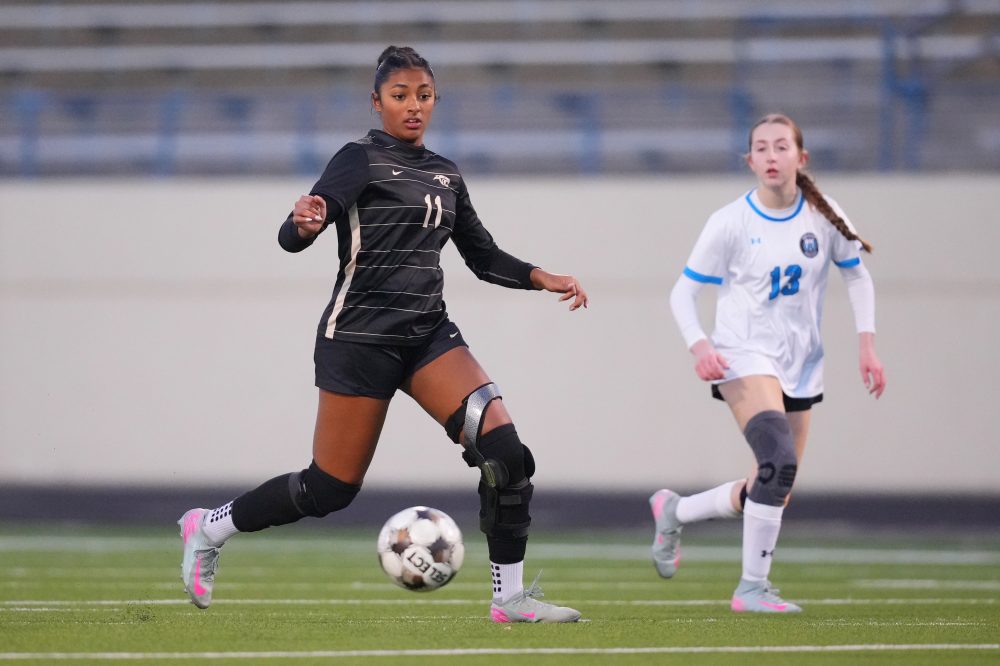

HARRISBURG, Pa. — During an October club soccer practice, Sofia Tepichin was defending against an approaching opponent when she redirected the ball and jumped over the player’s extended leg. Landing awkwardly, she heard a distinct “pop” sound.
She collapsed immediately as sharp pain pierced her left knee, knowing instinctively the severity of her situation. The moment was, as she described it, “heartbreaking.”
“And I knew personally that I tore my ACL,” Tepichin said.
Tepichin became another statistic in the alarming trend of female high school athletes suffering anterior cruciate ligament tears, a serious knee injury that experts say the athletic community must address more aggressively.
While decades of prevention research exists, parents, scientists and athletic trainers argue that teams, coaching staff and sports organizations fall short in protecting young female athletes and informing families about risks.
High-profile ACL injuries among athletes like Olympic skier Lindsey Vonn frequently make headlines, and many people dismiss these injuries as unfortunate accidents or inevitable consequences of competitive athletics.
However, teenage female athletes experience these injuries at dramatically higher rates than male peers — some research indicates up to eight times more frequently — and more often than adult athletes, typically during non-contact situations in sports requiring rapid directional changes, according to researchers.
Experts in biomechanics, athletic training and physical therapy point to pre-practice warmup routines and muscle-building programs — including FIFA 11+ or PEP protocols — that can significantly lower the risk of an injury causing severe physical and psychological damage to young competitors.
Unfortunately, most coaching staff lack proper education or professional guidance, and high school female athletes compete with substantially fewer resources compared to professional and college programs. Consequently, injury-prevention protocols are seldom integrated into regular coaching practices and training sessions.
“The real crime in this is that the data has been out there for 25 years,” said Holly Silvers-Granelli, a physical therapist and biomechanics researcher who advises athletes, professional teams and major sports leagues on injury prevention. “People are clamoring for answers, and the answers are largely there.”
While ACL injury trends remain somewhat unclear, the National ACL Injury Coalition — established by the Aspen Institute and New York’s Hospital for Special Surgery — reported that analysis of high school athletic trainer data revealed nearly 26% growth in average annual ACL injury rates among high school athletes between 2007 and 2022.
Female athletes experienced rate increases exceeding 32%, while male rates rose 14.5%, according to the coalition’s findings.
Following injury, high school athletes and families frequently navigate recovery independently. ACL injuries often necessitate surgical intervention and year-long rehabilitation involving physical therapy and strength conditioning, costs that insurance may not completely cover.
The healing process disrupts athletes’ daily routines and self-identity: they lose team fellowship and watch from sidelines, creating emotional challenges that can match the physical trauma, parents report.
Numerous high school athletes who sustain ACL tears never regain their previous performance level, with some never returning to their sport, according to the National ACL Injury Coalition. Additionally, once injured, they face increased risk of subsequent ACL injuries and long-term issues including degenerative joint disease, researchers note.
The coalition advocates treating ACL injuries with the same seriousness as brain injuries, following professional and youth sports’ efforts to enhance training, regulations and equipment standards for concussion prevention and identification.
Sophia Gerardi, a Pennsylvania Apollo Ridge High School sophomore who suffered an ACL tear during a December basketball game, learned from doctors that she must permanently wear a knee brace during sports participation. Following January surgery, she’ll miss volleyball season and hopes to return for next winter’s basketball.
Similar to many girls with ACL tears, she doesn’t remember receiving any ACL injury-prevention education.
Coach surveys reveal many lack knowledge about risk-reduction programs, proper training to implement them, or encouragement to learn these methods, according to Vince Minjares, who directs the Aspen Institute’s ACL injury prevention initiative. Some coaches inform Minjares that such programs consume excessive time.
He remains optimistic about changing attitudes.
This spring, the American Youth Soccer Organization — a major national youth soccer entity — will launch new age-appropriate neuromuscular training programs designed to prevent ACL injuries through specialized warm-ups.
Coaching staff will receive exercise routines in manageable segments with video demonstrations. The objective involves establishing beneficial habits before preteens enter more physical and competitive levels.
“My biggest shock was that this didn’t already exist,” said Scott Snyder, AYSO’s senior director of programs and education. “Everyone I talk to says, ‘Yeah, that makes perfect sense,’ but nobody’s done it yet.”
Last year, biomechanical researchers at Scottish Rite for Children hospital in metropolitan Dallas started offering high school teams resources typically available only at professional and collegiate levels.
They developed pre-season injury-prevention training specifically designed for female athletes to enhance strength and movement quality. Each athlete receives a complimentary motion-capture 3D assessment at the eight-week program’s beginning to identify strength, movement or balance deficiencies. A concluding assessment determines whether the program decreased injury risk.
Future programs might incorporate nutrition and sleep components, said Sophia Ulman, who leads the hospital’s Movement Science Laboratory.
“My team and I got tired of studying ‘why, why, why’ when there’s so many different possibilities to answer that question. And we wanted to move into the ‘what is the solution,’” said Ulman. She noted that other U.S. biomechanics laboratories are attempting similar community outreach.
Plano East High School in Texas participated in the program, where players — including Tepichin — had experienced multiple ACL tears in recent years.
Cristy Cooley, Plano East’s coach, emphasized that receiving direct instruction from trained professionals in proper exercises and movement techniques creates significant impact.
“It’s one thing talking about it,” Cooley said. “But it’s a totally different thing to show us.”
Like other parents, Tiffany Jacob discovered crucial information about ACL injury prevention that she wishes she had known before her daughter — East Plano sophomore Aliya Jacob — tore her ACL last February. For example, the surgeon informed them that three weekly strength training sessions are essential for soccer players.
“Something’s got to change,” Tiffany Jacob said. “Coaches, clubs, something. They have to do something to prevent this because it’s just such a horrible injury.”
Aliya — who knows at least seven other female soccer players with ACL tears, her mother noted — has returned to playing for East Plano. She endured twice-weekly physical therapy, rehabilitation isolation and, her mother said, “figuring out who you are when you’re not playing soccer.”
Tepichin, now a high school senior, remembers her surgeon advising her to spend a few days processing her sadness and frustration — then commit fully to recovery.
She’ll miss her final year of high school and club soccer. Her next field time may be at Saint Vincent College in Pennsylvania, where she’s committed to the NCAA Division III program.
Tepichin has consulted a sports psychologist, received support from others who underwent the surgery — her sister, father and friend — and established new routines after previously maintaining constant activity with two soccer teams and employment.
“There’s not a day that I go that I’m not working out or doing something,” she said, “or getting better for my health and my recovery.”