
Researchers are scrambling to western Thailand after a long-submerged train depot from World War II’s notorious “Death Railway” emerged from beneath a reservoir, offering an uncommon glimpse into one of the war’s darkest chapters.
The station, known as Nithe Station, sits in Kanchanaburi province and was uncovered after the Electricity Generating Authority of Thailand drained the reservoir at Vajiralongkorn Dam for routine maintenance. Historians are taking advantage of the rare window to search for artifacts and confirm historical details about the site.
The clock is ticking, however. Dam maintenance is expected to wrap up in August, and Southeast Asia’s rainy season could soon refill the reservoir, sending Nithe back beneath the water.
Nithe was a significant stop along the 415-kilometer (257-mile) railway that once linked Thailand — then called Siam — with Myanmar, which was known as Burma at the time. The line was constructed using the forced labor of roughly 60,000 Allied prisoners of war, primarily from Australia, the United Kingdom, the United States, and Indonesia, then called the Dutch East Indies. Hundreds of thousands of Asian laborers, referred to by the Japanese as römusha, also worked on the project.
The human cost was staggering. More than 12,500 Allied POWs and approximately 75,000 laborers died during construction — a toll that earned the route its grim nickname, “The Death Railway.”
The railway has been immortalized in popular culture, including the classic 1957 film “The Bridge on the River Kwai” and the 2013 movie “The Railway Man.” It also served as the subject of the award-winning novel “The Narrow Road to the Deep North,” which was adapted into a 2025 miniseries featuring Australian actor Jacob Elordi.
Independent Australian researcher Martyn Fryer made the journey from Perth specifically to walk the site. His grandfather perished as a prisoner of war while laboring on the railway following his capture in Singapore in 1942.
Fryer waded through muddy terrain in sweltering 38-degree Celsius (100-degree Fahrenheit) heat, saying he wanted to “understand what those lads went through and to appreciate the country and the terrain that they endured.”
Fryer, who authored a book about his grandfather’s regiment titled “From the Woodlands to the Jungle,” swept the historic railway embankments with a metal detector and uncovered iron dog spikes, bridge staples, and other wartime relics.
“I’ve been to Nithe Station three times in the past, but the water level has always been too high to actually really appreciate the fantastic offerings that it has with the remaining infrastructure and the layout of the railway itself,” Fryer said.
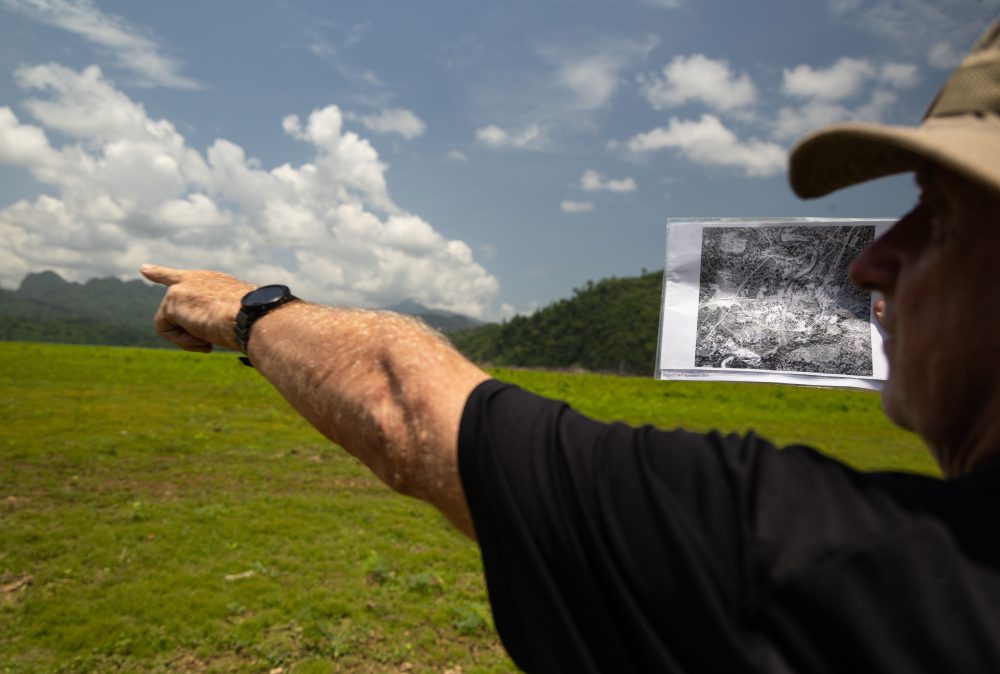
To help pinpoint where POW camps once stood, Fryer compared wartime aerial photographs sourced from the National Archives in London with hand-drawn maps brought by Andrew Snow, a researcher with the Thailand–Burma Railway Centre. Snow’s father, like Fryer’s grandfather, was captured in Singapore and compelled to work on the railway.
Snow noted that the dry season in Southeast Asia typically exposes small portions of the station, but this year water levels dropped lower than usual — and drained so rapidly that vegetation has not had time to grow back, making the site far easier to examine.
“It is a good opportunity for us to do some surveying,” Snow said. “When you’re dealing with relatives of people that worked on the railway, it’s always nice to be able to show them the areas that maybe their relative worked on.”
The exposed station has also drawn significant public attention. Kitti Laokham, a 47-year-old local resident, posted footage of Nithe online that has since accumulated 32 million views on social media. Hundreds of Thai visitors have traveled to the area to witness what Laokham described as a “rare incident.”
Channarong Noimala was among those drawn to the site, riding a motorbike 350 kilometers (217 miles) northwest from Bangkok after seeing the videos.
“At least for those who died here, no matter whether they are laborers or prisoners of war, we can remember them,” Noimala said.
Roughly 100 kilometers (60 miles) of winding mountain roads southwest of Nithe lies Hellfire Pass, a grueling stretch of mountain terrain where hundreds of POWs lost their lives. The Hellfire Pass Interpretive Centre, which is funded by the Australian government, welcomed a record 169,000 visitors last year — coinciding with the 80th anniversary of the end of World War II.
Mick Clarke, an Australian Army veteran who oversees the center, reflected on the site’s growing significance.
“As time passes, places like Hellfire Pass become even more important,” Clarke said. “They keep personal stories alive and help future generations understand the cost of war.”
According to Australia’s Department of Veterans’ Affairs, around 22,000 Australians became prisoners of war during the conflict, with about 13,000 working on the railway and 2,800 dying during its construction.
“For many Australians, Hellfire Pass is deeply personal,” Clarke added. “It connects families and the nation to a difficult but important chapter of wartime history.”