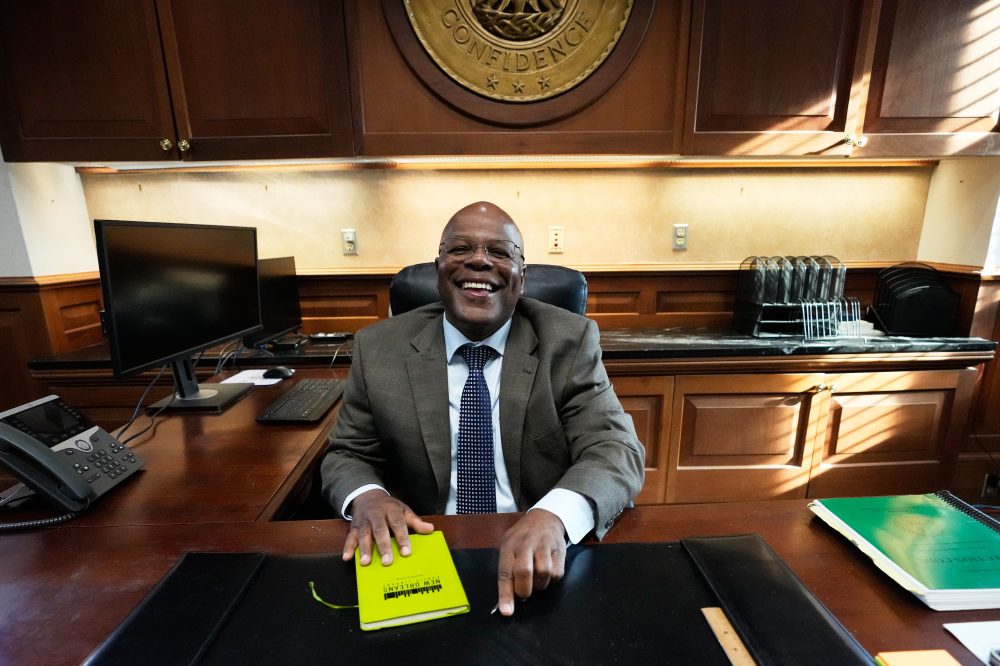

NEW ORLEANS — A man who served decades behind bars for a crime he didn’t commit started his new job Monday running New Orleans’ criminal court operations, after a federal judge temporarily stopped Louisiana officials from dissolving his elected position.
Calvin Duncan secured 68% of voter support to become Orleans Parish criminal court clerk. However, with encouragement from Republican Governor Jeff Landry, the Republican-majority state Legislature quickly enacted a bill to eliminate Duncan’s role just days before he was scheduled to begin serving, moving his responsibilities to a different official.
On Sunday, U.S. District Judge John deGravelles stepped in, ruling that the legislation abolishing the clerk role violated constitutional principles by replacing a position chosen by voters with one filled through political appointment. He approved Duncan’s request for emergency protection while court proceedings continue and scheduled a Monday status meeting for all parties.
“The Court is not ruling that the state lacks the authority to abolish an agency or office writ large,” deGravelles stated.
The judge explained he’s “simply holding” that Louisiana’s method violated Duncan’s constitutional rights to due process.
Louisiana officials quickly filed an appeal Monday, requesting a higher court suspend the judge’s order.
The bill, which Landry approved Thursday, would have transferred criminal court clerk duties to the Orleans Parish civil court clerk. Landry and fellow Republicans argued the consolidation would streamline government operations and bring Orleans Parish in line with other areas statewide.
When Duncan walked up the courthouse steps Monday morning and entered his new workspace, he shared with The Associated Press his enthusiasm about starting work and confidence in ultimately prevailing in court.
“I’m not just elated but overelated and happy that this day finally came,” Duncan said to the AP. “It’s something I’ve been working towards a very long time. This is a testament that God is still in control.”
Duncan, whose murder conviction was overturned in 2021, studied law while incarcerated and eventually obtained his attorney’s license. He campaigned for the clerk role promising to make court documents more accessible, inspiring many voters with his firsthand experience battling to prove his innocence. He shared with the AP his plans to use his opening day meeting staff members and fellow courthouse workers.
Duncan’s advocates argue that efforts by the predominantly white conservative Legislature to eliminate Duncan’s position undermines the democratic choice of New Orleans voters, a mainly Black Democratic stronghold within a Republican-controlled state. Louisiana has been at the forefront of challenging the Voting Rights Act.
New Orleans Mayor Helena Moreno, a Democrat, praised the judge’s decision in Duncan’s case as protecting voting rights.
“The court made clear that you cannot change the rules after an election has already taken place,” Moreno stated. “Voters in New Orleans overwhelmingly elected Calvin Duncan and the will of the people should be respected.”