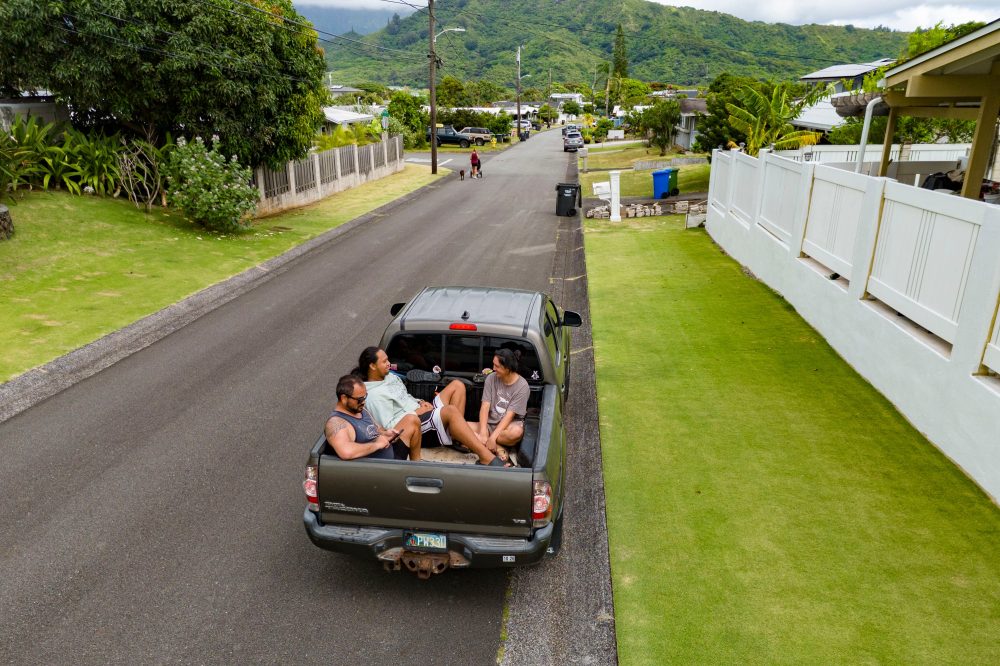

KAILUA, Hawaii — Across Hawaii, it’s a familiar sight: people perched in the beds of pickup trucks rolling along country highways, flanked by lush mountains on one side and the Pacific Ocean on the other.
“It’s a cultural thing, especially in a small, agricultural community,” said Kimeona Kane, who grew up hopping into truck beds to get to baseball and football practice. For him, cruising through his coastal hometown in an open truck bed — soaking up the sun and salt air — was the very essence of island life.
But as parts of Hawaii have grown more urban and traffic has increased — particularly on Oahu, home to the capital city of Honolulu — worries about the safety of riding in open truck beds without seats or seat belts have mounted.
Even today, Kane limits his family’s truck bed rides to back roads, mostly in Waimanalo, the Oahu community where he was raised and still lives.
After years of attempts to regulate the practice, lawmakers this spring passed a bill raising the minimum legal age for truck bed riding from 12 to 16. Democratic Gov. Josh Green quietly signed the measure into law last month.
Green has a personal connection to the issue. In 2023, he was traveling in a car behind a pickup truck when a 25-year-old man was thrown from the vehicle’s bed. Green, who is a physician, immediately stepped in to provide medical assistance.
“I would prefer that nobody ride in a truck bed, because people need to be belted in,” he said in a statement at the time.
In a state where music often romanticizes pickup trucks on dusty roads — including a popular cover of John Denver’s “Take Me Home, Country Roads” — it’s easy to see why truck-riding carries a certain charm.
Richard Landford Jr., now 80, recalls skipping school and catching rides in the back of a farmer’s pickup to travel out of Waianae, on the opposite side of the island from Kane’s hometown. “When you went fast, the dust off the highway would tell you you’re going too fast,” he said. He noted it’s much harder to gauge speed today inside a modern, quiet vehicle with air conditioning and sealed windows.
Despite the faster roads, Landford still believes truck beds should remain an option for passengers. “You drive to almost any church out here in the rural area, you’ll see people in the back of trucks,” he said. “I wish there was a simple answer.”
For Kane, who is Native Hawaiian, riding in a truck bed is deeply tied to local identity — but he’s careful to draw a distinction. “It’s not Hawaiian culture,” he said. “It’s Hawaii culture.”
“It takes us back to even the plantation days,” Kane added, referencing the era when Waimanalo and other parts of Hawaii were sugar and pineapple plantation communities. Workers who came from the Philippines, China, Puerto Rico, Portugal, Japan, and other countries helped shape the islands’ multicultural identity, and piling into truck beds was a common way to get around the fields.
State Rep. Darius Kila, who introduced the bill, noted that some people still ride in truck beds simply because they have no other choice — pointing to large families who own only a pickup truck without enough cab seating for everyone.
Kane has his own set of rules for truck bed riding, even on short trips: no leaning against the tailgate, and no sitting on chairs or coolers — something many people commonly do.
In recent years, some farms have shifted to using passenger vans equipped with seats and seat belts for their workers. Dean Okimoto, chief of operations for Nalo Farms, said the farm now uses vans for groups of 10 or 12 workers. “I wouldn’t chance putting people in an open truck,” he said. “They should ban it completely.”
Earlier this year, a woman was thrown from a truck bed after a vehicle rear-ended the pickup on a Honolulu freeway. That death renewed calls for stricter rules — and this time, those calls led to action.
“Where do you strike the balance of safety and trying to maintain this culture of something that’s so synonymous with people in Hawaii?” Kila said. “Like, because what a cool thing it is to ride in the back of a pickup truck.”
Kila originally sought broader restrictions, such as banning truck bed riding on certain highways, but scaled back the proposal. “Any time that legislation has been proposed of restricting or removing it, people have viciously fought back because I think for identity and place, that’s something they associate with Hawaii,” he said.
According to David Kidd, vice president of vehicle research at the Insurance Institute for Highway Safety, 29 states and the District of Columbia have laws restricting truck bed riding, though all include exceptions for situations like farm use, parades, and emergencies. By comparison, every state except New Hampshire requires adult front-seat passengers to wear seat belts.
Hawaii’s new law includes similar exceptions and allows those 16 and older to ride in a truck bed only when there is no available seating in the cab. Kidd compared resistance to truck bed regulations to early pushback against seat belt and motorcycle helmet laws, noting that truck beds are especially dangerous because they offer no safety features whatsoever.
Still, Kidd said Hawaii’s new law is a meaningful step toward safety and may gradually shift how residents think about the practice.
Kila shares that view and believes a full ban may eventually come. “And it will probably be met with resistance, and then 20 years later after the fact, it will just be like, wow, we should have done that sooner,” he said.