
Economists have a name for what has happened to grocery prices across the United States in recent years: the “rockets and feathers” effect. Prices shot upward like rockets after the pandemic — and now they’re drifting back down as slowly as a feather.
That sluggish descent has left millions of Americans frustrated. Food prices at grocery stores saw their steepest climb in half a century, peaking in 2022 with an 11.4% jump. But despite inflation easing since then, prices have not gone back down. A fresh wave of price pressure following U.S. and Israeli military strikes on Iran has added to shoppers’ pain.
“I think the public is coming to grips with, ‘Well, I’m hearing inflation has slowed, but things aren’t getting any cheaper.’ It has to be deflation for prices to go down, and that’s very rare,” said Matt Hamory, who oversees the global grocery practice at the consulting firm AlixPartners.
According to a report released Friday by the U.S. Department of Agriculture, grocery prices nationwide are projected to climb another 2.7% this year. While that figure is higher than what shoppers experienced in 2024 and 2025, it is close to the long-term historical average of 2.6%.
What consumers are really feeling is the cumulative weight of all those post-pandemic price spikes stacking on top of each other — and their shopping habits are shifting in ways that could ripple through the broader U.S. economy.
A recent study by consulting firm Bain & Co. and market research company NielsenIQ found that the number of items purchased at U.S. grocery stores fell during the second half of last year, with a sharper drop beginning in February of this year. The study pointed to elevated gas prices, growing use of GLP-1 weight-loss medications, and reductions in government food assistance as contributing factors.
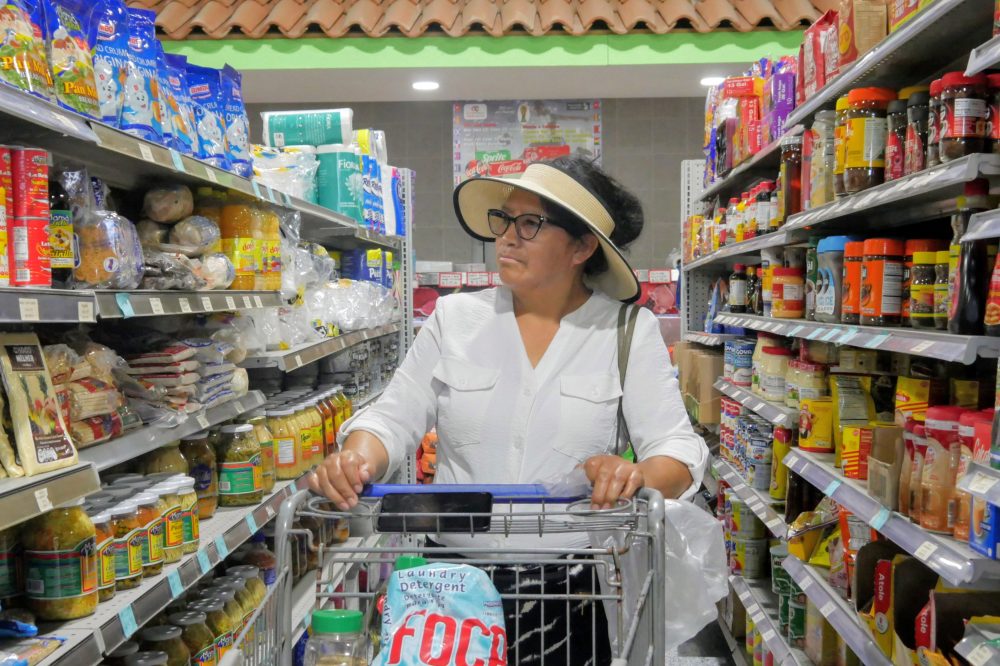
Shoppers are also chasing bargains more aggressively. During the second quarter of this year, discount retailers like Costco, Walmart, and Aldi gained market share at the expense of traditional grocery chains like Kroger and Albertsons, according to the market research firm Numerator.
Store-brand products are also surging in popularity as consumers look to stretch their dollars. Total sales of private-label goods at supermarkets, drugstores, and other retailers reached a record $282.8 billion last year, according to the Private Label Manufacturers Association.
“Now that this option becomes available, why would I go back? You have the convenience, it’s the same, but my cost is 40% less and it’s a brand that I know and trust,” said Sean Hooper, a senior solution principal at the retail and grocery consulting firm Relex Solutions.
Grocery prices surged for a variety of reasons after the pandemic, including the war in Ukraine and a widespread bird flu outbreak that drove retail egg prices to record highs last year. And as with gas prices or other consumer goods, when food costs spike, they tend to come back down only gradually.
Part of the reason is that retailers are hesitant to cut prices on goods they purchased at higher wholesale costs, according to Jared Bernstein, a senior policy fellow at the Stanford Institute for Economic Policy who previously served as chair of President Joe Biden’s Council of Economic Advisers.
Grocery stores and food manufacturers have also been reluctant to surrender the profit gains they enjoyed in the post-pandemic period, Bernstein said. PepsiCo, for instance, raised its prices by double-digit percentages for eight consecutive quarters in 2022 and 2023, citing higher costs for ingredients and packaging. It only began rolling back some snack prices last year after consumer demand weakened.
Consumer behavior plays a role as well. When prices spike, shoppers hunt for deals — but once they see prices stabilizing or nudging downward, they often stop comparison shopping, which reduces the competitive pressure on stores to cut prices further.
“There’s less competitive force on the feather side of the mountain,” Bernstein said.
Some grocery price increases stem from long-running problems with no easy solution. The average price of coffee in U.S. cities has climbed 54% since 2019, according to government data, driven by climate-related issues — drought in Vietnam, heavy rainfall in Indonesia, and hot, dry conditions in Brazil — that have cut global coffee production.
Other price increases have more direct causes. U.S. consumers paid 19.5% more for fresh tomatoes in June compared to a year ago, largely because the Trump administration imposed a 17% import tax on fresh tomatoes coming from Mexico. Coffee also faced a tariff for much of 2025, though that duty was eventually lifted.
Hamory suggested there are signs the “feather” may finally be picking up speed. In early July, Walmart announced it was cutting prices on items including ground beef, corn, red cherries, ice cream, potato chips, and Coca-Cola and Pepsi products. Target also reduced prices on select food items back in March.
“If the big guys are really investing, saying, ‘That’s what I need to do to get right with my customer,’ that will force others in the market to act,” Hamory said. “It’s just in the process of starting, but that’s a thing we could be seeing.”