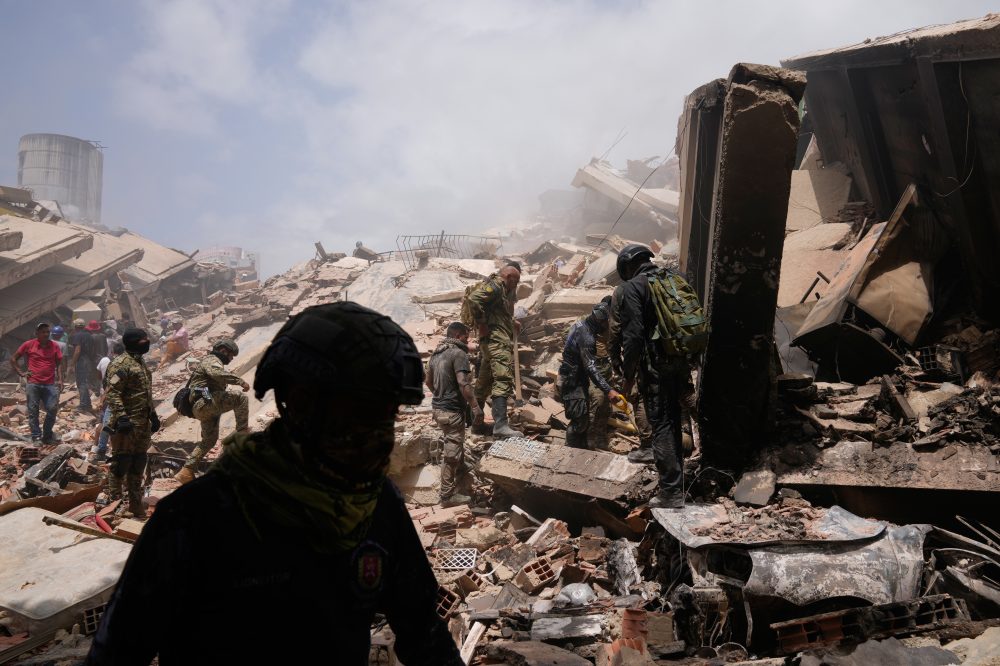

A deadly combination of aging infrastructure, poor construction practices, and dangerous terrain left countless Venezuelan neighborhoods defenseless against the powerful earthquakes that struck the country this week.
Engineers and experts described Wednesday’s back-to-back quakes as among the most powerful to hit Venezuela in over a century. The twin earthquakes leveled buildings and claimed more than 900 lives, with that number expected to climb. Video footage and satellite images reviewed by The Associated Press showed dozens of multi-story structures had completely collapsed.
Microsoft’s AI for Good Lab used satellite imagery to assess damage in Catia La Mar, located in La Guaira state along the Caribbean coast — one of the cities hit hardest by the disaster. Using artificial intelligence-based damage models, Microsoft determined that roughly one-third of the city’s nearly 30,000 structures sustained damage.
Experts pointed to several reasons so many buildings were at risk. In northern Venezuela, some housing complexes were thrown up rapidly during oil boom periods, and builders may have cut corners on safety measures designed to reduce earthquake damage.
Structures built in the 1950s and 1960s — constructed before modern earthquake safety standards were established — likely were never upgraded to withstand violent ground shaking, engineers said. On top of that, many buildings sit on soft soils and unstable terrain that make earthquake damage significantly worse.
David Cocke, a structural engineer based in California and a former president of the Earthquake Engineering Research Institute, explained that a mix of soft ground, tall towers, and older concrete construction drove the widespread devastation — especially in cases where buildings pancaked, meaning they collapsed floor by floor.
“They just don’t have the more modern reinforcing steel connections that we put in those kinds of buildings today,” Cocke said.
Engineers have understood since the 1970s that concrete structures are especially vulnerable during earthquakes, and modern construction incorporates steel reinforcement to reduce that risk. Wealthier nations have often required property owners to either upgrade or demolish unsafe buildings, but many lower- and middle-income countries have struggled to enforce such requirements while dealing with other pressing challenges.
“Some of the more advanced countries like Japan and New Zealand and the U.S. have made those changes, but some of the other countries have not,” Cocke said. “It’s a very typical kind of construction all over the world.”
Other experts highlighted additional design flaws that contributed to building collapses. Some structures featured heavy brick non-structural walls, while others had what engineers call “soft stories” — ground floors made up of open spaces like garages. Both conditions increase the likelihood of a pancake-style collapse.
“Soft stories are a huge problem everywhere in the world,” said Eduardo Miranda, a civil and environmental engineering professor at Stanford University. “And in Venezuela, they are particularly prevalent, and if you combine softer soils with a soft story, buildings can collapse.”
Marcos Ferreira, a geophysicist and researcher at the Geological Survey of Brazil, said the destruction was made worse by the fact that two major quakes struck back-to-back — a phenomenon known as a doublet. A similar sequence struck Turkey and Syria in 2023, killing nearly 60,000 people.
“It is as if I am screaming and then someone starts screaming, too,” Ferreira said. “That amplifies the vibration and adds to the potential hazard.”
Venezuelan officials did update building codes after a deadly earthquake in 1967, but it remains unclear how many existing buildings were ever brought into compliance with those new rules.
In late 1999, after floods and landslides destroyed housing across northern Venezuela — including along the coast — the government launched a major construction push to replace lost homes and shelter displaced residents, according to Juan Carlos Vielma, a Venezuelan civil engineer who leads academic affairs in the civil engineering school at Pontifical Catholic University of Valparaíso in Chile. That construction boom came during former President Hugo Chávez’s first year in office.
Troublingly, some of those newer buildings also appear to have collapsed in this week’s earthquakes.
“Something that leaves me perplexed is the fact that, among the collapsed buildings, more than one was recently designed and built in accordance with current standards,” Vielma said. “We need to embark on a process not only of reconstruction, but also of reviewing the applicable standards, since something might have gone wrong within our engineering processes, too.”