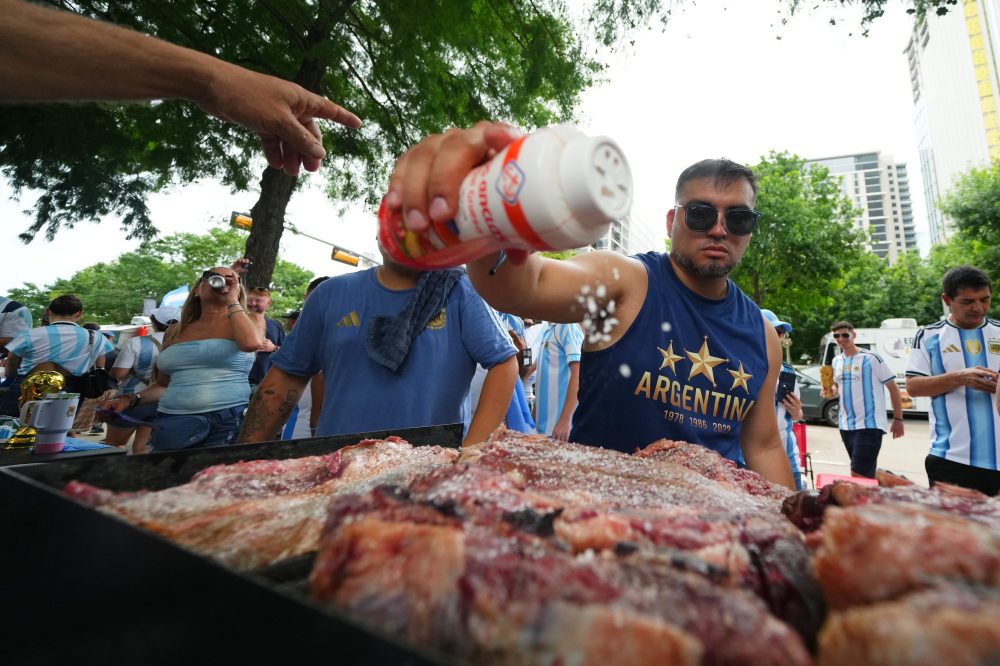

DALLAS — When thousands of Argentine soccer fans arrived in Texas for the World Cup, a spirited argument was bound to follow — and it had nothing to do with goals or goalkeepers. The real debate? Whose beef reigns supreme.
It turns out two of the planet’s most celebrated cattle-raising regions have strong opinions about each other’s steaks. Texas holds the top spot in U.S. beef production, and the United States ranks second in the world behind Brazil, according to the U.S. Department of Agriculture. Argentina comes in sixth globally.
So who grills it better?
Carlos Eduardo Barahona, a 64-year-old Argentine chef who has called Texas home since 1998 and has worked in restaurants across Argentina, Uruguay, and Texas, didn’t hesitate with his answer.
“Argentine beef is simply unbeatable. The savory texture, the style of the cut — there is no competing with it,” Barahona said.
He argued that even the cheapest Argentine cuts outshine premium American options. “You can make an (Argentine) asado with the cheapest cut in our country and you will enjoy it. Here, you can use the best meat, like tenderloin, and depending on its source, it can turn out tough, inedible or tender. But our beef has a completely different flavor profile,” he said.
The difference comes down to how the cattle are raised. Argentine beef cattle typically graze freely on open pastures and are mostly grass-fed, which takes longer but produces leaner meat with deep, earthy flavors. American beef — particularly in Texas — is predominantly grain-fed, resulting in more marbling, the streaks of fat within the muscle that keep meat juicy and tender, and a somewhat sweeter taste.
Texas Agriculture Commissioner Sid Miller had no trouble picking a side.
“There’s no better beef than U.S. beef, particularly Texas beef,” Miller said — though he did acknowledge that Argentine beef is also quite good. He credited Texas, in part, for that improvement.
Miller said his agency launched a marketing office more than a decade ago to connect Texas cattle producers with ranchers in South America, including Argentina.
“I don’t want to disparage our friends in Argentina, but we have helped them improve,” he said. “Their genetics were lacking. We do have them up to pretty high quality. We sold them a lot of semen, embryos, and breeding stock.”
“Their herds have American genetics in them, so they should be good,” Miller added.
Not every Argentine fan was ready to pick a fight over the matter. Gonzalo Herrera, visiting from Argentina, was browsing packaged meat at a Walmart in Arlington, Texas, after watching Messi net two goals in a win over Austria. Loading four T-bone steaks into his cart — and wincing at the $45 price tag — he shrugged at the whole debate.
“Honestly, I don’t see a massive difference,” Herrera said. “The key is knowing exactly which cuts to buy and finding the equivalent of what we eat in Argentina.” He did note, however: “Prices are higher here.”
Much of the rivalry also comes down to cooking style rather than the meat itself. At Corrientes 348 Argentinian Steakhouse in Dallas, assistant manager Emmanuel Tobon said steaks are prepared with nothing more than salt and mesquite charcoal.
“There’s a big difference. Texans use a lot of pepper, they use butter, they use a little barbecue (sauce),” Tobon said. “(Argentines) like to bring all the flavor of the steak by only using salt.”
With Argentina still set to play at least one more match in Dallas on Saturday, Argentine fans have been filling the restaurant, looking for a familiar taste while away from home.
“They have been enjoying the Texas culture,” Tobon said. “(But) it has been a great pleasure to have all of them, to make them feel like home.”
He described how Argentines hold their steak traditions as almost sacred — recipes handed down through generations, and the grill master at a family cookout treated with deep respect.
Fernando Garcia Morillo, an Argentine originally from Buenos Aires who now lives near Miami, said he appreciates both countries’ beef. But old habits die hard when he orders steak in the U.S.
“I order just salt, no pepper, just plain,” Morillo said. “Sometimes they use a lot of sauce.”
As for any real rivalry between the two nations over beef? Morillo wasn’t buying it.
“Maybe there’s a rivalry as usual against Brazil, our neighbor,” he said. “I love the U.S. meat.”