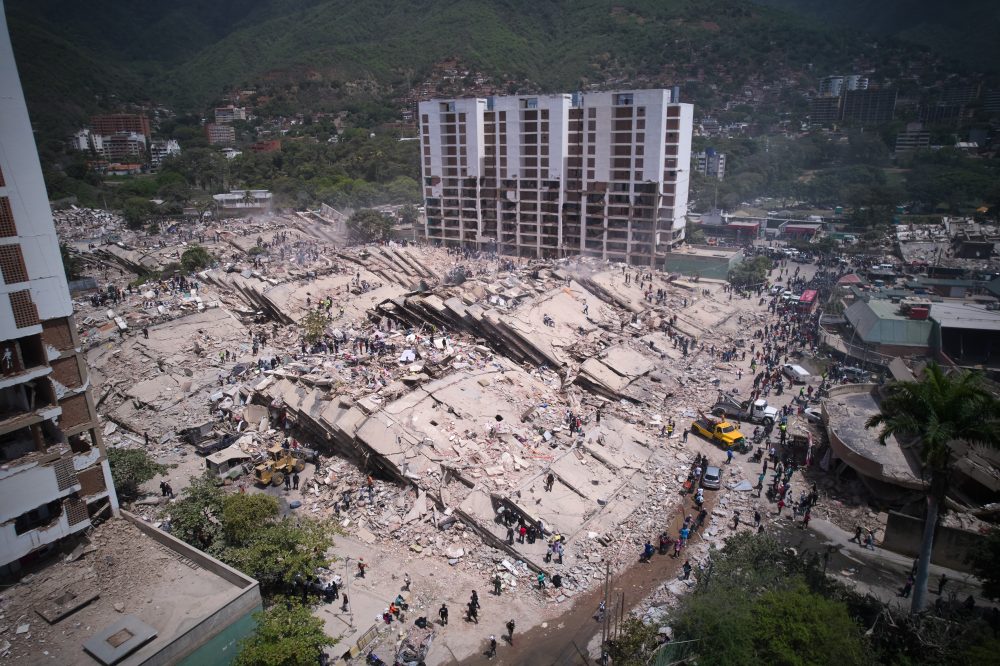

Three days after a devastating pair of earthquakes rocked Venezuela, the race to find survivors is becoming more urgent by the hour. Families have been digging through mountains of rubble with their own hands, desperate to reach loved ones buried beneath collapsed homes and apartment buildings, as the window for finding people alive grows smaller.
On Friday night, officials announced they would restrict entry into La Guaira — the area hardest hit by the disaster — citing growing chaos and traffic congestion that has been interfering with rescue operations. Anyone wishing to enter the area will now need to obtain an official permit, though authorities offered little clarity on who would qualify.
With government rescue teams seen by many as too few and too slow, residents took matters into their own hands. The death toll from Wednesday’s twin quakes has risen to at least 920, with more than 51,000 people reported missing. Those missing figures are tracked on independent digital databases and may include people simply cut off from communication due to damaged cell networks, with some entries potentially counted more than once.
Emergency aid organizations typically consider the first 48 to 72 hours after a disaster to be the most critical period for rescuing survivors alive, though that window can stretch longer if trapped individuals have access to food and water.
Jorge Rodríguez, president of the National Assembly, expressed both hope and sobering honesty about the situation. “Each person saved is a miracle,” he said. “We are not going to hide absolutely anything about the magnitude of this tragedy.”
In La Guaira state, just north of the capital city of Caracas, a woman named Nazareth Jimenez broke down in tears as she watched neighbors hack through concrete slabs with hammers and power tools at a building reduced to rubble. She was waiting anxiously to learn whether her siblings, nephews, nieces, and friends had survived.
“My God, how are we going to get them out of there?” Jimenez said quietly through her grief. She also made a direct appeal for help: “We’re making a call for help to the government and countries across the world. There are still people alive in there,” she said, urging authorities to bring in heavy machinery capable of moving the debris.
Acting President Delcy Rodríguez said her government was mounting a full response during what she called “critical hours for rescuing people alive.” Government forces have been distributing food and water to survivors in La Guaira, and she said the area has been placed under military control with additional help on the way. She also welcomed the arrival of international rescue teams and humanitarian aid, though many residents say what has arrived so far is just a fraction of what is needed.
The disaster presents an enormous challenge for Rodríguez, the former vice president who assumed the presidency in January following the capture and removal of then-President Nicolás Maduro by the United States. Venezuela has been mired in economic turmoil for over a decade, and a significant portion of the population does not recognize the legitimacy of the political movement she leads.
By midday Friday, more than 3,300 people had been reported injured, and authorities confirmed that 243 individuals had been rescued. The International Organization for Migration estimated that as many as 6.76 million people could be affected by the disaster, including roughly 2 million in Caracas alone. Experts noted the destruction was worsened by the rapid back-to-back nature of the shallow quakes.
Loyce Pace, the International Red Cross’ regional director for the Americas, noted that “people are still terrified to reenter what were their homes.” Many continued sleeping outdoors in the streets.
One man, Omar Reyes, said approximately 20 family members perished in the quakes. Walking through the rubble where two of his children were buried, he said simply, “I’ve been left alone in this life.”
In the city of Maiquetia, residents lined up outside stores and pharmacies, which were serving customers one at a time through closed doors. At one point, a woman in the crowd threw herself on top of a package of diapers to shield it from others, unwilling to give up what little she had managed to obtain.
Search efforts were repeatedly disrupted by heavy traffic and crowds of motorcyclists. Mexican soldiers and volunteers asked repeatedly for silence so they could listen for signs of life beneath the debris, but motorcycles — both civilian and military — continued honking and revving engines, frustrating first responders.
In the area of Catia La Mar, near the country’s main airport, some people began taking basic goods such as food and toilet paper from stores. A civilian pickup truck handing out bread and water was swarmed until a soldier stepped in to restore order. A nearby pharmacy parking lot had been transformed into a makeshift shelter, with tarps, hammocks, and tents set up across the lot.
A short distance away, 28-year-old Yuleidy Cadenas stood across the street from a collapsed public housing building, hoping her son, mother, and brother would be pulled from the wreckage alive. She had fled another building barefoot as it came down on Wednesday, only to discover that her mother’s 12-story apartment tower had completely pancaked.
“I got on top of the rubble and told them to yell back, and nobody did, not my brother, nor my son or my mother,” Cadenas said.
Venezuelan authorities reported Friday that 861 volunteers from Mexico, the United States, El Salvador, Switzerland, Colombia, and other nations were on the ground, with more on the way. Acting President Rodríguez said she spoke with U.S. President Donald Trump and Secretary of State Marco Rubio on Friday, and both reaffirmed their commitment to send rescue teams and aid equipment to Venezuela.